

Bible · Prophecy · ~22 min read
Daniel and Revelation — the sweep of history, written before it happened.
Two books read as one: the metal image, the four beasts, the little horn, the 1,260 years, the two beasts of the Revelation, and the question of worship the whole prophetic line has been driving toward from the start.
By George Hinestrosa · Personal study & research
There is a claim God makes about Himself that no other being in the universe can make and survive the test. He stakes His identity on it openly:
“I am God, and there is none like me, declaring the end from the beginning, and from ancient times the things that are not yet done.”
— Isaiah 46:9-10, KJV
That is a falsifiable claim. Either a mind exists that can lay out the course of history in advance, in order, with names and dates a reader can check — or it cannot. The books of Daniel and Revelation are where that claim is cashed in. Written centuries apart, they are really one prophecy told twice and then a third and fourth time, each pass adding detail to the same outline. Daniel gives the skeleton. Revelation puts flesh on it. Jesus Himself pointed His disciples back to Daniel when they asked Him about the end — “whoso readeth, let him understand” (Matthew 24:15) — and the Revelation opens by pronouncing a blessing on the one who reads it (Revelation 1:3). These are not sealed books. They were given to be understood.
This study walks the spine of both: the metal image of Daniel 2, the four beasts of Daniel 7, the little horn and the 1,260 years, the proof that the prophetic clock runs on a day-for-a-year, the two beasts of Revelation 13, the three angels of Revelation 14, and the contest over worship that the entire line has been bending toward since Babylon. It is long because the subject earns it. And the conclusions land on powers and institutions by name — so a word before we start about how that is meant, and how it is not.
The one rule: let the book define its own words
Prophecy is written in symbols, and the single fastest way to go wrong is to assign those symbols meanings out of your own head. A beast, a horn, a woman, a flood of water — you can make any of them mean anything if you are inventing as you go. The discipline that keeps the whole thing honest is this: the Bible defines its own symbols, usually within a verse or two, and we are bound by its definitions, not ours. Build the dictionary from the text first, then read.
A beast is a kingdom. Not a computer, not a literal monster. Daniel is told plainly: “These great beasts, which are four, are four kings” — and a few verses on, “The fourth beast shall be the fourth kingdom upon earth” (Daniel 7:17, 23). A beast in prophecy is a political power.
A horn is a king or kingdom. “The ten horns out of this kingdom are ten kings that shall arise” (Daniel 7:24).
Waters are peoples. “The waters which thou sawest… are peoples, and multitudes, and nations, and tongues” (Revelation 17:15). A beast rising “out of the sea,” then, rises out of the crowded, settled, populated old world.
Winds are strife and war. The four winds striving on the great sea (Daniel 7:2) are the commotions of nations — compare Jeremiah 49:36-37, where the four winds bring war and scattering.
A mountain is a kingdom (the stone becomes a mountain that fills the earth, Daniel 2:35, 44; cf. Isaiah 2:2), and the Rock is Christ (1 Corinthians 10:4). And one more that governs the whole timeline, which we will prove rather than assert: a prophetic day stands for a literal year — “each day for a year” (Numbers 14:34; Ezekiel 4:6).
With that dictionary in hand, the prophecies stop being a Rorschach test and start reading like a map.
The metal image: Daniel 2
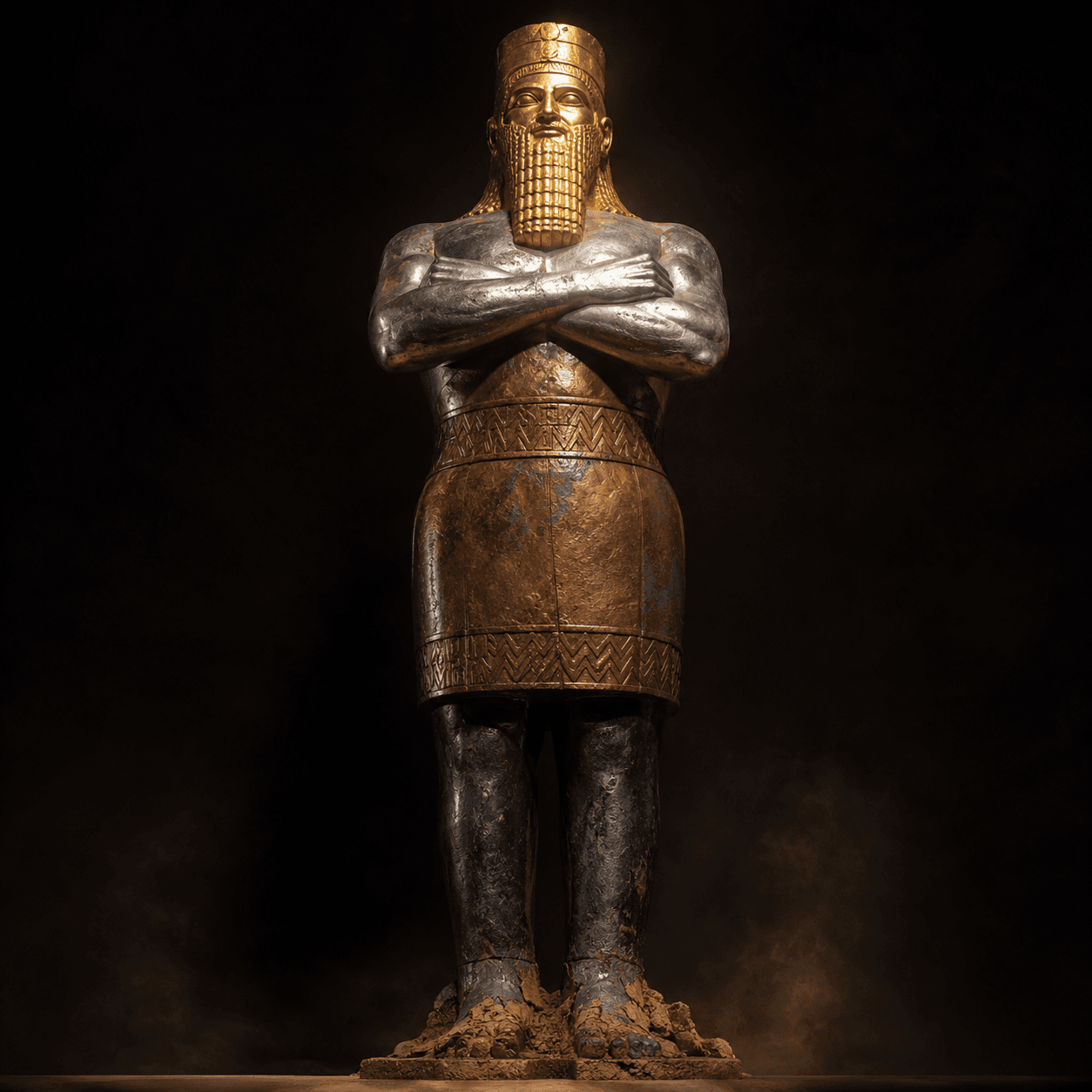
Nebuchadnezzar, the founder of imperial Babylon, dreamed a dream that troubled him and then slipped from his memory. His astrologers and magicians could not recover it — God had removed it precisely to expose the bankruptcy of that whole apparatus and to put the answer in the mouth of a captive Hebrew who gave the credit elsewhere: “there is a God in heaven that revealeth secrets” (Daniel 2:28). The dream was a colossal metal man.
“This image’s head was of fine gold, his breast and his arms of silver, his belly and his thighs of brass, his legs of iron, his feet part of iron and part of clay.”
— Daniel 2:32-33, KJV
Then a stone, “cut out without hands,” struck the image on its feet and ground the whole thing to chaff, and the stone became a mountain that filled the whole earth. We do not have to guess at the meaning, because the prophet gives it outright. The metals are a timeline of empires, told to the king to his face:
The head of gold — Babylon. “Thou art this head of gold” (Daniel 2:38). 605–539 BC. No interpretive cleverness required; Daniel names it.
The breast and arms of silver — Medo-Persia. “After thee shall arise another kingdom inferior to thee” (Daniel 2:39). Babylon fell to the Medes and Persians in a single night in 539 BC (read Daniel 5). Two arms, two peoples. They ruled to 331 BC.
The belly and thighs of brass — Greece. “A third kingdom of brass, which shall bear rule over all the earth.” Alexander’s Greece, 331–168 BC. Daniel 8 will later name this one outright too.
The legs of iron — Rome. “The fourth kingdom shall be strong as iron” (Daniel 2:40). Iron is exactly the word for Rome — the empire that broke and subdued all things, that crucified its dissenters, that ruled the world from 168 BC well into the Christian centuries. Edward Gibbon, no Bible expositor, wrote that “the images of gold, or silver, or brass, that might serve to represent the nations and their kings, were successively broken by the iron monarchy of Rome.”
The feet of iron and clay — divided Rome. Here the prophecy does something the others did not: the fourth kingdom does not fall to a fifth empire. It fragments. “The kingdom shall be divided” (Daniel 2:41), iron mixed with brittle clay, and “they shall not cleave one to another” (2:43). Western Rome was carved up by the barbarian tribes into the nations that became modern Europe — and Europe has resisted every attempt to be fused back into one. Charlemagne tried it; Charles V tried it; Louis XIV, Napoleon, the Kaiser, Hitler — each reached for a reunified Europe and each failed, because the prophecy said iron would not cleave to clay. “They shall mingle themselves with the seed of men: but they shall not cleave one to another.” Intermarriage, treaties, conquest — none of it has made the feet into a single empire. That is not hindsight. It is a 2,500-year-old prediction that has held against the strongest men in history.
And then the stone. “Cut out without hands” — no human empire, no political solution, no superpower riding to the rescue. A divine intervention. Note carefully where it lands: it strikes the image on the feet, in the era of divided Rome — not on the brass thighs, not in the time of Greece. That single detail quietly rules out an entire family of popular readings that locate the climax back in the ancient past. The stone strikes now, in the time of the toes, and it stands forever:
“And in the days of these kings shall the God of heaven set up a kingdom, which shall never be destroyed… it shall break in pieces and consume all these kingdoms, and it shall stand for ever.”
— Daniel 2:44, KJV
One chapter, the whole of history from Babylon to the kingdom of God, in metals a child can follow. That is the skeleton. Daniel 7 colors it in — and introduces the figure the rest of the Bible will not let go of.
The four beasts: Daniel 7
Decades later, Daniel himself is given the dream — and where a king saw an impressive statue, the prophet sees the same powers as God sees them: predatory beasts rising out of a wind-torn sea.
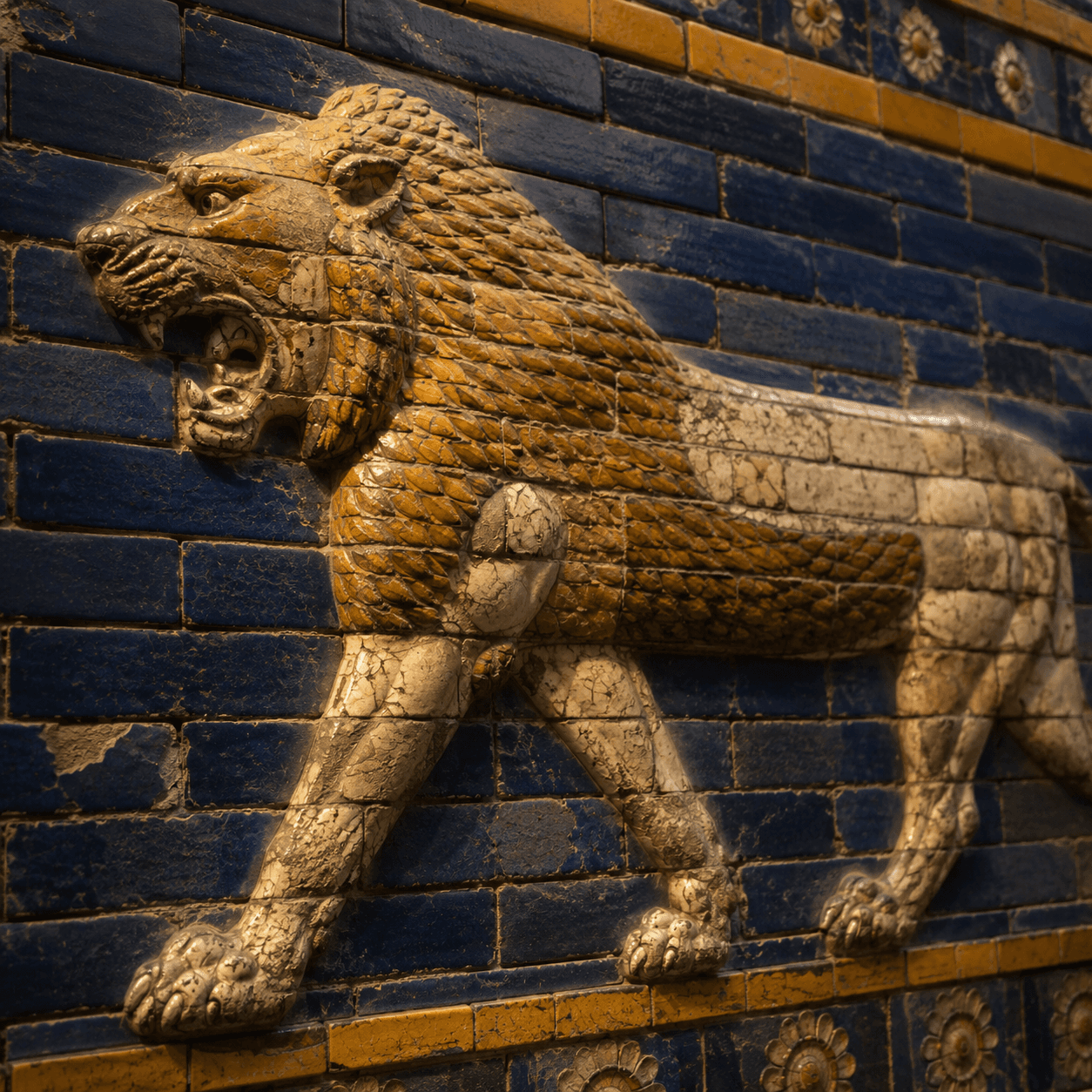
A lion with eagle’s wings — Babylon, whose winged lions still guard its museum gates, and whom Jeremiah and Habakkuk both picture as a lion and an eagle. A bear raised up on one side, three ribs in its mouth — Medo-Persia, lopsided because Persia overtook Media, three ribs for its three great conquests. A leopard with four wings and four heads — Greece, swift as a leopard under Alexander, divided after his death into four (Cassander, Lysimachus, Ptolemy, Seleucus). And then a fourth beast, dreadful and terrible, with iron teeth and ten horns — Rome again, the same iron, now with ten horns where the image had ten toes. Same sequence, same fourth power, same tenfold division. Two prophecies, one history.
The new material is what Daniel sees among those ten horns:
“I considered the horns, and, behold, there came up among them another little horn, before whom there were three of the first horns plucked up by the roots: and, behold, in this horn were eyes like the eyes of a man, and a mouth speaking great things.”
— Daniel 7:8, KJV
This little horn is the figure the chapter is really about, and Daniel was so disturbed by it that he asked the interpreting angel for more. The text gives a remarkably specific description — a fingerprint, really — and the honest way to read it is to lay the fingerprint over history and see what, if anything, matches every line. Gather the marks (Daniel 7:8, 20-21, 24-25):
One — it comes up among the ten horns, so it is a power that arises in the territory of divided Western Rome (Europe), not in Asia, not in the New World. Two — it rises after the ten, so after Rome’s breakup (after AD 476). Three — it is diverse from the other horns: not a plain kingdom like the rest, but a different kind of power. Four — it uproots three of the ten before it. Five — it has “eyes like the eyes of a man, and a mouth speaking great things” — a single human leadership, speaking with vast claims. Six — it “speaks great words against the most High” (blasphemy). Seven — it “wears out the saints,” a persecuting power. Eight — it “thinks to change times and laws.” Nine — it reigns “a time and times and the dividing of time” before judgment strips its dominion away. And ten — it endures to the very end, until “the Ancient of days” sits and the kingdom is given to the saints.
Ten precise marks, all on one power, persisting from the fall of Rome to the end of the age. There is exactly one institution in the record of the West that fits all of them — and naming it is not an act of malice but of arithmetic. Before we name it, two of the marks need their own treatment, because they are where the prophecy is most often blurred: the blasphemy, and the time.
What “blasphemy” means — and let the system define itself
We do not get to decide what blasphemy is either; the Gospels define it twice. First, when a man claims to be God: “for a good work we stone thee not; but for blasphemy; and because that thou, being a man, makest thyself God” (John 10:33). Second, when a man claims to forgive sins in God’s own place: “Who can forgive sins but God only?” (Mark 2:7). Two biblical definitions: claiming to be God on earth, and claiming the prerogative to absolve sin.
The cleanest way to test a system against that standard is to let the system speak for itself rather than to characterize it from outside. On the claim to stand in God’s place on earth, the office’s own literature is explicit: “we hold upon this earth the place of God Almighty” (Pope Leo XIII, quoted in The Great Encyclical Letters of Pope Leo XIII, p. 304). On the prerogative to forgive: the priest in the confessional pronounces ego te absolvo — “I absolve thee” — in the first person, the Catholic manuals teaching that the priest does what Christ does. Whatever one’s sympathies, those are the two biblical marks of blasphemy, stated by the institution about itself. The little horn “speaks great words against the most High” not by cursing God but by assuming His prerogatives.
The eighth mark — “think to change times and laws” — is the same kind of self-documenting claim, and we will come back to it when we reach the question of worship, because it is the hinge the whole final crisis turns on.
The day-year principle — proved before it is used
The ninth mark gives a length of reign: “a time and times and the dividing of time” (Daniel 7:25). A “time” is a prophetic year; “times” is two; the dividing of time is half — three and a half prophetic years. On the biblical calendar of 360 days to a year, that is 1,260 prophetic days. The Revelation gives the same span three different ways to make sure we cannot miss it: “forty and two months” (42 × 30 = 1,260), “a thousand two hundred and threescore days,” and “a time, and times, and half a time” (Revelation 11:2-3; 12:6, 14; 13:5). One period, stated seven times across the two books.
But 1,260 literal days is three and a half years — far too short for a power that reigns from the fall of Rome to the end of the world. The key is the prophetic measure God states in plain words twice: “each day for a year” (Numbers 14:34; Ezekiel 4:6). On that measure, 1,260 days means 1,260 years.
Now — is the day-year measure a convenient trick we apply only where it helps? No. It has the most spectacular proof in all of Scripture sitting right next door in Daniel 9, and that proof is Messianic, not denominational. Gabriel tells Daniel that “seventy weeks are determined” upon his people (Daniel 9:24). Seventy weeks is 490 days — on the day-year measure, 490 years — beginning with “the going forth of the commandment to restore and to build Jerusalem” (9:25). That decree went out in 457 BC. Sixty-nine weeks (483 years) from 457 BC lands precisely on AD 27 — the year Jesus was baptized and anointed by the Spirit and began to preach “the time is fulfilled” (Mark 1:15). “In the midst of” the seventieth week (9:27) — three and a half years later, AD 31 — Messiah was “cut off,” and at the cross “the veil of the temple was rent,” causing “the sacrifice and the oblation to cease.” The 490 years closed in AD 34. A prophecy written five centuries beforehand, dating the anointing, the death, and the timing of the Messiah to the year — on the day-year measure. The clock is real, it is vindicated at the cross, and it is the same clock that runs the 1,260 and the 2,300.
538 to 1798 — the 1,260 years on the calendar
So the little horn reigns 1,260 years. From when? Daniel said it would rise after Rome’s tenfold division and after three of those kingdoms were uprooted. History supplies the names. The three barbarian powers cleared away — the Heruli (AD 493), the Vandals (534), and the Ostrogoths (538) — were precisely the three standing in the way of the bishop of Rome’s rise to civil power. In AD 533 the emperor Justinian issued the decree recognizing the bishop of Rome as head of all the churches and corrector of heretics; that decree could not take effect until the Ostrogoths were driven from Rome — which Belisarius accomplished in 538.
Add 1,260 years to 538 and you arrive at 1798. And in February 1798, the French general Berthier, acting for Napoleon, marched into Rome, took Pope Pius VI captive, and proclaimed the temporal power of the papacy at an end. The pope died in exile. To the world it looked like the death of an institution. The Revelation had already described exactly that — and what would follow:
“And I saw one of his heads as it were wounded to death; and his deadly wound was healed: and all the world wondered after the beast.”
— Revelation 13:3, KJV
A deadly wound — 1798, exactly 1,260 years after 538 — and then a healing. In 1929 the Lateran Treaty restored the Vatican as a sovereign state, and the wound began to close. The same power, recovering its standing, with “all the world” increasingly turning its way. The dates are not forced onto the text after the fact; the text named the wound and the recovery in advance, and the calendar simply confirms them.
(Daniel 8 reinforces the whole chain and stretches it further: a ram — named as Medo-Persia, 8:20 — a goat — named as Greece, 8:21 — then a power that “waxed exceeding great” and cast truth to the ground, and a 2,300-day span (8:14) reaching, from the same 457 BC starting point as the seventy weeks, to 1844 and the beginning of the final “hour of his judgment” that Revelation 14:7 announces. The sanctuary that the 2,300 days concern has its own study in this section.)
Two roads that lead away from the text
This continuous reading — prophecy unrolling step by step through real history — is the reading the Reformers held with one voice. Wycliffe, Luther, Calvin, Knox, Tyndale, Cranmer, the Westminster divines: across the whole Protestant world they identified the little-horn power with the Roman see, openly and in print. It was not a fringe opinion; it was the mainstream Protestant conviction for three centuries, and it is the conviction that built the case for religious liberty.
Two alternative systems were raised specifically to break it, and both came from the Counter-Reformation. Preterism— advanced by the Jesuit Luis de Alcázar — throws the prophecies into the distant past, making the antichrist a figure already gone, often Antiochus Epiphanes or Nero. But the stone struck the feet, not the brass thighs of Greece; the antichrist arises after Rome divides, not centuries before. Futurism — advanced by the Jesuit Francisco Ribera — throws them instead into a brief crisis still wholly future, a single end-time superman appearing after the church is removed. But Paul says the “mystery of iniquity” was already working in his own day (2 Thessalonians 2:7), restrained only until the power holding it back — the Roman imperial state, as the early fathers understood — was taken out of the way. Both systems share one effect: they point the searchlight anywhere except at the power Daniel actually described, sitting in plain sight across the centuries between. Futurism is, today, the reading most Christians have absorbed without ever examining where it came from.
Revelation 13: the same beast, and a second one
Now the Revelation gathers Daniel’s four beasts into one. John sees a single beast rise from the sea with the mouth of a lion, the feet of a bear, the body of a leopard, and ten horns (Revelation 13:1-2) — Babylon, Medo-Persia, Greece, and divided Rome compounded into one composite power that inherits all their traits. It has seven heads and ten horns; it receives its “power, and his seat, and great authority” from the dragon (13:2 — the dragon being Satan, and behind him pagan Rome, the power that first tried to kill the Christ-child, Revelation 12:4-9, Matthew 2). It speaks blasphemies; it makes war on the saints; it is given authority for “forty and two months” — the same 1,260 years; it receives the deadly wound and the healing. Every mark of Daniel’s little horn reappears. It is the same power, seen now at the end of its arc, with the world wondering after it.
Then John sees a second beast, and the change of scenery is deliberate. The first beast rose from the sea — the crowded peoples of the old world. The second comes up “out of the earth” (13:11) — a sparsely settled place, a new ground. It has “two horns like a lamb” — gentle, Christ-like in appearance, with two principles rather than crowns, suggestive of civil and religious liberty — and it rises just as the first beast is receiving its wound, around 1798. A power emerging in a new, unpeopled land at the close of the eighteenth century, professing freedom, lamb-like in its founding. But the verse does not end there: it “spake as a dragon.” The lamb speaks like the serpent. And it uses its influence to make “an image to the beast” — a likeness of the old union of church and state — and to give that image life, enforcing worship and the mark (13:14-17). The full treatment of this second beast and the mark belongs to its own study; here it is enough to see that the prophecy moves the stage west and forward in time exactly where history did.
What the whole line was driving at: worship
Step back and the theme of the entire prophetic line comes into focus. From Babel onward, every kingdom in the image has been a counterfeit gate to heaven — a man-made way to God set up against the appointed one. And the climax in the Revelation is not a war over territory or money. It is a war over worship. The word runs through Revelation like a drumbeat. The three angels of Revelation 14 carry the final message to the world, and the first of them frames the whole contest:
“Fear God, and give glory to him; for the hour of his judgment is come: and worship him that made heaven, and earth, and the sea, and the fountains of waters.”
— Revelation 14:7, KJV
That is not generic religious language. “Worship him that made heaven, and earth, and the sea” is a direct echo of the fourth commandment — “for in six days the LORD made heaven and earth, the sea… wherefore the LORD blessed the sabbath day” (Exodus 20:11). The seventh-day Sabbath is the standing sign of the Creator, the seal God set in the heart of His own law to mark off who made the world and who it belongs to: “a sign between me and you… that ye may know that I am the LORD your God” (Ezekiel 20:20). The final call to worship the Creator is, by its own wording, a call back to the day that names Him.
Set that beside the little horn that would “think to change times and laws.” The one commandment that is both a time and a law, the one that fixes the sacred time and carries the lawgiver’s seal, is the Sabbath. And here, again, the cleanest evidence is the system’s own testimony. Rome has never claimed Scripture for the change; it has claimed her own authority:
“Sunday is our mark of authority… The church is above the Bible, and this transference of Sabbath observance is proof of that fact.”
— The Catholic Record, London (Ontario), 1 September 1923
Cardinal Gibbons, in The Faith of Our Fathers, granted the same thing from the other direction: “You may read the Bible from Genesis to Revelation, and you will not find a single line authorizing the sanctification of Sunday.” The change of the day is offered, by the institution itself, as the proof and the badge of a power to alter divine law. The seal of the Creator on one side; an institution’s mark of authority on the other. That is the contest the three angels announce, and it is why the whole prophetic line, from the gold of Babylon to the feet of clay, has been a long argument about one question: whom will you worship, and on whose authority? The mark, the seal, and the Sabbath each have their own study in this section; the point here is only that this is the destination the prophecy was always headed toward.
A note on what is being critiqued
The argument of this study is with a system of doctrine and power — not with the people inside it. There are millions of sincere, kind, Christ-loving believers in the Roman Catholic communion, and in every Protestant church that has quietly inherited the futurist reading or the changed day without ever examining either from the Scriptures. Every Christian tradition has held worshippers Christ calls His own, and God “takes the knowledge that they have and judges according to the knowledge that they have.” The quarrel here is with a teaching and an institution, never with neighbours. The prophecies are not given to fuel contempt for anyone; they are given so that people who love God can recognize an old deception and walk out of it into the truth — the same content read as a call home rather than as an attack. If anything in this study reads as scorn for persons rather than scrutiny of a system, it is written badly and the fault is mine.
The week of the world
There is one more frame Daniel’s timeline fits inside, and it answers the question every reader of these prophecies eventually asks: where are we? Scripture gives a measuring rod for the whole of human history, not just the empires. Peter writes that “one day is with the Lord as a thousand years, and a thousand years as one day” (2 Peter 3:8). Lay that over the creation week — six days of labor and a seventh of rest (Genesis 2:2-3) — and you have the old picture of the great week of time: roughly six thousand years of human history, six millennial “days” of toil under sin, followed by a seventh-millennium Sabbath of rest. This was a common reading among the earliest Christian writers, long before any later denomination, and it is woven straight from Genesis, Peter, and the Revelation.
That seventh-millennium rest is the thousand years of Revelation 20 — the millennium — which opens at the return of Christ, the very stone of Daniel 2 striking the image and beginning the kingdom that fills the earth and stands forever. The empires of the image have run nearly their full course; the feet of iron and clay are the last political stage before the stone falls; the deadly wound has healed and the world is wondering after the beast again. The plain sense of the line is that we are living late in the sixth day — near the close of the working week of the world, on the edge of the rest that follows. That is not a date-setting claim; Christ forbade setting the day or the hour. It is a sense of where on the map the prophecies place us: not at the beginning, not in the middle, but in the time of the toes, with the stone poised.
The dream is certain
What ought to land, after walking the whole line, is not fear but confidence. A mind exists that wrote the rise and fall of Babylon, Medo-Persia, Greece, and Rome before they happened; that named the breakup of the West and its stubborn refusal to reunite; that dated the Messiah’s anointing and death to the year five centuries in advance; that described a wound in 1798 and a healing afterward; and that has been telling the same story, in deepening detail, across two books written hundreds of years apart. The accuracy is the evidence. “I am God, and there is none like me, declaring the end from the beginning.” He told us so we would not be deceived, and so that when the things come to pass we would believe (John 14:29).
Daniel closed his great prophecy with the only verdict that fits a record this exact:
“The dream is certain, and the interpretation thereof sure.”
— Daniel 2:45, KJV
The same God Who wrote the history is the one setting up the kingdom that ends it — and the invitation, underneath all the beasts and horns and dates, is simply to be found on the right side of it when the stone falls.
Sources & further reading
The prophecies themselves
- Daniel 2 — Nebuchadnezzar's image: the four kingdoms and the stone.
- Daniel 7 — the four beasts, the ten horns, the little horn, the judgment.
- Daniel 8 — the ram, the goat, the little horn, and the 2,300 days.
- Daniel 9:24-27 — the seventy weeks and the Messiah, dating the anointing and the cross.
- Revelation 12-14 — the dragon, the sea-beast and the earth-beast, and the three angels.
- Revelation 17 & 20 — Babylon and the woman on the beast; the thousand years.
Scripture defining its own symbols
- Daniel 7:17, 23 — a beast is a kingdom.
- Daniel 7:24 — a horn is a king or kingdom.
- Revelation 17:15 — waters are peoples, nations, and tongues.
- Numbers 14:34; Ezekiel 4:6 — the day-for-a-year measure.
- Exodus 20:8-11; Ezekiel 20:12, 20 — the Sabbath as the sign of the Creator.
- 2 Thessalonians 2:3-8 — the mystery of iniquity already working, and the restrainer removed.
- 2 Peter 3:8; Genesis 2:2-3 — the day-as-a-thousand-years measure and the creation week.
Rome on Rome — primary sources
- The Catholic Record, London, Ontario, 1 September 1923 — “Sunday is our mark of authority… the church is above the Bible.”
- James Cardinal Gibbons, The Faith of Our Fathers — no line of Scripture authorizes the sanctification of Sunday.
- Pope Leo XIII — “we hold upon this earth the place of God Almighty” (The Great Encyclical Letters of Pope Leo XIII, p. 304).
Historical record
- Edward Gibbon, The History of the Decline and Fall of the Roman Empire — the iron monarchy of Rome and its division.
- The Heruli (AD 493), Vandals (534), and Ostrogoths (538) — the three uprooted Arian kingdoms; Belisarius takes Rome, 538.
- General Berthier takes Pope Pius VI captive, February 1798; the Lateran Treaty restores Vatican statehood, 1929.
- Ribera and Alcázar — the Counter-Reformation origins of futurism and preterism, set against the Reformers' historicist reading.