
Bible · Law & Worship · ~22 min read
The day the church set aside.
Most people are sure the Sabbath was done away with long ago. But it began before there was ever a Jew, Jesus kept it, the apostles kept it — and the Bible never records the day being changed. Here is the question, answered gently and from Scripture.
By George Hinestrosa · Personal study & research

If you grew up in most churches, you learned the Sabbath the same way nearly everyone does: it was an old rule for the Jews, it was nailed to the cross with the rest of the law, and we worship on Sunday now because that’s the Lord’s day. It’s taught so widely and so confidently that almost no one stops to check it. This study is an invitation to check it — calmly, without arm-twisting, letting the Bible speak for itself. The question is simple: was the seventh-day Sabbath really done away with, or was it only set aside by people? The answer turns out to be far warmer, and far more beautiful, than a rule about a day.
It started in a garden, not at Sinai
The first place most people put the Sabbath is Mount Sinai — a law handed to Israel, for Israel. But the Sabbath is older than Israel, older than the Ten Commandments, older than there being a single Jew on the earth. It goes all the way back to the seventh day of the world:
“And on the seventh day God ended his work which he had made… And God blessed the seventh day, and sanctified it: because that in it he had rested from all his work.”
— Genesis 2:2-3, KJV
Adam and Eve were made at the close of the sixth day. Their very first full day of life was that rested seventh day — not a day God needed (He never tires; Isaiah 40:28), but a day He set apart to spend with the people He had just made. The Sabbath was the first thing God called holy. And notice who it was made for — not a nation that wouldn’t exist for two thousand years, but the human family:
“The sabbath was made for man, and not man for the sabbath: therefore the Son of man is Lord also of the sabbath.”
— Mark 2:27-28, KJV
For man — in the Greek, anthropos, mankind, the word behind “anthropology.” Not for the Jew especially; for everyone. Adam wasn’t a Jew. Neither was Abraham, of whom God said he “obeyed my voice, and kept my charge, my commandments, my statutes, and my laws” (Genesis 26:5) — commandments and laws, centuries before Sinai. The Sabbath was never “the Sabbath of the Jews.” All through Scripture it is called something else entirely: the sabbath of the LORD thy God (Exodus 20:10). It was His before it was anyone’s.
It’s one of the Ten — you can’t lift it out
When the law was finally written in stone, the Sabbath sat right in the middle of it — and it is the only commandment that opens with the word remember, as if God knew it would be the one most easily forgotten:
“Remember the sabbath day, to keep it holy… the seventh day is the sabbath of the LORD thy God… For in six days the LORD made heaven and earth, the sea, and all that in them is, and rested the seventh day: wherefore the LORD blessed the sabbath day, and hallowed it.”
— Exodus 20:8-11, KJV
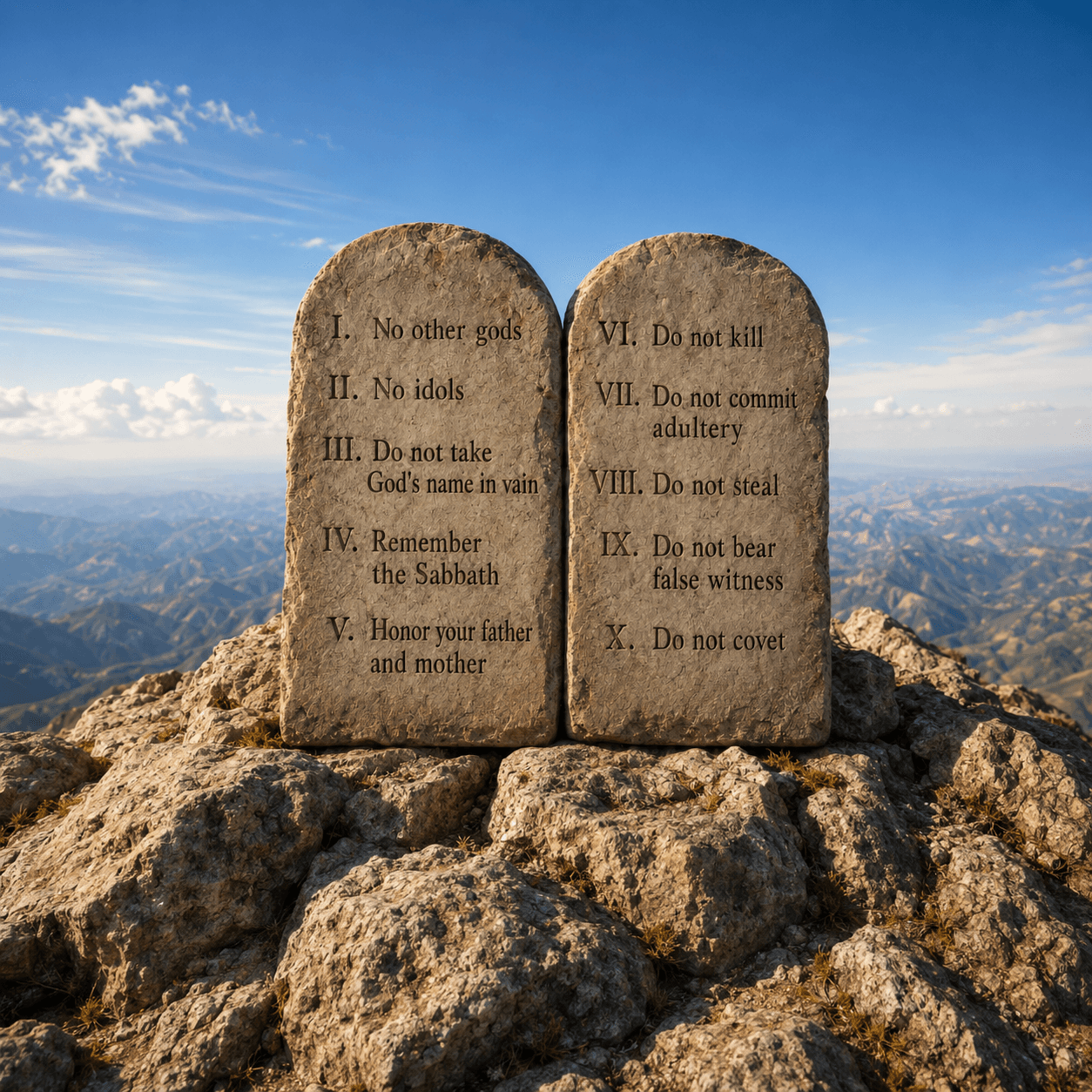
Here is the quiet problem for the idea that this one command expired: the other nine didn’t. No one argues that stealing, lying, murder, or idolatry became acceptable at the cross. They are written on the same two tables, in the same handwriting — God’s own (Exodus 31:18) — as one whole law. James says they stand or fall together: “whosoever shall keep the whole law, and yet offend in one point, he is guilty of all” (James 2:10). You cannot quietly slip the fourth commandment out of the ten and leave the rest intact. If the Sabbath is gone, the whole law is gone — and Scripture never says that.
That matters because the law is not a cage; it is a description of God’s own character. “God is love” (1 John 4:8), and “love is the fulfilling of the law” (Romans 13:10). The first four commandments show us how to love God; the last six, how to love our neighbor. The Sabbath belongs to that first table — it is simply love for God, given a time and a place.
Jesus kept it. So did the apostles.
If the Sabbath had been abolished, you would expect to see the change somewhere in the life of Jesus or the early church. Instead you see the opposite. The Sabbath was Jesus’ settled habit:
“And he came to Nazareth… and, as his custom was, he went into the synagogue on the sabbath day, and stood up for to read.”
— Luke 4:16, KJV
As his custom was. If keeping the Sabbath was the custom of Christ, and a Christian is a follower of Christ, the conclusion is not hard. And the pattern continued long after the cross. Paul “as his manner was” reasoned in the synagogue on the Sabbath (Acts 17:2); at Corinth he “reasoned in the synagogue every sabbath, and persuaded the Jews and the Greeks” — Greeks, that is, Gentiles — and stayed doing it “a year and six months” (Acts 18:4, 11). In Acts alone the Sabbath is kept again and again, decades after the resurrection (Acts 13:42-44; 15:21). The apostles plainly did not believe the day had been retired. Jesus even assumed His followers would still be keeping it forty years later, when He told them to pray their flight from Jerusalem’s coming destruction would “not… be… on the sabbath day” (Matthew 24:20) — a strange thing to say of a day He had supposedly just abolished.
“But Paul said it was nailed to the cross…”
A handful of verses are usually raised to prove the Sabbath ended, and they deserve honest, unhurried answers. The most quoted is Colossians 2:
“Let no man therefore judge you in meat, or in drink, or in respect of an holyday, or of the new moon, or of the sabbath days: Which are a shadow of things to come; but the body is of Christ.”
— Colossians 2:16-17, KJV
At a glance it looks decisive. But read closely it points somewhere specific. Israel actually had two kinds of “sabbaths.” There was the weekly seventh-day Sabbath of creation — and there were the annual festival sabbaths (Passover, Pentecost, Tabernacles, and the rest) that Leviticus 23 lists alongside their “meat and drink offerings.” Those feast days were tied to the sacrificial system; each one pointed forward to Christ, like a shadow thrown ahead of the body that casts it. Colossians names exactly that cluster — “meat… drink… holyday… new moon… sabbath days” — the ceremonial calendar that met its fulfillment when Jesus died and the temple veil tore in two.
And there’s a clean test to tell which Sabbath is meant. A shadow points forward to something coming. The festival sabbaths pointed forward to the cross. But the seventh-day Sabbath was established at creation — before sin ever entered the world. It cannot be a shadow pointing to the remedy for sin, because when it was given there was nothing yet to remedy. The weekly Sabbath looks backward, to a finished creation; the feast-day sabbaths looked forward, to a coming Saviour. Colossians is talking about the second kind.
What about Romans 14, where “one man esteemeth one day above another”? Read the chapter from its first verse and the subject is plain: it is about eating — whether to eat meat or “herbs,” and which days a person chose to fast (Romans 14:1-6). The Sabbath is never mentioned in the passage, or anywhere in Romans. Paul is settling a quarrel between believers over private fast-days, not quietly cancelling one of the Ten Commandments — something he’d never do, having just written, “Do we then make void the law through faith? God forbid: yea, we establish the law” (Romans 3:31).
And “come unto me… and I will give you rest” (Matthew 11:28) — doesn’t that make Jesus our rest, so the day no longer matters? It is a beautiful promise of rest from the burden of sin; it says nothing about replacing a commandment. Even Hebrews, which speaks of entering God’s “rest,” defines that rest by pointing straight back to the seventh day — “God did rest the seventh day from all his works” — and then says plainly:
“There remaineth therefore a rest to the people of God.”
— Hebrews 4:9, KJV
Remaineth. Still here, not replaced. Far from abolishing the day, Hebrews insists it remains for God’s people.
This is not about earning anything
It’s worth stopping to say this plainly, because it is the thing most often misheard. None of this means a person is saved by keeping a day. We are “saved by grace through faith… not of works” (Ephesians 2:8-9). The Sabbath saves no one; nothing we do does. Grace is not a New Testament invention either — Noah “found grace in the eyes of the LORD” (Genesis 6:8) long before Sinai. We are saved the same way in every age: by grace, received through faith.
So why keep any commandment at all? For the same reason a person who is loved keeps faith with the one they love. Jesus put it in one sentence: “If ye love me, keep my commandments” (John 14:15). Obedience isn’t the price of love; it’s the proof of it. We don’t keep the Sabbath to be saved — we keep it because we already are, and because we love the One Who made it. Grace and the law were never rivals; grace forgives the broken law and then writes it on the heart: “I will put my laws into their hearts, and in their minds will I write them” (Hebrews 10:16). That is the only real difference between the old covenant and the new — not which commandments, but where they are written.
So how did the day get changed?
Here is the part that surprises people most. If you search all sixty-six books of the Bible, you will not find a single verse where God, or Jesus, or an apostle moves the holy day from the seventh to the first. The eight New Testament mentions of “the first day of the week” never call it the Lord’s day, never call it a new Sabbath, and never command worship on it. (The one place Scripture does say “the Lord’s day,” Revelation 1:10, is left undefined — and Jesus had already called Himself “Lord even of the sabbath day,” Matthew 12:8, while God calls the Sabbath “my holy day” in Isaiah 58:13.) The change simply is not in the Book.
It is in history. In the centuries after the apostles, as the church drifted toward the surrounding culture — in which the first day was already widely honored as the day of the sun — civil and church authority gradually moved worship to Sunday. The Roman emperor Constantine issued the first civil Sunday law in AD 321; church councils followed. It was a human decision, made by human authority, and Scripture had actually warned that such a thing would come. Daniel saw a power that would “think to change times and laws”:
“…and he shall… think to change times and laws…”
— Daniel 7:25, KJV
Of all God’s commandments, only one deals with both time and law — the fourth, which fixes a specific day. The full prophetic identity of that power belongs to its own study (traced in Daniel and Revelation). The point here is gentler and simpler: a day was moved, and it was moved by people, not by God — and God had already said of His own word, “My covenant will I not break, nor alter the thing that is gone out of my lips” (Psalm 89:34), and “I am the LORD, I change not” (Malachi 3:6). What men change, God has not.
Why it still matters today
If it’s not about earning salvation, why does the day matter at all? Because of what keeping it says. The Sabbath is the one commandment that is also a sign — a standing acknowledgment of who God is:
“Moreover also I gave them my sabbaths, to be a sign between me and them, that they might know that I am the LORD that sanctify them.”
— Ezekiel 20:12, KJV
Think about what the Sabbath quietly declares. To rest on the seventh day “because in six days the LORD made heaven and earth” is to confess, every single week, that there is a Creator and that He is mine. It is the only commandment you keep simply by resting — and the moment you keep it, you have named your God as the One Who made everything. A person can avoid stealing or lying without believing in God at all; but no one keeps the seventh-day Sabbath without pointing straight back to the Maker of heaven and earth. That is exactly why it appears at the climax of the Bible’s last warning, where the final call to the world is a call to worship the Creator in the very language of the fourth commandment:
“…Fear God, and give glory to him… and worship him that made heaven, and earth, and the sea, and the fountains of waters.”
— Revelation 14:7, KJV
At the end, the Bible says, the whole question of worship comes back to the Creator — and the Sabbath is His chosen sign of who He is. It mattered in the garden, it mattered to Jesus, and Scripture says it will matter right to the end.
What it actually looks like
Strip away the arguments and the Sabbath is, at heart, a gift — one of two God gave us in Eden before sin (the other was marriage). It is not a list of things you may not do; it is a standing weekly appointment with the One Who made you. God Himself framed it as a delight, not a burden:
“If thou turn away thy foot from the sabbath, from doing thy pleasure on my holy day; and call the sabbath a delight… then shalt thou delight thyself in the LORD.”
— Isaiah 58:13-14, KJV
In practice it is wonderfully ordinary. A family prepares ahead so the day itself can be unhurried. When the sun sets on Friday, the work stops — the phone, the projects, the endless list — and for twenty-four hours there is rest, worship, a good meal, time in creation, time with the people you love and the God Who loves you. People who keep it describe the same thing again and again: a weight lifting at sundown, a peace they don’t find any other day, a marriage and a household that breathe. It turns out the Maker of the human body knew it needed to stop. The Sabbath was His way of making sure that, no matter how busy the week, that time would always be there.
Jesus said it Himself: the Sabbath was made for man — for our good, like a parent who insists the family keep one evening sacred so the relationship doesn’t get buried under everything else. It is not God being restrictive. It is God refusing to let the most important relationship of your life get crowded out.
A note on what is being critiqued
Nothing here is aimed at the millions of sincere Christians who worship on Sunday. The overwhelming majority have never been shown any of this; they keep the day they were handed, in good faith, out of genuine love for God — and God “winketh at” what we did in ignorance and meets every honest heart where it is (Acts 17:30). The quarrel in this study is with a change that men made to God’s law, never with the people who inherited it. If you keep Sunday, you are not the target of a single sentence here; you are simply being invited to look at the text for yourself, the way anyone who loves the truth would want to. The aim is not to win an argument. It is to hand back a gift that was quietly mislaid.
An invitation, not a demand
So here is the gentle challenge that so many who keep the Sabbath were once given themselves: just try it. Set one seventh day aside — from Friday sunset to Saturday sunset. Put the work away. Call it a delight. Read, rest, walk in creation, gather with people who love God, and give the day to Him. You are not earning anything and you are not joining a club; you are simply keeping an appointment that has been open since the seventh day of the world. The God Who made you is, by His own description, waiting there to meet you:
“The sabbath was made for man.”
— Mark 2:27, KJV
It was made for you. It was never taken away — only set aside, and only by people. And it is still there, every seventh day, waiting to be picked back up.
Sources & further reading
The Sabbath began at creation, for everyone
- Genesis 2:2-3 — God rested, blessed, and sanctified the seventh day at the end of creation week.
- Mark 2:27-28 — 'made for man' (anthropos / mankind); the Son of man is Lord of the sabbath.
- Genesis 26:5; Exodus 20:10 — Abraham kept God's commandments and laws; it is 'the sabbath of the LORD,' not 'of the Jews.'
It belongs to the Ten Commandments
- Exodus 20:8-11 — the fourth commandment, the only one that opens with 'remember,' grounded in creation.
- Exodus 31:18; James 2:10 — written by God's own finger; break one point and you are guilty of all.
- 1 John 4:8; Romans 13:10 — God is love, and love is the fulfilling of the law.
Kept by Jesus and the apostles
- Luke 4:16 — the Sabbath was Jesus' custom.
- Acts 13:42-44; 15:21; 17:2; 18:4, 11 — Paul and the early church kept the Sabbath for decades after the cross, with Jews and Gentiles.
- Matthew 24:20 — Jesus assumed His followers would still keep the Sabbath at Jerusalem's fall (AD 70).
The texts said to abolish it
- Colossians 2:16-17 with Leviticus 23 — the 'sabbath days' are the annual feast-day sabbaths tied to sacrifices, shadows pointing forward to Christ.
- Romans 14:1-6 (with Romans 3:31) — about eating and fast-days, not the Sabbath; faith establishes the law.
- Matthew 11:28; Hebrews 4:4, 9 — Jesus' rest from sin; 'there remaineth a rest,' defined by the seventh day — not replaced.
Grace, not earning
- Ephesians 2:8-9; Genesis 6:8 — saved by grace through faith, in every age (Noah found grace before Sinai).
- John 14:15; Hebrews 10:16 — we keep it because we love Him; the new covenant writes the law on the heart.
How the day was changed — and why it matters
- Daniel 7:25 — a power that would 'think to change times and laws' (the only commandment touching both is the fourth).
- Psalm 89:34; Malachi 3:6 — God does not alter His word or change.
- Ezekiel 20:12; Revelation 14:7 — the Sabbath as the sign of the Creator, echoed in the Bible's final call to worship Him.
- Isaiah 58:13-14 — the Sabbath as a delight, God's holy day.
- The first civil Sunday law (Constantine, AD 321) and later church councils — the historical record of the change, made by human authority.