
Health · Vitamin Complex · ~11 min read
B Vitamins — the engine room of the body.
What each B does, why folic acid is the wrong folate, why P5P beats pyridoxine, and what Dr. Hoffer learned about niacin that mainstream medicine still hasn’t absorbed.
By George Hinestrosa · Personal experience & independent research

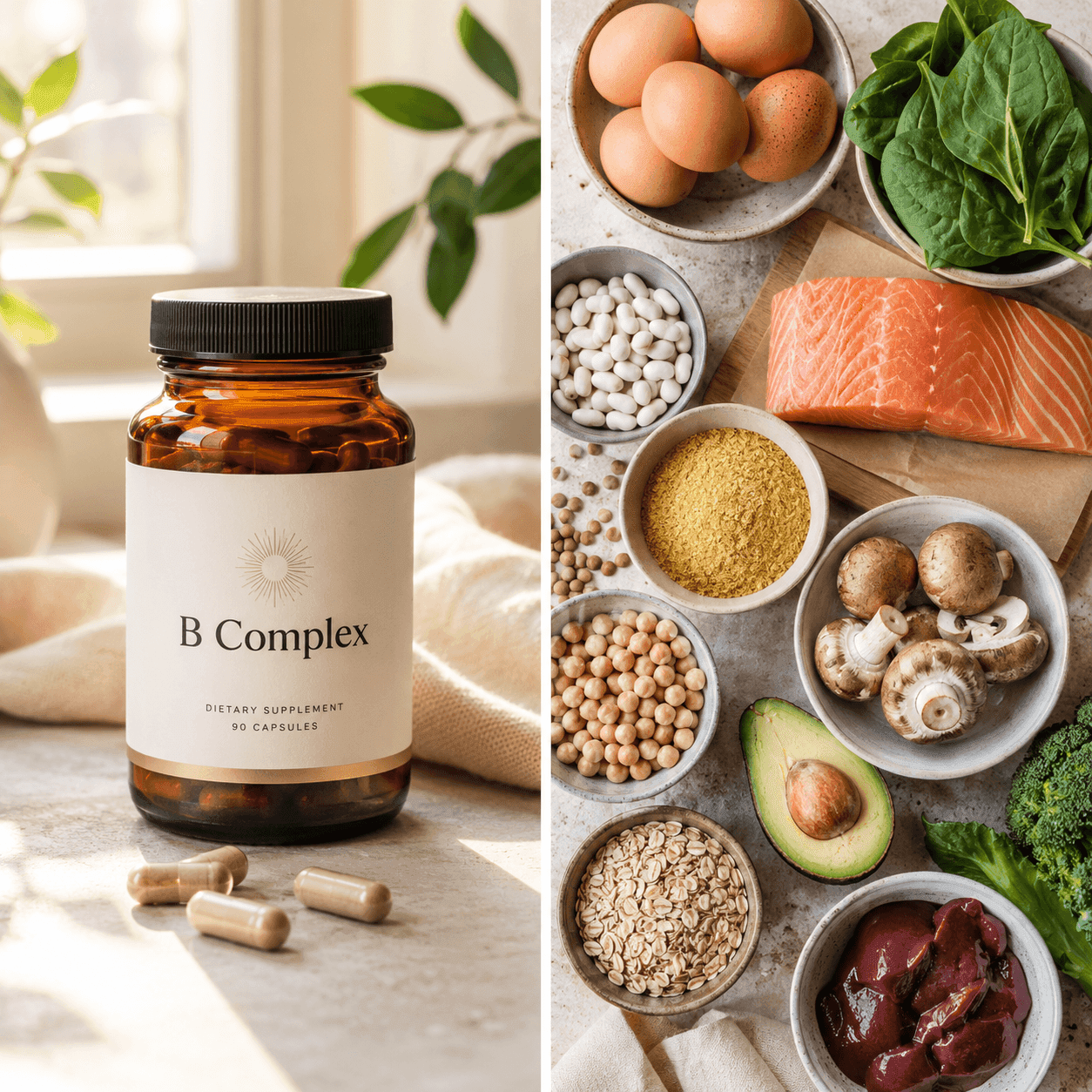
The B vitamins are the engine room. Eight related but distinct compounds that the body uses to convert food into energy, build and repair tissue, produce neurotransmitters, detoxify everything from alcohol to heavy metals, and run the methylation pathways that touch nearly every system in the body. They were originally lumped together because they were extracted from the same food sources — brewer’s yeast, liver, whole grains — before researchers realized they were separate molecules with separate jobs.
Most people running on the standard refined-grain diet are running short on several of them at once. The form of the supplement matters more than mainstream nutrition has ever admitted. And the methylation half of the family — folate, B12, B6 — deserves particular care if you want it to actually do its job.
What the B complex does
- Energy production. B1, B2, B3, B5, and B7 all participate in the Krebs cycle and the electron-transport chain that converts food into ATP. Without them, the metabolic engine sputters.
- Methylation. B9 (folate), B12, and B6 drive the methylation cycle, which the body uses to detoxify, synthesize neurotransmitters, repair DNA, and regulate gene expression.
- Nervous system. B1, B6, B9, and B12 are all required for neurotransmitter synthesis and the maintenance of the myelin sheath that insulates nerve fibers.
- Hormonal and adrenal support. B5 (pantothenic acid) feeds the adrenals directly. Stress depletes B vitamins faster than almost anything else.
- Cardiovascular. The methylation cycle keeps homocysteine in check; high homocysteine is a stronger cardiovascular risk marker than cholesterol, and the fix is B vitamins.
The eight, one at a time
B1 (Thiamine). Energy metabolism, particularly in nerve tissue. Severe deficiency causes beriberi; chronic mild deficiency shows up as fatigue, irritability, and poor stress tolerance. Alcohol depletes B1 hard — Wernicke-Korsakoff syndrome in chronic alcoholics is severe thiamine deficiency. Whole grains, pork, sunflower seeds.
B2 (Riboflavin). Cofactor for the enzymes that recycle glutathione, the body’s master antioxidant. Required for iodine utilization (per Brownstein) and migraine prevention (clinically established at 400 mg per day). Liver, almonds, eggs, leafy greens.
B3 (Niacin / Niacinamide). Cofactor for over 400 enzymes. Affects cholesterol (lowers LDL, raises HDL), cognitive function, and the schizophrenia protocols Dr. Abram Hoffer pioneered. Available as two forms — niacin (causes the famous flush, lowers cholesterol) or niacinamide (no flush, better for joints and anxiety). Liver, fish, mushrooms, peanuts.
B5 (Pantothenic Acid). The adrenal vitamin. Feeds the pathways that produce cortisol and the other adrenal hormones. Deficiency drives burnout, fatigue, low stress tolerance. Liver, mushrooms, sunflower seeds, eggs.
B6 (Pyridoxine / P5P). Neurotransmitter synthesis (serotonin, GABA, dopamine, melatonin). PMS symptoms in women often respond to B6. The form matters — pyridoxine HCl is the cheap synthetic version that requires conversion to the active P5P form, which many people don’t do efficiently. P5P is the form to take. Liver, salmon, poultry, bananas, chickpeas.
B7 (Biotin). Hair, skin, nails, and the enzymes that manage fat metabolism and blood-sugar regulation. The deficiency is uncommon in adults except in long-term raw-egg-white consumption (avidin in raw whites binds biotin) or chronic antibiotic use. Liver, egg yolks, almonds, sweet potato.
B9 (Folate). The methylation team captain. Required for DNA synthesis and repair, red-blood-cell production, neural-tube formation in pregnancy, neurotransmitter synthesis. The form question is critical here, and gets its own section below. Leafy greens (the word "folate" comes from the Latin folium, leaf), liver, asparagus, avocado.
B12 (Cobalamin). The other methylation pillar. Required for nervous-system maintenance, red-blood-cell production, energy. The most commonly deficient B vitamin in vegetarians and vegans. The absorption pathway involves intrinsic factor in the stomach, which fails in many older adults regardless of intake. Gets its own dedicated article in this section.
Folate, folic acid, and MTHFR
This is the single most important thing to get right in B-vitamin supplementation, and it’s a thing mainstream medicine has been slow to absorb.
Folate is the natural form found in food. Folic acid is the synthetic form added to enriched flour, breakfast cereal, and most cheap multivitamins. They’re not the same thing.
The body has to convert folic acid through several enzymatic steps to reach the bioactive form, 5-methyltetrahydrofolate (5-MTHF, methylfolate). The rate-limiting step is governed by an enzyme called MTHFR (methylenetetrahydrofolate reductase). Roughly 30–40% of the population carries one or both copies of a polymorphism that reduces this enzyme’s efficiency by 30–70%.
For those people — a third of everyone reading this — supplemented folic acid doesn’t convert efficiently. It can actually accumulate as unmetabolized folic acid in the bloodstream, where it competes with natural folate at receptor sites and may make things worse. The fix is to skip folic acid and take methylfolate directly — the activated form the body actually uses.
When you buy a B-complex, look at the supplement-facts panel for folate. If it says folic acid, put it back. If it says folate (5-MTHF), methylfolate, or L-methylfolate, that’s the one. Same rule for prenatal vitamins — methylfolate, not folic acid.
Pyridoxine versus P5P
The parallel issue with B6. Cheap supplements use pyridoxine HCl, the inactive form that the body has to convert to the active P5P (pyridoxal-5-phosphate) form to actually use. The conversion isn’t universal, and chronic high-dose pyridoxine HCl (around 100 mg per day or more for long periods) can paradoxically cause peripheral neuropathy.
The fix: take P5P directly. It’s the active form, doesn’t require conversion, and is safer at higher doses. Most quality B-complex products use P5P; cheap ones use pyridoxine. Read the panel.
Dr. Hoffer and niacin
Dr. Abram Hoffer was a Canadian psychiatrist who began using high-dose niacin (B3) to treat schizophrenia in the 1950s. He published the first double-blind placebo-controlled study in psychiatric history — on niacin for schizophrenia — and reported response rates that mainstream psychiatry has never replicated with drugs because mainstream psychiatry stopped doing the protocol.
Hoffer’s work expanded into orthomolecular medicine more broadly: high-dose vitamin therapy for mental illness, cardiovascular disease, and cancer. His niacin protocols for cholesterol (1–3 grams per day of immediate-release niacin) remain effective for raising HDL and lowering LDL and triglycerides, more thoroughly than statins, and without the muscle-pain side effects. Mainstream cardiology mostly ignored him.
The famous “niacin flush” — skin reddening, warmth, sometimes itching, lasting 15–30 minutes after a high dose of immediate-release niacin — is harmless prostaglandin-driven vasodilation. Taking a low aspirin before the niacin blunts it. Sustained-release niacin reduces flushing but can be harder on the liver; the immediate-release form Hoffer used remains the cleanest choice for therapeutic doses.
Niacinamide — the non-flushing form — doesn’t affect cholesterol but is useful for anxiety, sleep, joint health, and as the form in standard B-complex products. 500 mg of niacinamide before bed has a mild calming and sleep-supportive effect well-documented in the literature.
B vitamins and the refined-grain problem
Most of the modern B-vitamin deficit traces to the same place: refined grains. When wheat is milled into white flour, the germ and bran are removed, and with them most of the B vitamins, magnesium, fiber, and trace minerals. What remains is essentially starch.
“Enrichment” is the regulatory response — B1, B2, B3, B9 (as folic acid, not folate), and iron are added back. Note what isn’t added back: B5, B6, B7, B12, the trace minerals, the fiber. And what is added is in the synthetic forms that the half of the population with MTHFR variants can’t metabolize well.
A diet built on refined grains is, by design, a B-vitamin deficiency engine. The fix is real food — whole grains where you do eat grains, plus liver, eggs, leafy greens, and the rest of the food list below.
What deficiency looks like
- Fatigue that doesn’t resolve with sleep
- Brain fog, slow recall, poor concentration
- Anxiety, depression, mood swings
- Insomnia or poor sleep quality
- Tingling or numbness in hands or feet
- Cracks at the corners of the mouth (B2)
- Sore, red, or smooth tongue (B12, B2)
- Hair thinning or hair loss
- Poor wound healing
- Acne and skin breakouts
- PMS symptoms in women (often B6-responsive)
- Elevated homocysteine on bloodwork
- Heart palpitations
Forms — what to look for in a B-complex
The supplement-facts panel tells you everything. Quality B-complex products use:
- Folate as 5-MTHF / methylfolate — not folic acid
- B12 as methylcobalamin — not cyanocobalamin (cheap, synthetic, requires conversion)
- B6 as P5P (pyridoxal-5-phosphate) — not pyridoxine HCl
- B2 as riboflavin-5-phosphate — the activated form
- B3 as niacinamide for general use, niacin for cholesterol-specific protocols
Cheap drugstore B-complex products almost universally use the unactivated synthetic forms. They’re better than nothing for people without MTHFR variants and without absorption issues, but for most people the activated-form products are worth the few extra dollars a month.
Foods that deliver
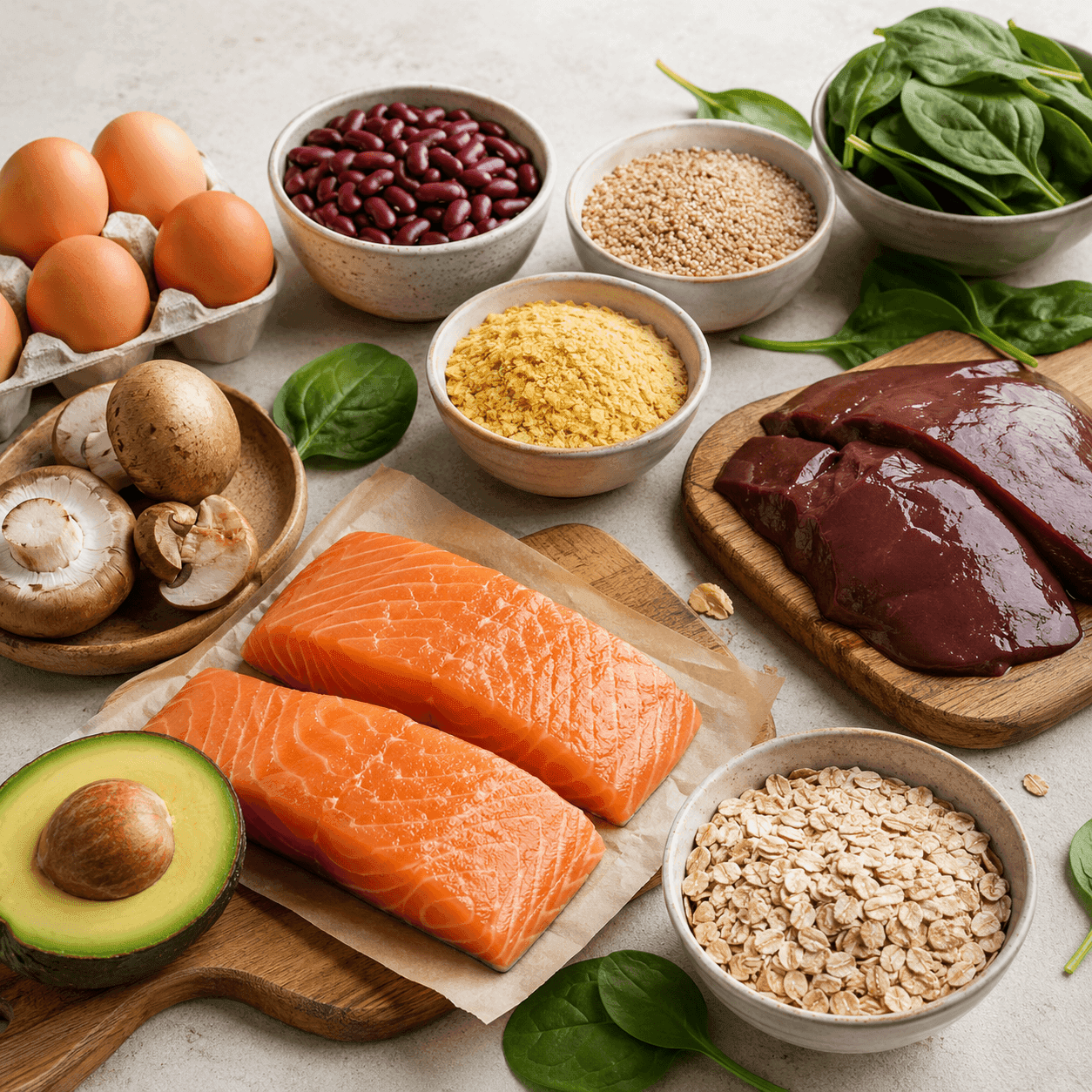
- Liver — the single most B-vitamin-dense food. Contains all eight Bs in their natural forms, with B12, folate, and B6 especially concentrated. Once a week is enough.
- Eggs — biotin (yolk), B12, B5, B2.
- Wild salmon and sardines — B12, B6, niacin.
- Leafy greens (spinach, kale, romaine, chard) — folate, the namesake source.
- Nutritional yeast — vegan-friendly source of most Bs; check the brand’s B12 fortification.
- Sunflower seeds, almonds — B1, B5, B6, biotin.
- Legumes — folate, B1, B5.
- Whole grains (oats, barley, brown rice) — B1, B3, B6, with the bran and germ intact.
- Mushrooms — B2, B3, B5.
Where I buy B vitamins
- Thorne Basic B Complex — the alt-health standard. Methylfolate, methylcobalamin, P5P, riboflavin-5-phosphate. Clean, well-formulated, my default.
- Pure Encapsulations B-Complex Plus — similar activated-forms formulation, also high-quality. Reasonable alternative to Thorne.
- Seeking Health Optimal B Complex — designed by Dr. Ben Lynch (the MTHFR specialist). Higher doses across the family; useful for people with known MTHFR variants or significant deficiencies.
- Jarrow Methyl Folate 400 mcg — for people who need extra folate alongside the B-complex, particularly women planning pregnancy or those with documented MTHFR mutations.
Where to start
A simple baseline is one B-complex with activated forms taken with breakfast every day, plus liver (beef or chicken) once a week when manageable — usually as pâté or in a stir-fry with onions, since plain liver isn’t for everyone — eggs most mornings, and leafy greens daily.
Under heavier stress — deadline weeks, travel, stretches of poor sleep — a second B-complex at lunch helps. Stress burns through B vitamins faster than almost any other nutrient, and doubling the dose during stretches like that is one of the cleaner interventions there is.
Closing
The B vitamins are unglamorous. None of them have a documentary made about them. None of them get the kind of cultural attention vitamin D or magnesium get. They just quietly do the work of the body — energy, methylation, nervous system, adrenal — from the inside, every day, in eight different but coordinated ways.
Take a B-complex with activated forms. Read the panel. Skip folic acid; take methylfolate. Skip pyridoxine; take P5P. Skip cyanocobalamin; take methylcobalamin. Eat liver when you can. The engine room runs better when it has the fuel it was designed to run on.
Sources & further reading
Authorities cited
- Dr. Abram Hoffer (1917–2009) — Canadian psychiatrist; founding figure in orthomolecular medicine. His high-dose niacin protocols for schizophrenia, cholesterol, and cardiovascular health remain foundational alt-health references.
- Dr. Ben Lynch, ND — Naturopathic physician and MTHFR specialist; author of Dirty Genes. The standard contemporary voice on methylation and folate-form selection.
- Dr. Linus Pauling (1901–1994) — Co-founder of orthomolecular medicine with Hoffer; brought high-dose vitamin therapy into mainstream scientific discussion.
Books & reading
- Dirty Genes — Ben Lynch, ND — The accessible guide to methylation and MTHFR; explains the folate-form question in detail.
- Orthomolecular Medicine for Everyone — Hoffer & Saul — Hoffer's standard reference on high-dose vitamin therapy across conditions.
- Niacin: The Real Story — Hoffer, Saul, Foster — The full case on niacin's clinical applications, written by the doctors who used it.
Testing
- MTHFR genetic test — 23andMe raw data run through Promethease or Genetic Genie reports MTHFR variant status. Quest and LabCorp also run direct MTHFR panels.
- Homocysteine — Functional marker for methylation health. Optimal range is 6–8 µmol/L; mainstream 'normal' goes up to 15.
- Serum B12 and serum folate — Standard labs; useful but limited. RBC folate and methylmalonic acid (MMA) are more accurate functional markers.