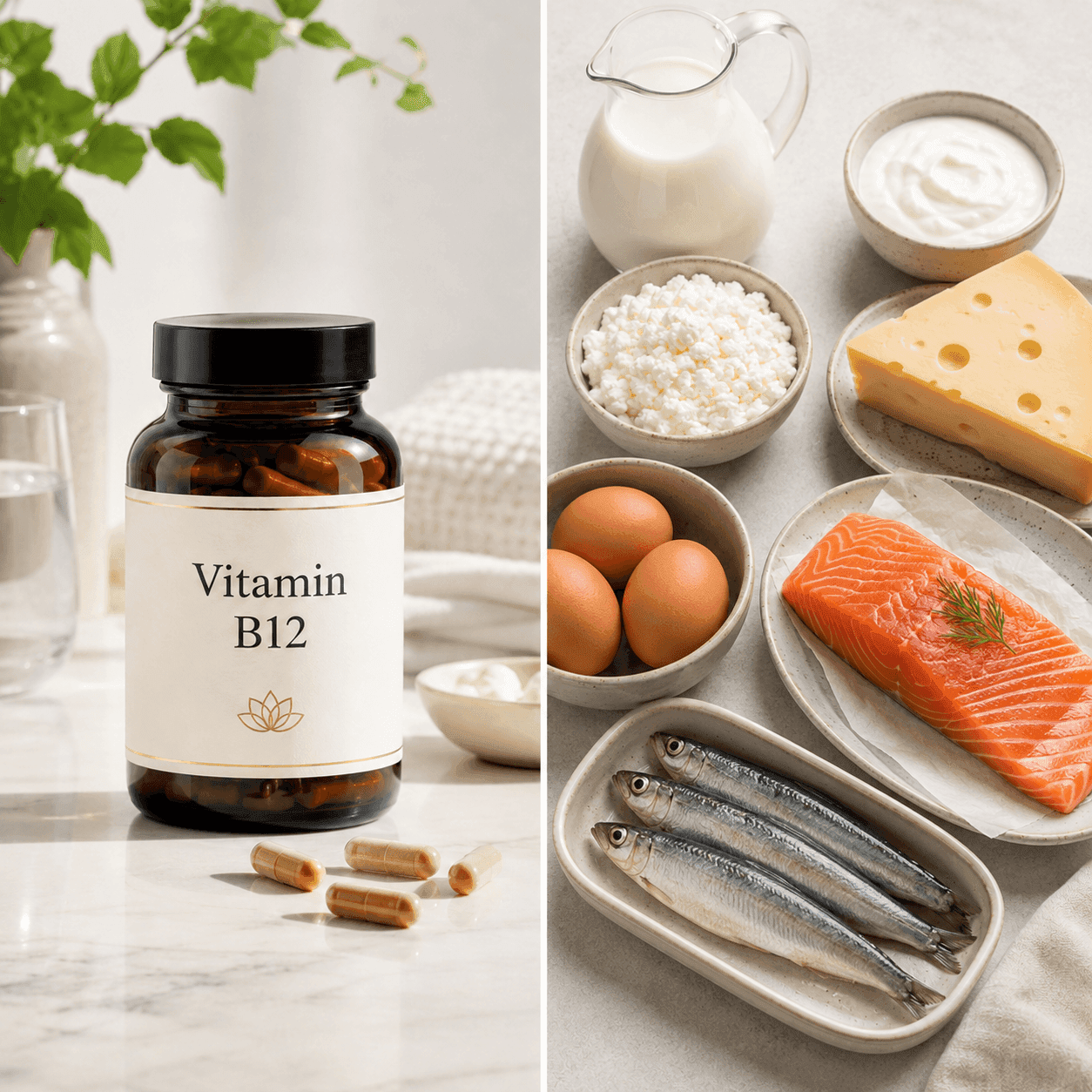

Health · Vitamin · ~10 min read
B12 — the vitamin you can’t get from plants.
Why absorption is uniquely fragile, why methylcobalamin beats cyanocobalamin, and why the neurological damage from missing it doesn’t fully reverse.
By George Hinestrosa · Personal experience & independent research

B12 is the only vitamin you can’t get from plants. It’s synthesized exclusively by bacteria. Animals that eat soil-grown plants, drink unfiltered water, or ingest insects pick up B12 incidentally; humans get it by eating those animals or their products. Modern hygiene, modern agriculture, and modern dietary choices have all cut us off from the casual exposure paths our ancestors relied on.
The result is a vitamin with a wide deficiency footprint and a uniquely fragile absorption pathway. The consequences of long-term deficiency aren’t cosmetic. They’re neurological — nerve damage, cognitive decline, and (if it goes long enough) permanent spinal-cord changes. This is the B vitamin worth getting right.
The absorption gauntlet
B12 absorption is the most complicated of any vitamin in the body. Several steps have to go right for dietary B12 to reach the bloodstream:
- Stomach acid releases B12 from the protein it’s bound to in food. Low stomach acid — common in older adults, and a known side effect of acid-blocking medications — means B12 stays bound and never gets released.
- Intrinsic factor, a protein made by the parietal cells of the stomach, binds the freed B12 and escorts it through the small intestine. People with pernicious anemia have lost parietal-cell function (often autoimmune) and can’t make intrinsic factor at all.
- Terminal ileum receptors recognize the intrinsic-factor-B12 complex and absorb it. Diseases or surgeries that damage the ileum (Crohn’s, ileal resection, gastric bypass) shut this step down.
- Transcobalamin proteins carry the absorbed B12 to the cells that need it.
Any one of those steps failing — and they fail often, especially with age — produces deficiency regardless of how much B12 is in the diet. This is why oral B12 in normal doses has only about 1% bioavailability, and why injections and high-dose sublinguals exist as workarounds.
What B12 does
- Myelin maintenance. B12 is required to build and maintain the myelin sheath that insulates nerve fibers. Chronic deficiency strips myelin and produces the peripheral neuropathy and cognitive symptoms that mark advanced deficiency.
- Red blood cell production. B12 is required for DNA synthesis in the bone marrow cells that produce red blood cells. Deficiency causes megaloblastic anemia — the cells get made, but malformed and oversized.
- Methylation. Alongside folate and B6, B12 drives the methylation cycle that handles detoxification, neurotransmitter synthesis, and DNA repair (see the B Vitamins article in this section for the full treatment).
- Energy metabolism. Adenosylcobalamin (the mitochondrial form of B12) is required for converting fatty acids and amino acids into ATP.
- Cognitive function. Adequate B12 status correlates strongly with brain volume preservation in aging studies; the Oxford OPTIMA trial documented that B-vitamin repletion slowed brain atrophy in older adults with mild cognitive impairment.
Why deficiency is so common
B12 deficiency hits some populations harder than others:
- Vegans and strict vegetarians. Plant foods contain essentially no B12. The few fermented products that contain B12-like molecules (spirulina, some seaweeds, nutritional yeast unless specifically fortified) often contain B12 analogues that the body can’t use and that can actually block real B12 receptors. Supplementation is mandatory in long-term plant-only diets.
- Adults over 50. Stomach acid production and intrinsic factor production both decline with age. Estimates put the deficiency prevalence in adults over 60 at 10–20%, and the functional-deficiency prevalence (where MMA is elevated despite normal serum B12) much higher.
- People on metformin. Metformin (the standard type 2 diabetes drug) interferes with B12 absorption in the ileum. Long-term metformin users routinely develop B12 deficiency. Anyone on this drug should supplement.
- People on acid blockers. Proton pump inhibitors (omeprazole, esomeprazole, etc.) and H2 blockers (famotidine, ranitidine) reduce stomach acid, the first step in B12 absorption. Chronic use produces deficiency.
- People with gut disorders. Crohn’s, celiac, SIBO, gastric bypass, H. pylori infection — all damage the absorption pathway.
- People with pernicious anemia. Autoimmune destruction of parietal cells. Affects roughly 2% of adults over 60. Lifelong supplementation (preferably injection) required.
- People exposed to nitrous oxide. N2O irreversibly inactivates B12. Dental patients, recreational users, and people in trades that use it should know this and supplement accordingly.
What deficiency looks like
- Fatigue that doesn’t resolve with sleep
- Numbness or tingling in hands and feet
- Brain fog, slower thinking, memory complaints
- Mood changes, depression, irritability
- Pale or slightly yellow skin
- Smooth, sore, or red tongue (glossitis)
- Heart palpitations and shortness of breath on exertion
- Unsteady gait or balance issues (advanced)
- Cognitive decline mistaken for early dementia
- Tinnitus
- Heightened anxiety
The neurological symptoms are the dangerous ones. By the time gait disturbance or significant cognitive symptoms appear, deficiency has been running for years, and some of the damage may not fully reverse with repletion. Don’t wait for late symptoms.
The form question
Four forms of B12 appear in supplements:
- Methylcobalamin. The bioactive form used in methylation. The standard alt-health choice. Most supplements should be this.
- Adenosylcobalamin. The bioactive form used in mitochondrial energy production. Complements methylcobalamin; some products combine both, which is the most complete approach.
- Hydroxocobalamin. The form most often used in injections. The body converts it to both active forms efficiently. A good option for people who don’t do well on methylcobalamin specifically (rare, but happens with certain methylation polymorphisms).
- Cyanocobalamin. The synthetic form used in cheap multivitamins and most drugstore B12. Contains a cyanide molecule the body has to discard. Requires conversion to the active forms, which not everyone does efficiently. Avoid where possible — the methyl and adenosyl forms cost pennies more and work substantially better.
For ongoing supplementation, methylcobalamin is the standard. For people with significant deficiency or complex methylation issues, the methyl + adenosyl combination (Seeking Health and others make it) is more complete.
The folate masking problem
This is a serious clinical issue and worth its own short section. High folate intake — whether from food or supplements — can correct the anemia of B12 deficiency without correcting the underlying B12 problem. Red blood cells start being produced normally again. Bloodwork looks better. But the neurological damage from ongoing B12 deficiency keeps progressing in the background.
This is why mainstream medicine traditionally measured B12 alongside folate, and why high-dose folate supplementation without matched B12 is dangerous. The rule: don’t supplement methylfolate without methylcobalamin. They’re a pair.
Testing
Three tests together give the clearest picture:
- Serum B12. The standard test. Mainstream “normal” range is roughly 200–900 pg/mL, but the functional optimal is above 500 pg/mL, and many alt-health clinicians push for 700–1,000. Below 400, intervention is warranted regardless of what the lab says.
- Methylmalonic acid (MMA). The functional B12 marker. MMA rises when B12 is insufficient at the cellular level, even if serum B12 looks “normal.” The most sensitive test for true deficiency. Order it specifically.
- Homocysteine. Elevated homocysteine suggests B12, folate, or B6 insufficiency. Optimal range is 6–8 µmol/L. Above 10 is a methylation problem to address.
Dosing
- Maintenance: 1,000–2,500 mcg per day sublingual methylcobalamin. Sublingual bypasses the intrinsic-factor pathway, which is why this dose level works even for people with absorption issues.
- Repletion: 5,000 mcg per day sublingual for 1–3 months, then drop to maintenance. Recheck MMA and homocysteine to confirm.
- Significant or longstanding deficiency: injection is the gold standard. Hydroxocobalamin or methylcobalamin, 1,000–5,000 mcg weekly to monthly, depending on protocol. Get this through a naturopath or integrative practitioner who’ll prescribe and ideally teach self-injection.
- Pernicious anemia and gut-absorption disorders: lifelong supplementation, either high-dose sublingual or injection. The deficiency doesn’t go away even if symptoms resolve.
Take B12 in the morning. It can be mildly stimulating for some people; taking it at night occasionally interferes with sleep.
Stomach acid — the upstream variable
For people whose B12 deficiency traces to low stomach acid (older adults, anyone on long-term PPIs who’s tapering off, people with chronic indigestion mistaken for too much acid when it’s often too little), the upstream fix is restoring stomach acid.
Betaine HCl with pepsin is the standard alt-health intervention. Start with one capsule with a protein-containing meal; increase by one capsule per meal until you feel mild warmth in the stomach, then drop back one. This is the level that matches your body’s deficit. The Heidelberg test or a Heidelberg-style at-home test (baking soda burp test) can confirm low acid.
For people on PPIs for genuine medical reasons (Barrett’s esophagus, severe reflux), don’t stop the medication without medical coordination — but do supplement B12 sublingually to compensate.
Foods that deliver
- Beef liver — the densest food source by far. 3 oz delivers 70+ mcg, roughly 30 times the RDA. Once a week covers most people.
- Clams and mussels — 84 mcg in 3 oz of clams. Higher than liver ounce-for-ounce.
- Sardines — 8 mcg per 3 oz can.
- Salmon (wild) — 4.8 mcg per 3 oz fillet.
- Beef and lamb — 1.5–3 mcg per 3 oz serving.
- Eggs — 0.5 mcg per egg.
- Dairy — 0.4–1.2 mcg per cup.
Note that the absorption ceiling for B12 from food is roughly 1.5–2 mcg per meal because intrinsic factor becomes the bottleneck. Spreading B12-rich foods across multiple meals is more useful than concentrating them in one.
Where I buy B12
- Jarrow Methyl B-12 5,000 mcg sublingual — chewable lemon-flavored tablets, dissolve under the tongue. The most accessible high-dose sublingual. The product I default to for repletion.
- Thorne Methylcobalamin 1,000 mcg — clean formulation, swallow capsules. Pair with chewing or holding-under-tongue for partial sublingual absorption.
- Seeking Health Adenosyl/Methyl B12 Lozenge — combines both active forms (methyl + adenosyl), the most complete approach. Useful for people with complex methylation issues or known deficiency.
- Pure Encapsulations B12 (methylcobalamin) — reliable alternative. Clean, no fillers.
Where to start
A common approach is one methylcobalamin (methyl-B12) 5,000 mcg sublingual, two or three mornings a week. A basic B-complex covers the everyday baseline; the higher-dose sublingual gives the methylation cycle the extra push the modern environment burns through.
On the food side: beef liver in some form (pâté, with onions, in chili) at least once a week, sardines once or twice a week, eggs daily, and clams when they’re available. Real food first, supplementation as the safety net.
Closing
B12 is the vitamin where the form, the dose, and the delivery route all matter, and where the cost of getting it wrong is steeper than for almost any other nutrient. Get the methylcobalamin form. Take it sublingually if ordinary absorption is in any way compromised. Test MMA and homocysteine, not just serum B12. If your numbers don’t budge on sublingual, pursue injections.
For vegans, for older adults, for anyone on metformin or acid blockers, for anyone with gut issues — don’t guess. Test, supplement properly, retest. B12 is the one you really don’t want to miss.
Sources & further reading
Authorities cited
- Dr. Sally Pacholok, RN — Co-author of Could It Be B12? The standard contemporary clinical reference on B12 deficiency, particularly in the elderly and in pernicious anemia.
- Oxford OPTIMA Trial (Smith et al., 2010) — Demonstrated that high-dose B-vitamin supplementation (including methylcobalamin) slowed brain atrophy in older adults with mild cognitive impairment.
- Dr. Ben Lynch, ND — Standard contemporary voice on methylation, MTHFR, and B-vitamin form selection.
Books & reading
- Could It Be B12? — Sally Pacholok, RN, and Jeffrey Stuart, DO — The most comprehensive lay-clinician reference on B12 deficiency presentations and protocols.
- Dirty Genes — Ben Lynch, ND — Methylation framework that contextualizes B12 alongside folate, B6, and MTHFR.
Testing
- Serum B12 — Standard test. Order at any major lab. Functional optimal: 500–1,000 pg/mL.
- Methylmalonic acid (MMA) — The functional cellular B12 marker; more sensitive than serum B12. Order specifically.
- Homocysteine — Elevated homocysteine signals methylation insufficiency (B12, folate, B6). Optimal 6–8 µmol/L.