
Health · Fat · ~10 min read
Beef tallow — the demonization of saturated fat, corrected.
How rendered beef fat went from the standard American cooking fat to a dietary villain, why the science behind that swap was wrong, and what your great-grandmother already knew about cooking with it.
By George Hinestrosa · Personal experience & independent research
For most of American culinary history, beef tallow was the default cooking fat. Restaurants fried in it. Home cooks kept a jar of rendered drippings on the back of the stove. McDonald’s famously fried their potatoes in a 93% beef tallow blend until 1990 — and people who remember those fries remember them as the best fast-food fries that have ever existed. The change wasn’t culinary. It was ideological. A man named Phil Sokolof took out full-page newspaper ads accusing McDonald’s of “poisoning America,” and the company capitulated and switched to partially hydrogenated vegetable oil. Which, of course, contained trans fats — the one category of fat we now know with confidence is genuinely cardiotoxic. The cure was worse than the disease, and we never went back.
This article is the case for going back. Not to industrial feedlot tallow — the source matters — but to real, rendered fat from well-raised cattle as a primary cooking fat. The reasoning starts with the actual composition of tallow, runs through the history of how saturated fat was framed as the villain, treats the current state of the evidence honestly, and ends with how to render, store, and cook with it.
What tallow actually is
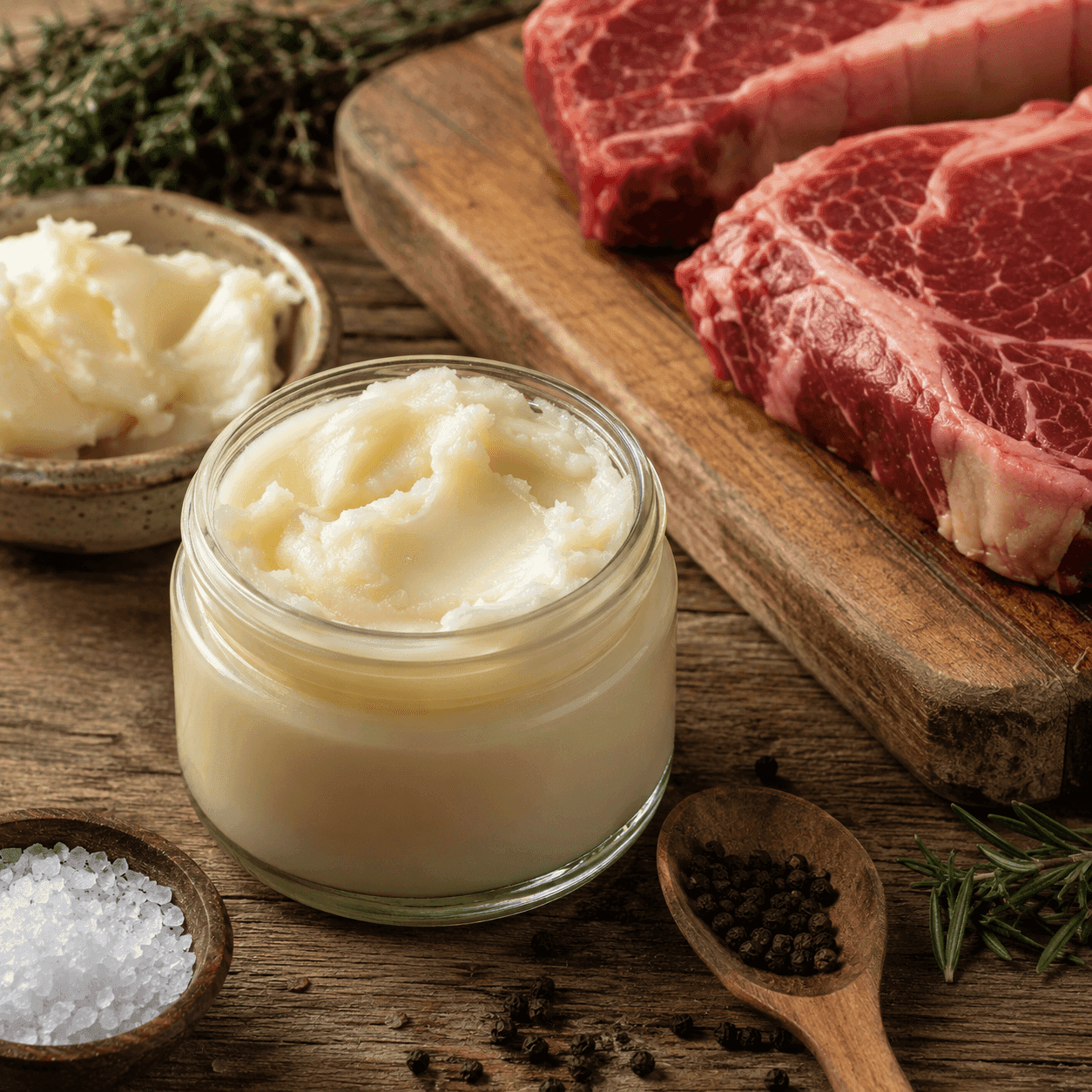
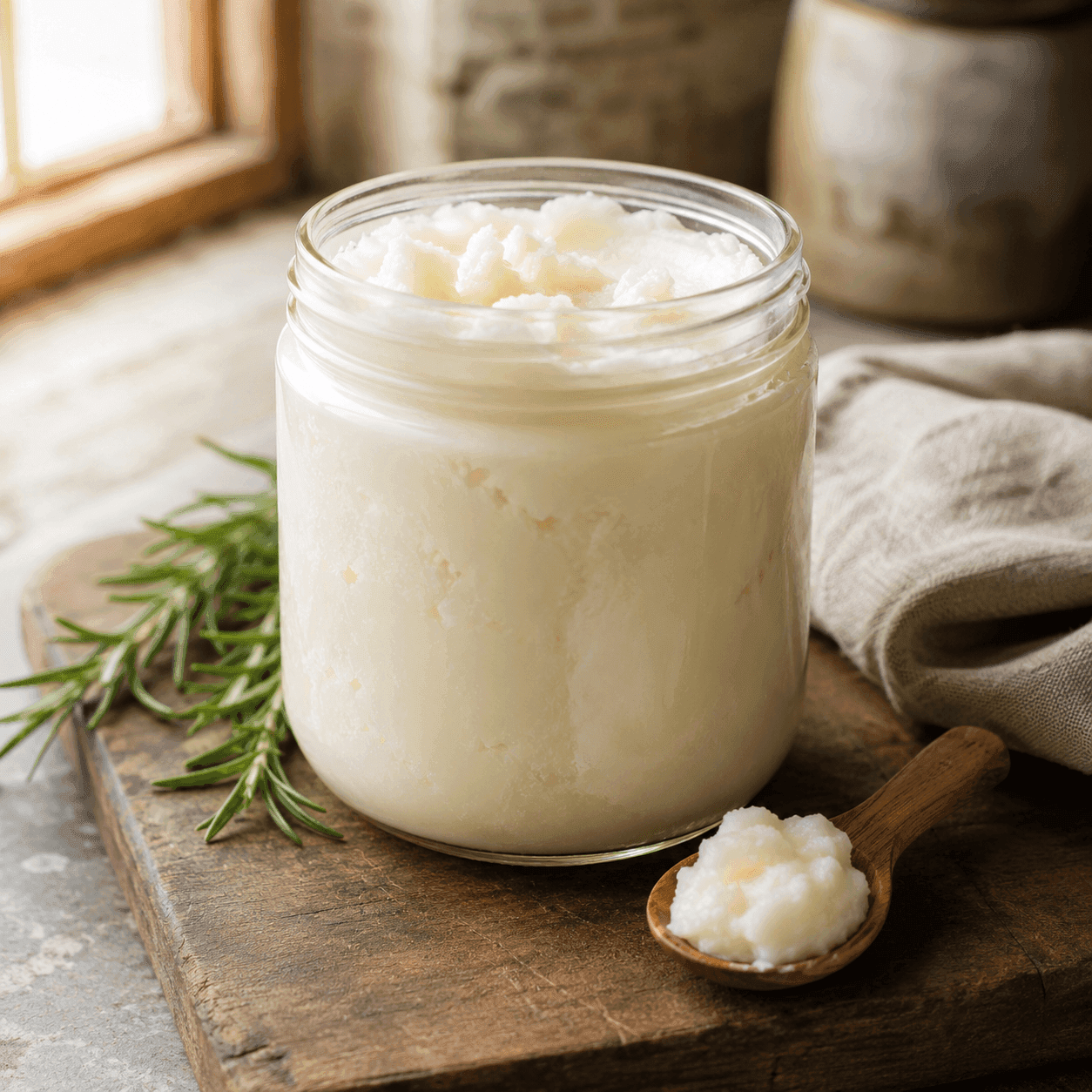
Tallow is rendered fat from cattle — specifically, the hard fat that sits around the kidneys and loins, called suet, though trimmed external fat works too. You cook it slowly with a little water until the fat liquefies and separates from the connective tissue, strain it, and let it solidify. What you’re left with is a firm, ivory-colored fat that’s shelf-stable at room temperature for months and refrigerator-stable for over a year.
By weight, tallow is roughly 50% saturated fat, 42% monounsaturated fat (mostly oleic acid — the same fat that makes olive oil what it is), and around 4% polyunsaturated. The exact ratio shifts with how the animal was raised: grass-finished tallow has more conjugated linoleic acid (CLA), more omega-3, and a yellower color from the carotenoids the cow accumulated from green forage. Feedlot tallow trends whiter, with a worse omega-6 to omega-3 ratio.
On top of the fat itself, tallow carries the fat-soluble vitamins the cow stored — A, D, E, and K2 — in concentrations that depend on the diet of the animal. Grass-finished animals concentrate vitamin K2 (the menaquinone form, which is the one that matters for calcium metabolism and arterial health) in a way that grain-finished animals do not. This is one of the under- appreciated arguments for tallow over seed oils: you aren’t just choosing a more stable cooking fat, you’re also getting a small, regular dose of fat-soluble vitamins you would otherwise have to supplement.
How saturated fat became the villain
The shift away from tallow — and lard, and butter — traces back to one man and one decade. Ancel Keys was a University of Minnesota physiologist who, in the late 1950s, published the Seven Countries Study, which appeared to show a clean correlation between saturated fat intake and heart disease. The story was tidy: more saturated fat, more heart attacks. The American Heart Association adopted the framing. Vegetable oils — cheap, abundant, industrially convenient — were positioned as the heart-healthy alternative.
There were two problems with Keys’s study, both visible at the time and both ignored. First, he had originally collected data from twenty-two countries. When the full dataset was plotted, the correlation vanished. He published the seven that fit. Second, the countries he selected didn’t hold lifestyle and sugar intake constant; the differences he attributed to saturated fat could just as easily have been driven by refined carbohydrate intake, smoking, or activity. The critique was made by his contemporaries — John Yudkin in the UK published Pure, White and Deadly in 1972 arguing that sugar, not fat, was the real driver — and the critique was largely shouted down. The saturated-fat hypothesis became dietary policy. Lard and tallow went out. Crisco, corn oil, and eventually soybean oil came in.
The Minnesota Coronary Experiment, run from 1968 to 1973 and finally published in full in 2016, randomized over 9,000 people to either a diet high in saturated fat or one high in linoleic acid from corn oil. The corn oil arm successfully lowered cholesterol — and had higher, not lower, all-cause mortality. The study had sat unpublished for forty years. The data, when it finally came out, undermined the foundational assumption that swapping animal fat for vegetable oil improved cardiovascular outcomes.
The current state of the evidence
I’ll be honest about where the evidence sits, because the alternative-health space is sometimes too quick to claim total exoneration. A 2010 meta-analysis by Siri-Tarino and Krauss in the American Journal of Clinical Nutrition pooled twenty-one prospective studies covering nearly 350,000 people and found no significant association between saturated fat intake and cardiovascular disease. A 2014 meta-analysis by Chowdhury and colleagues in the Annals of Internal Medicine reached a similar conclusion. A 2020 review in the Journal of the American College of Cardiology by Astrup, Krauss, and others argued explicitly that the recommendation to limit saturated fat is not supported by the science and called for it to be revised.
On the other side, the American Heart Association continues to recommend limiting saturated fat to less than 6% of calories, and their 2017 advisory pointed to trials in which replacing saturated fat with polyunsaturated fat lowered cardiovascular events. The critique of that advisory, made by independent cardiologists like Aseem Malhotra, is that it cherry- picked older trials and ignored the more recent meta- analyses. There’s a real scientific argument happening, and it is not yet settled. What is settled, in my reading, is that the case against saturated fat is much weaker than mainstream dietary guidance presents it as, and that the alternative cooking fats people were pushed toward — industrial seed oils, especially heated and reheated — carry their own well- documented harms.
The practical conclusion isn’t “eat unlimited tallow.” It’s “cook with stable fats from real food sources, and stop fearing the foods your great-grandparents ate.”
Why tallow is one of the best cooking fats
The case for tallow as a cooking fat is straightforward. It has a smoke point around 400°F — high enough for searing, roasting, and deep-frying without breaking down. It’s mostly saturated and monounsaturated, both of which are chemically stable under heat. The small polyunsaturated fraction is the only part vulnerable to oxidation, and it’s small enough that the fat as a whole tolerates repeated heating in a way that corn, soybean, canola, and sunflower oils do not.
When you heat a polyunsaturated-rich oil — the standard restaurant fryer running soybean or canola at 350°F for hours — the oil oxidizes, forming aldehydes, lipid peroxides, and trans isomers. These are not theoretical concerns; they’re measured in the oil and in the food fried in it. Tallow doesn’t do this to the same degree, because the molecules aren’t structured to. The double bonds that make polyunsaturated oils “heart healthy” on a label are the same double bonds that make them chemically unstable in a pan.
On flavor, tallow is the best fat that exists for potatoes — this is not nostalgia, it’s chemistry. The crisp it produces on the exterior of a fry, a roast potato, or a hash brown is something seed oils cannot replicate. Roast vegetables in tallow once, and the version made with olive oil will feel insufficient by comparison.
Grass-finished vs feedlot
The single most important variable in tallow quality is what the cow ate. Grass-finished beef has been allowed to eat its species-appropriate diet for its entire life, including the final months. Grain-finished or feedlot beef has been moved to a corn-and-soy ration for the last 90 to 180 days to fatten the animal quickly before slaughter. The fat profile shifts substantially during that finishing window.
Grass-finished tallow has roughly two to five times more conjugated linoleic acid, a meaningfully better omega-6 to omega-3 ratio, higher concentrations of vitamins A and K2, and the yellow tint from beta-carotene that the cow couldn’t convert to retinol fast enough. Feedlot tallow lacks most of these. It’s still a more stable cooking fat than seed oil, but you’re losing most of the nutritional argument for choosing tallow over a neutral fat.
If you can find a local farmer raising 100% grass-fed and grass-finished beef, that’s the best source — and the cheapest, because rendering your own from suet costs almost nothing. If you can’t, specialty brands like US Wellness Meats and Fatworks source from grass-finished animals and ship nationally.
How to render tallow at home
Rendering tallow is one of the most satisfying kitchen projects there is, and it’s effectively free if you ask your butcher for trimmings or buy a few pounds of suet. Suet is the firmer fat from around the kidneys and is the best yield-to-effort ratio; trimmed external fat works fine and is usually cheaper.
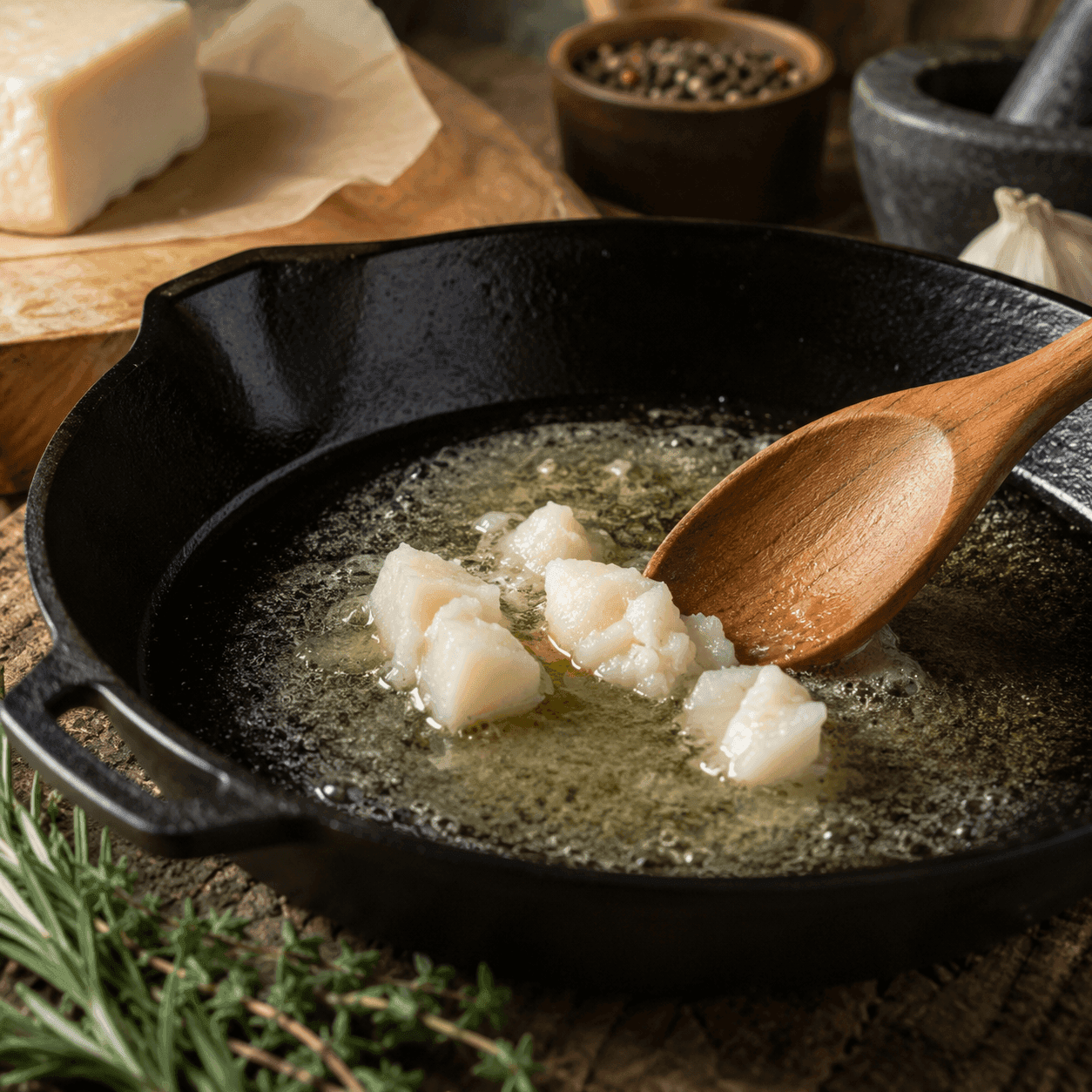
Chop the fat into small pieces — smaller is faster, but you can also throw chunks in and just be patient. Put it in a heavy-bottomed pot with about a quarter cup of water (the water keeps the fat from scorching before it starts releasing its own liquid), set it on the lowest heat your stove will hold, and walk away. Stir it every twenty minutes or so. Over the course of two to four hours, the fat will liquefy, the water will evaporate, and the connective tissue will turn into golden, crispy bits called cracklings. Strain the liquid fat through a fine sieve or cheesecloth into clean glass jars. It will solidify into a pale ivory block as it cools.
Stored at room temperature in a sealed jar, well- rendered tallow keeps for several months without rancidity. Refrigerated, over a year. Freeze it indefinitely. The cracklings, salted and eaten warm, are arguably the best part of the project.
Where to start
Tallow earns a permanent spot in a glass jar next to the stove. For roasting potatoes, root vegetables, or a whole chicken, it goes in the pan. For frying eggs, it rotates with butter and ghee — tallow gives eggs a deeper, more savory flavor that’s easy to start craving. For searing a steak in cast iron, it’s the default fat: it tolerates the heat and reinforces the flavor of the meat itself.
For the occasional deep fry, tallow is the fat to use. Hand-cut potatoes blanched in water and then fried in tallow are the closest thing at home to what McDonald’s fries used to be in the 1980s, and once you’ve had them, the seed-oil version stops tasting like food.
One thing tallow isn’t is a supplement. There is no need to eat spoonfuls of it to capture the benefit. It just needs to be the fat in the pan — instead of the canola, soybean, or vegetable oil that came before.
Tallow on the skin
One use that’s reentered the conversation in the last few years: tallow as a face and body balm. The argument is structural — the fatty acid profile of tallow is closer to the lipid profile of human skin than almost any other natural fat, which means it absorbs cleanly and doesn’t sit on the surface. Whipped tallow balms have become a small but real industry. People who’ve struggled with eczema or chronic dryness on seed-oil-based moisturizers often report substantial improvement when they switch.
Whether this is worth doing depends on whether your skin needs the help. The case for it isn’t that tallow is magic — it’s that the rest of the skincare industry uses inflammatory seed oils, occlusive petroleum products, and fragrances that aggravate exactly the conditions the products claim to treat. A simple tallow balm (often just tallow and a tiny amount of olive oil or honey) avoids all of that.
Products I’d recommend
The honest answer is that the best tallow is the one you render yourself from a quarter cow of grass-finished beef you bought from a local farmer. Failing that, the commercial options below are all reputable — meaning they source from grass-finished animals and don’t blend in industrial fats.
Fatworks Premium Grass-Fed Beef Tallow is the brand most likely to show up in a well-stocked grocery store and the one I default to when I haven’t rendered my own in a while. Sourced from 100% grass-fed and grass-finished cattle, no additives. Comes in a glass jar.
US Wellness Meats Grass-Fed Tallow is what I order in bulk when I’m deep-frying. US Wellness has been in the grass-fed business since before most of the current crop of brands existed, and their tallow is genuinely grass-finished. They sell it in larger tubs, which is the right format if you cook with it regularly.
EPIC Provisions 100% Grass-Fed Beef Tallow is widely distributed and reliable. EPIC was acquired by General Mills a few years back — some people care about that, others don’t. The product itself is still well-sourced.
FOND Tallow comes from the same company that makes one of the better jarred bone broths. Grass-fed, grass-finished, in a glass jar. Slightly premium price but consistent quality.
Raw Farm Grass-Fed Beef Tallow is the option if you’re already buying from Raw Farm for their raw milk and other pasture products. Same supply chain, same standards.
The bottom line
Beef tallow was the cooking fat of choice for most of American history and was demonized on the back of weak science that more recent evidence has substantially undermined. It’s stable under heat, carries fat- soluble vitamins, tastes excellent, and replaces exactly the industrial seed oils that carry the most well- documented harms. The case for cooking with it again isn’t a fringe alternative-health argument anymore — it’s a return to what we used before someone in the 1960s convinced us otherwise.
Render your own when you can. Buy grass-finished when you can’t. Keep it next to the stove. Use it for roasting, searing, and the occasional fry. Stop being afraid of it.
Sources & further reading
Saturated fat and cardiovascular outcomes
- Siri-Tarino PW, Sun Q, Hu FB, Krauss RM. Meta-analysis of prospective cohort studies evaluating the association of saturated fat with cardiovascular disease. American Journal of Clinical Nutrition. 2010;91(3):535-46.
- Chowdhury R, Warnakula S, Kunutsor S, et al. Association of dietary, circulating, and supplement fatty acids with coronary risk: a systematic review and meta-analysis. Annals of Internal Medicine. 2014;160(6):398-406.
- Astrup A, Magkos F, Bier DM, et al. Saturated fats and health: a reassessment and proposal for food-based recommendations. Journal of the American College of Cardiology. 2020;76(7):844-857.
- Ramsden CE, Zamora D, Majchrzak-Hong S, et al. Re-evaluation of the traditional diet-heart hypothesis: analysis of recovered data from Minnesota Coronary Experiment (1968-73). BMJ. 2016;353:i1246.
Mainstream guidance
- Sacks FM, Lichtenstein AH, Wu JHY, et al. Dietary fats and cardiovascular disease: a presidential advisory from the American Heart Association. Circulation. 2017;136(3):e1-e23.
Books and authority figures
- Teicholz N. The Big Fat Surprise: Why Butter, Meat and Cheese Belong in a Healthy Diet. Simon & Schuster, 2014.
- Yudkin J. Pure, White and Deadly: The Problem of Sugar. 1972 (reissued 2012).
- Malhotra A, Redberg RF, Meier P. Saturated fat does not clog the arteries: coronary heart disease is a chronic inflammatory condition, the risk of which can be effectively reduced from healthy lifestyle interventions. British Journal of Sports Medicine. 2017;51(15):1111-1112.