
Health · Whole Food · ~9 min read
Beets — nitric oxide, blood pressure, the deepest liver food.
Why Dr. Berg keeps coming back to this one, why cyclists drink the juice before races, and why the betaine inside quietly fixes the methylation cycle.
By George Hinestrosa · Personal experience & independent research
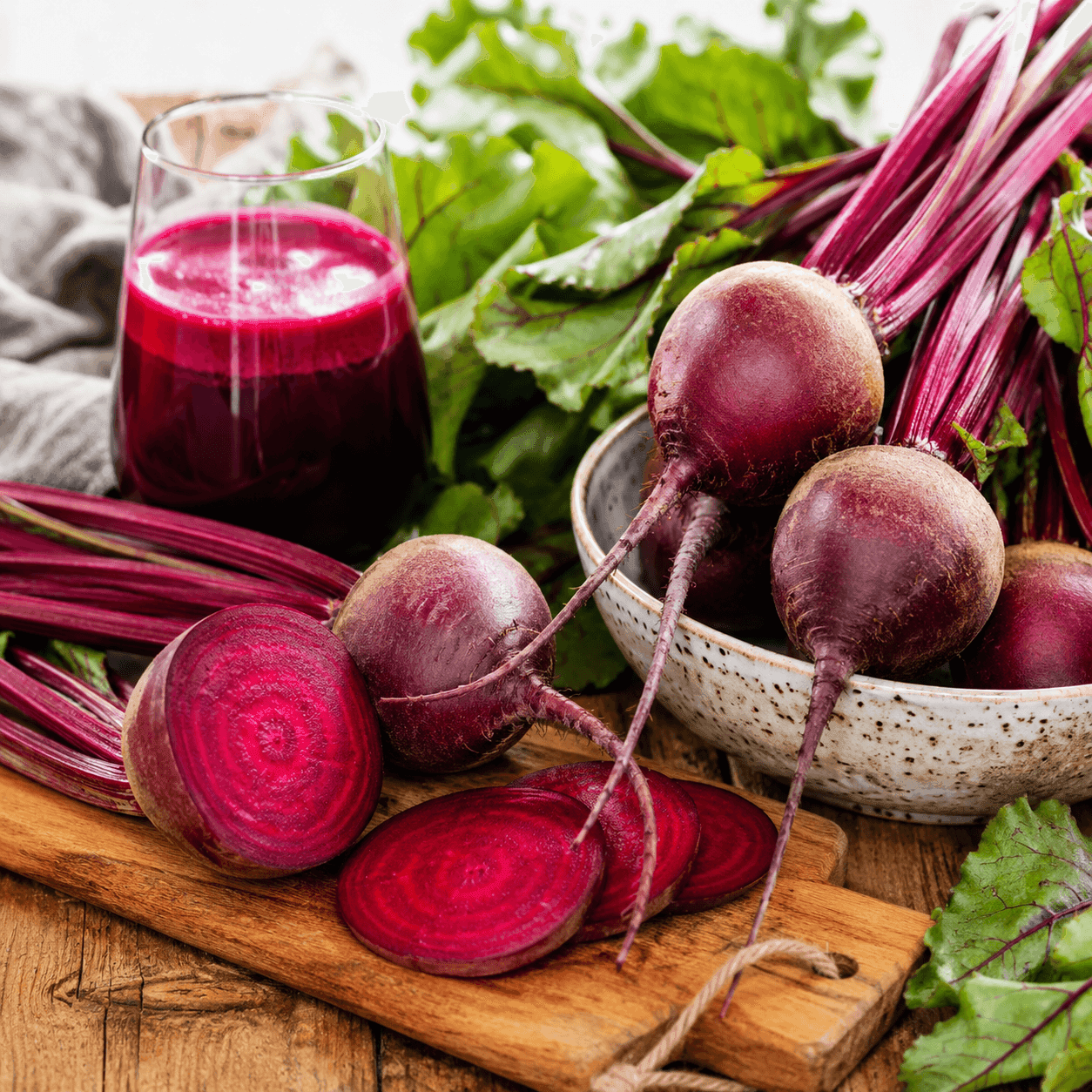
Beets are the kind of vegetable people either love or quietly avoid. Earthy, deep red, stains the cutting board, stains the kitchen towel, stains the hand that peeled it. The mainstream nutrition world has historically grouped them with starchy vegetables and moved on. The alt-health world — and a generation of endurance athletes — has paid much closer attention.
Dr. Eric Berg has been pointing at beets for years. Three things stack up at once in this one root: a powerful nitric oxide pathway that lowers blood pressure and improves circulation, an unusually deep liver and methylation support through the compound betaine, and a family of pigments (betalains) that act as some of the strongest dietary antioxidants known. Plus the greens at the top of the root, which most people throw away, are one of the highest-potassium and highest-magnesium vegetables on earth.
The nitric oxide story
Beets are exceptionally high in dietary nitrates. The body converts these nitrates — in a multi-step pathway that starts with bacteria living on the back of the tongue — into nitric oxide (NO), one of the most important signaling molecules in human physiology.
Nitric oxide is the body’s vasodilator. It relaxes the smooth muscle around blood vessels, opens them up, improves blood flow, lowers blood pressure, and increases oxygen delivery to working tissue. The 1998 Nobel Prize in Medicine went to the researchers who worked out NO’s role in cardiovascular signaling. Forty years of follow-up research has documented its central role in heart health, exercise performance, sexual function, and cognitive blood flow.
Beets are one of the densest food sources of the nitrate substrate that drives that pathway. Three or four medium beets, or a cup of fresh beet juice, deliver roughly 400–800 mg of nitrate — enough to substantially raise plasma NO levels for several hours.
The blood pressure effect
Multiple clinical trials have documented the blood pressure effect of beet juice. The most-cited — a 2013 study published in Hypertension — found that 250 ml of beet juice daily lowered systolic blood pressure by an average of 8 mmHg in adults with mild hypertension after four weeks. Other trials have shown similar effects in the 4–10 mmHg range.
For perspective, the typical blood-pressure-lowering effect of a first-line antihypertensive medication is roughly 10–15 mmHg. The effect of dietary beets isn’t quite at that level, but it’s the same order of magnitude — and the side-effect profile is “your urine might briefly turn pink.”
The effect kicks in within hours of consumption (NO production peaks 2–3 hours after ingestion) and wears off over 24 hours. Daily intake is required to maintain the effect. Stop drinking beet juice and the pressure-lowering effect fades within a few days.
Liver support — the betaine angle
Beets contain unusually high levels of betaine (also called trimethylglycine, or TMG). Betaine is a methyl donor — it participates directly in the methylation cycle covered in the B-vitamins article. Specifically, betaine converts homocysteine back into methionine, which keeps homocysteine levels in check.
Elevated homocysteine is a stronger predictor of cardiovascular events than cholesterol. The standard methylation-cycle interventions are folate, B12, and B6. Betaine is the fourth tool in that toolbox, and beets are the densest dietary source.
Betaine also supports liver function more directly — it’s used clinically in the alt-health world to support bile production, fatty liver resolution, and the detoxification of heavy metals and xenobiotics. Berg often groups beets alongside wheatgrass and bitter greens as “liver foods” for exactly this reason.
The athletic performance angle
In 2009, researchers at the University of Exeter published a study showing that cyclists who drank beet juice before exercise could ride at a given intensity for 16% longer before exhaustion. The mechanism was improved mitochondrial efficiency — the body used less oxygen to produce the same amount of work.
That study put beet juice on the menu of professional cycling teams within a year. The follow-up research has replicated the effect across running, swimming, high-intensity training, and even sustained mental work. The standard performance dose is 6–8 mmol of dietary nitrate (roughly 300–500 ml of beet juice) taken 2–3 hours before activity.
The effect is most pronounced in non-elite athletes. Elite athletes are already operating close to their physiological ceiling and see smaller absolute gains. For weekend runners, recreational cyclists, and people getting back into training, the effect is meaningful and cheap to access.
Don’t throw away the greens
The greens at the top of a beet are one of the most nutrient-dense vegetables you can buy at a grocery store. One cup of cooked beet greens delivers:
- 1,300 mg of potassium (more than a banana three times over)
- 98 mg of magnesium
- 697 mcg of vitamin K (a multi-day supply)
- 11,000 IU of vitamin A as beta-carotene
- Calcium, iron, manganese, folate
Most people cut them off in the kitchen and throw them in the compost. They’re excellent sautéed in olive oil with garlic, or added to a green smoothie, or used like spinach in soups and stews. If you’re buying beets, you’re paying for the greens too — eat them.
Forms — whole, juice, powder, fermented
- Whole beets, roasted or steamed. The everyday form. Retains nitrates, betaine, betalains, fiber, and the matrix that slows absorption. The baseline food.
- Beet juice (fresh or shelf-stable). The concentrated nitrate delivery. Fastest NO response, strongest blood-pressure and performance effect. The form used in clinical studies.
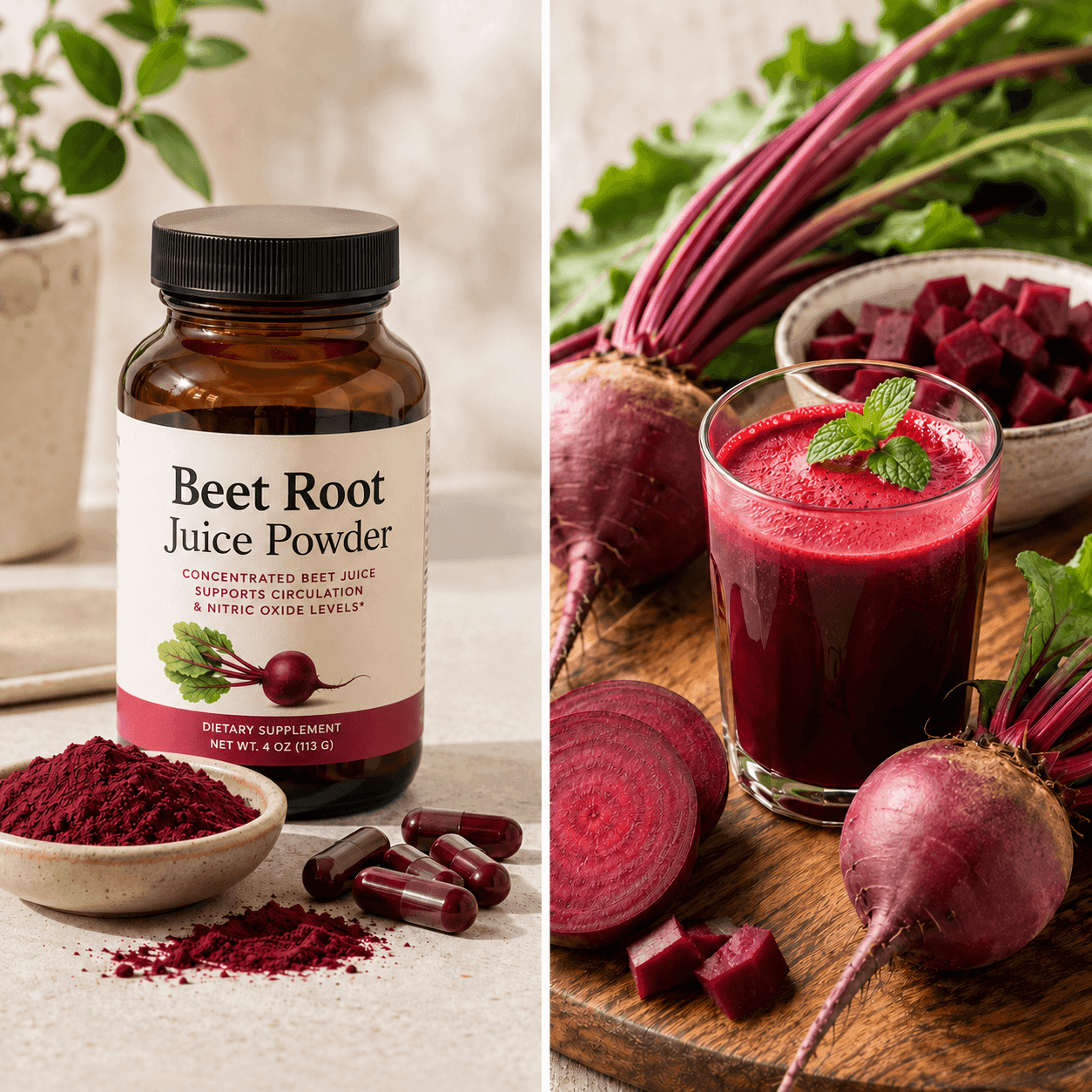
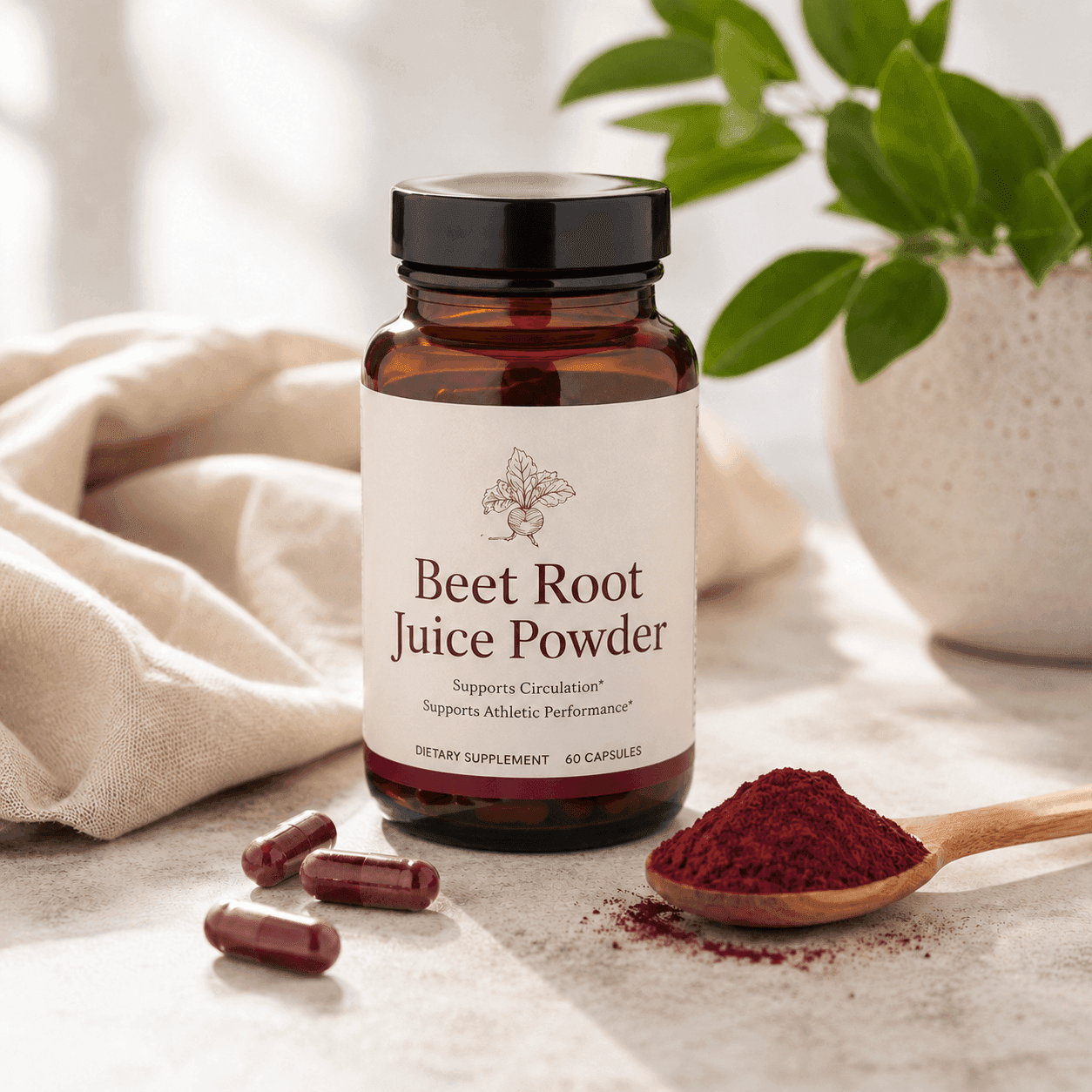
- Beet powder. Dehydrated juice. Convenient, shelf-stable, easy to add to smoothies. Lower nitrate per serving than fresh juice but still meaningful. The form most endurance athletes use for travel.
- Fermented beet kvass. Traditional Eastern European drink — beets fermented in salt water for a few weeks. Adds probiotic benefit, easier on the digestive system, retains most of the original nutrient profile. The most traditional way humans have consumed beets for medicinal effect.
- Pickled beets (in vinegar). Lower in nitrate than the others; the vinegar processing degrades much of the nitric oxide substrate. Reasonable as a side dish, not the form to use for therapeutic effect.
The mouthwash problem
One detail mainstream medicine almost never mentions: the nitric-oxide pathway depends on bacteria living on the back of the tongue to convert dietary nitrate to nitrite. Antiseptic mouthwash kills those bacteria.
Studies have shown that using antibacterial mouthwash (chlorhexidine, alcohol-based commercial mouthwashes) for as little as a week reduces the blood-pressure benefit of dietary nitrate by 90% or more. The mouth bacteria are doing real work, and we’re killing them on schedule with products marketed as health products.
If you’re using beets for blood pressure or exercise performance, drop the antiseptic mouthwash. A simple salt-water rinse, or a clean-ingredient mouthwash without antimicrobials, handles oral hygiene without disrupting the pathway.
Beeturia — the pink urine question
Roughly 10–15% of people excrete pink or red urine after eating beets. This is called beeturia, and it’s caused by the betalain pigments passing through largely intact instead of being broken down. It’s harmless on its own.
What it can indicate, though, is low stomach acid or iron-absorption issues. The body’s betalain-degrading process appears to work better when stomach acid and iron status are healthy. If your urine consistently turns pink after beets, it’s worth checking ferritin (iron storage) and considering whether you might have low stomach acid (see the B12 article on betaine HCl as the standard intervention).
Preparation — roasting beats boiling
Nitrates and betalains are both somewhat water-soluble. Boiling beets leaches significant nitrate into the cooking water (which is why traditional Eastern European cooks save it for borscht). Roasting whole beets in their skins, wrapped in foil, at 400°F for about an hour preserves the most. Steaming is intermediate. Raw is highest in nitrate but harder on digestion for many people.
For the cardiovascular and performance benefits, the fresh-juice or raw-grated approach delivers the most. For everyday eating, roasted whole beets are the sweet-spot — sweet, deep, easy to slice cold onto salads or eat warm with butter and salt.
Where I buy beets
For the everyday form, the produce aisle. Look for firm beets with the greens still attached — if the greens are wilted, the beets aren’t fresh, and you’re losing half of what you came for.
For the concentrated forms:
- Lakewood Organic Pure Beet Juice — cold-pressed, organic, no additives. The cleanest shelf-stable option.
- Biotta Organic Beet Juice — Swiss brand, biodynamic, contains a little lactic acid (gentle fermentation), well-tolerated.
- BeetElite Beet Performance Powder — designed for athletic use, standardized nitrate content per scoop. The product cycling teams actually use.
- Country Farms Bountiful Beets — budget-friendly beet powder, decent quality for everyday smoothie use.
Where to start
Roasted whole beets once or twice a week — sliced cold onto salads or warmed with butter and a little salt — make an easy baseline. The greens are worth keeping too, sautéed with garlic in olive oil rather than thrown out.
On training days, especially harder cardio or anything endurance-flavored, a glass of quality beet juice (around 8 oz; brands like Lakewood or Biotta) two or three hours before exercise is the common protocol. The performance effect is subtle but builds over time.
One caveat worth pairing with all of this: skip antiseptic mouthwash, which kills the oral bacteria that convert beet nitrates into nitric oxide. A salt-water rinse or a clean-ingredient toothpaste does the job without undoing the benefit.
Closing
Beets are an unusual food in that the alt-health and mainstream-research literatures actually agree on them. The nitric oxide pathway is well-characterized. The blood-pressure effect is documented in peer-reviewed trials. The athletic-performance benefit is in textbooks now. The betaine and methylation contribution is just adding to a long list.
For something you can buy for a couple of dollars at any grocery store, beets do a remarkable amount of work. Eat the greens. Roast the roots. Drink the juice when you train. The body knows what to do with all of it.
Sources & further reading
Authorities cited
- Dr. Eric Berg — Standing voice on beets for liver, blood pressure, and nitric oxide.
- Prof. Andrew Jones, University of Exeter — Lead researcher on the foundational beet juice and exercise performance studies, beginning 2009.
Studies & reading
- Kapil, V. et al. (2015). Dietary nitrate provides sustained blood pressure lowering in hypertensive patients. Hypertension, 65(2), 320-327. — The most-cited beet juice + blood pressure trial; 250 ml daily lowered systolic BP by ~8 mmHg.
- Bailey, S.J. et al. (2009). Dietary nitrate supplementation reduces the O2 cost of low-intensity exercise. Journal of Applied Physiology. — The original Exeter beet juice + exercise efficiency study.
- Bondonno, C.P. et al. (2015). Antibacterial mouthwash blunts oral nitrate reduction and increases blood pressure. — The mouthwash + nitric-oxide pathway study; the practical implication for anyone using beets for blood pressure.