
Health · Fat · ~9 min read
Ghee — lactose-free, shelf-stable, and the case for clarified butter.
The form of butter that survived 5,000 years of Ayurvedic medicine, what clarifying actually removes, why grass-fed matters, and how to make it in twenty minutes on your own stove.
By George Hinestrosa · Personal experience & independent research
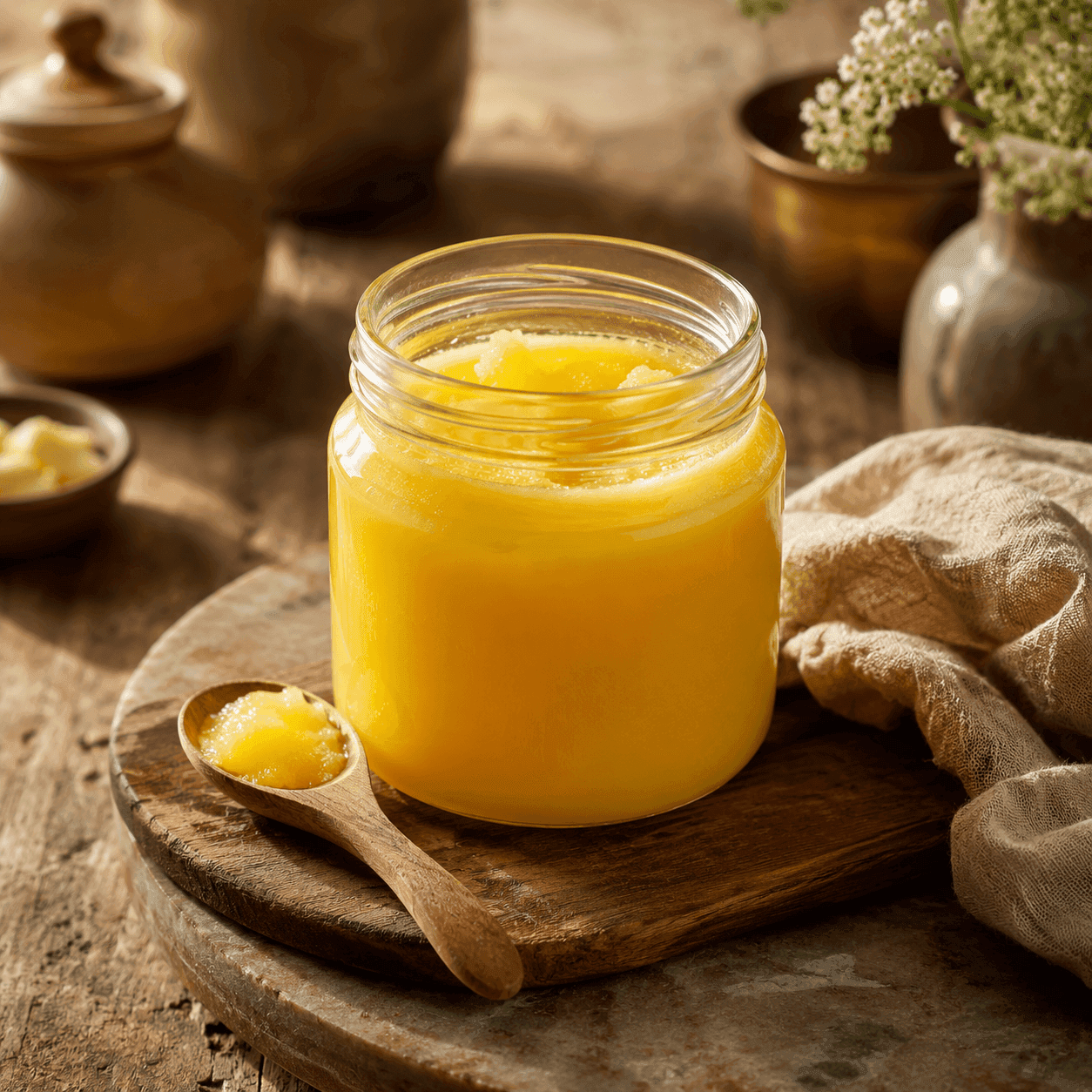
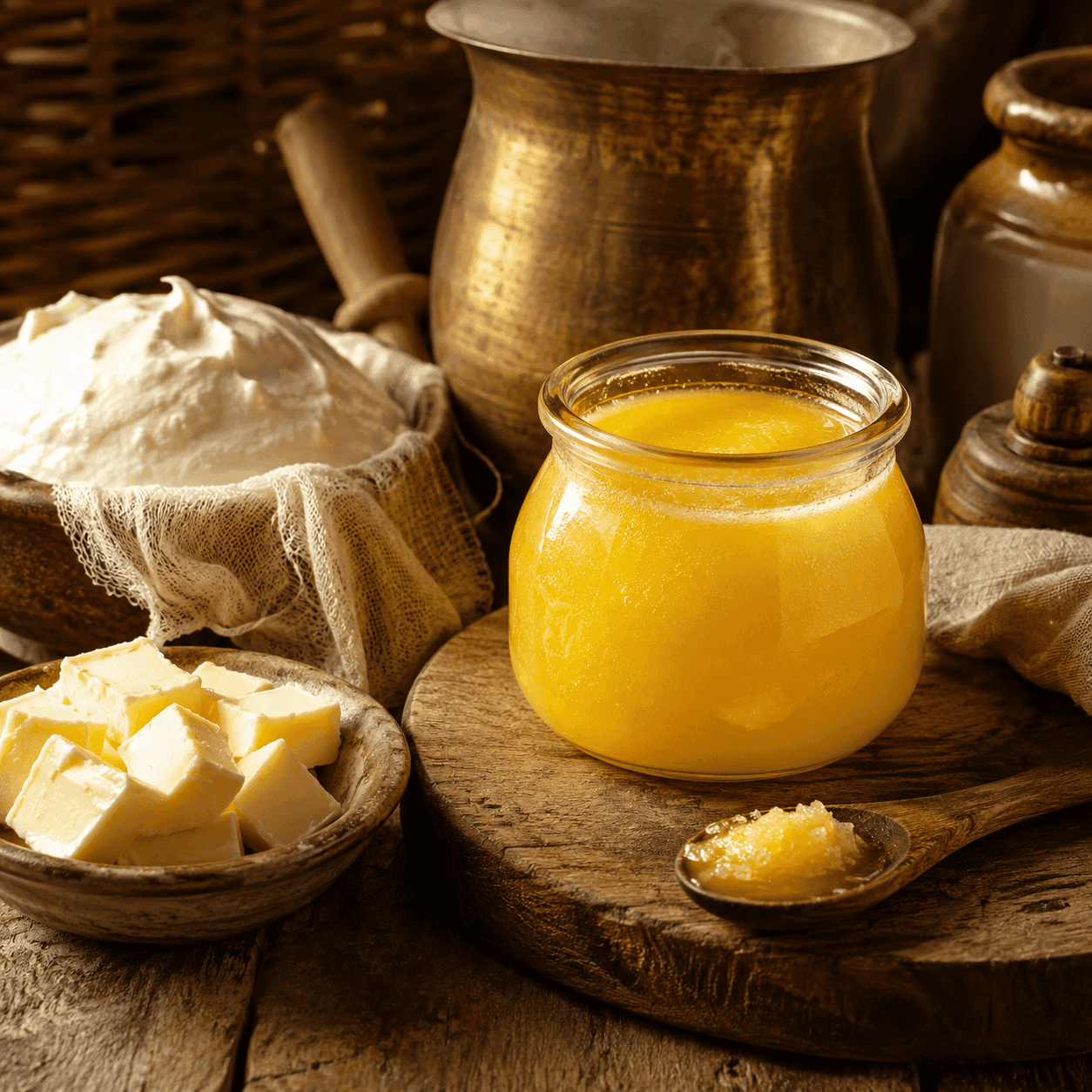
Ghee is butter with the water and milk solids removed. That’s the technical description. What it actually is — what 5,000 years of Indian cooking and Ayurvedic medicine recognized it as — is the form of dairy fat that the human body tolerates better than any other. Lactose is in the water phase of butter; casein and whey are in the milk solids. Take both of those out, and what’s left is pure butterfat, deeply golden, with a nutty aroma and a shelf life measured in months at room temperature.
This article is the case for keeping a jar of ghee next to your stove. The reasoning runs through what ghee actually is, why Ayurveda considered it medicinal, the lactose and casein question, the grass-fed argument, how to make it at home in twenty minutes, and the cooking applications where ghee outperforms butter and most other fats.
What ghee actually is
Start with butter. Butter is roughly 80% fat, 18% water, and 2% milk solids (a mix of proteins, lactose, and minerals). When you melt butter and hold it at a gentle heat, three things happen: the water boils off as steam, the milk solids separate — a foam rises to the top and a brown sediment sinks to the bottom — and what remains in the middle is clear, golden butterfat. Strain it, and you have ghee.
Clarified butter and ghee are sometimes used interchangeably, but they’re technically different. Clarified butter is butter with the water and solids removed at the moment they separate. Ghee is cooked further — the milk solids at the bottom are allowed to brown lightly before straining, which is what gives ghee its characteristic nutty, almost caramelized aroma. That browning is the Maillard reaction working on the proteins, and the resulting compounds are part of what makes ghee taste distinct from regular butter.
By composition, ghee is roughly 62% saturated fat, 29% monounsaturated fat, and 4% polyunsaturated, with the balance being water and trace solids. It carries fat-soluble vitamins A, D, E, and K2 from the original butter — concentrations that depend, again, on what the cow ate. It contains conjugated linoleic acid (CLA) and butyric acid, a short-chain fatty acid that’s the preferred fuel for the cells lining the colon.
What Ayurveda saw in it
In the Ayurvedic tradition, ghee occupies a category of its own. It’s not just food — it’s classified as a rasayana, a substance that rejuvenates and restores. The ancient texts describe it as enhancing digestion, sharpening memory, soothing the nervous system, and improving skin and complexion. It’s used as a carrier for herbal medicines on the reasoning that fat-soluble compounds penetrate the tissues more effectively when delivered in a fat.
That last point isn’t mystical — it’s pharmacology. Many medicinal plant compounds (curcumin from turmeric is the obvious example) are fat-soluble, and bioavailability improves substantially when they’re consumed with fat. The Ayurvedic practice of cooking turmeric in ghee before adding it to food is a 3,000-year-old version of the same intervention modern research validates when it tells you to take curcumin with a fatty meal.
Ayurveda also held that the age of ghee mattered — that ghee aged for months or years (stored properly, sealed, in a cool place) developed deeper medicinal properties. Modern science can’t really evaluate that claim. What modern science can evaluate is the stability claim: ghee, properly made and stored, does in fact resist rancidity for far longer than butter, lard, or most other animal fats. The water and protein removal eliminates the substrates microbes need to grow.
The lactose and casein question
This is the practical reason ghee matters for a lot of people who can’t tolerate dairy. Lactose is the sugar in milk — it sits in the water phase. Casein and whey are the two main protein groups — they sit in the milk solids. When you make ghee, you boil off the water (taking the lactose with it) and strain out the milk solids (taking most of the casein and whey with them).
The residual amounts of lactose and protein in a well- made ghee are very low — usually below the threshold that triggers symptoms for most lactose- intolerant or casein-sensitive people. This is not a guarantee. People with severe IgE-mediated milk allergy can sometimes still react to ghee, and clinical allergists generally recommend they avoid it. But for the much larger population that experiences digestive symptoms from milk — bloating, gas, the kind of low-grade inflammation that people often don’t even associate with dairy until they remove it — ghee is usually fine.
This is one of the reasons ghee shows up so prominently in dairy-free communities, paleo, Whole30, and AIP. It gives you back butterfat without the components most people react to.
Why grass-fed matters
The vitamin profile of ghee is downstream of the diet of the cow. Cows that eat grass for the entirety of their lives produce milk — and therefore butter, and therefore ghee — that is meaningfully richer in vitamin K2 (the menaquinone-4 form, which the cow converts from K1 in the grass), beta-carotene (the yellow tint you see in real grass-fed butter and ghee), conjugated linoleic acid, and omega-3 fatty acids.
Vitamin K2 is the one that matters most. It directs calcium into bones and teeth and away from arteries and soft tissue. Most Americans are functionally deficient in K2 because the modern food system has replaced the grass-fed animal fats that historically supplied it. Weston A. Price, the dentist who traveled the world in the 1930s documenting the diets of traditional cultures, identified what he called “Activator X” in the diets of healthy traditional populations — concentrated in grass- fed butter, fermented foods, and organ meats. We now know Activator X was K2.
Grass-fed ghee is one of the most concentrated dietary sources of K2 you can buy off a shelf. Feedlot ghee isn’t. The price difference is real but not enormous, and if you’re only going through one jar a month, the math works out.
How to make ghee at home
Making ghee is easier than rendering tallow and takes about twenty minutes of mostly passive attention. Start with two pounds of high-quality unsalted butter — Kerrygold, Vital Farms, or any grass-fed butter from your local farmer. Salted butter works in a pinch but the salt stays in the finished ghee, which isn’t always what you want.
Put the butter in a heavy-bottomed pot over medium-low heat. Let it melt completely, then turn the heat down. You’ll see three phases. First, the butter bubbles loudly as the water boils off — this takes five to ten minutes. The bubbling will slow and change pitch as the water phase finishes. Second, a white foam rises to the surface; this is whey proteins denaturing. Some recipes have you skim it; I leave it on, because it’s easier to strain at the end. Third, the milk solids settle to the bottom and start to brown — this is the ghee phase. You’ll smell the change: the butter aroma becomes nuttier, almost like toasted hazelnuts. The liquid in the pot becomes transparent and deep gold.
That’s the moment. Pull it off the heat. Let it sit for a few minutes, then strain through a fine mesh sieve lined with cheesecloth or a clean paper towel into clean glass jars. The browned solids collected in the strainer can be discarded or, if you’re ambitious, salted and sprinkled on vegetables. The strained ghee will be deeply golden and translucent. As it cools, it solidifies into a soft, spreadable consistency.
Store it at room temperature in a sealed jar away from light. It’ll keep for three to six months. In the fridge, indefinitely.
Where to start
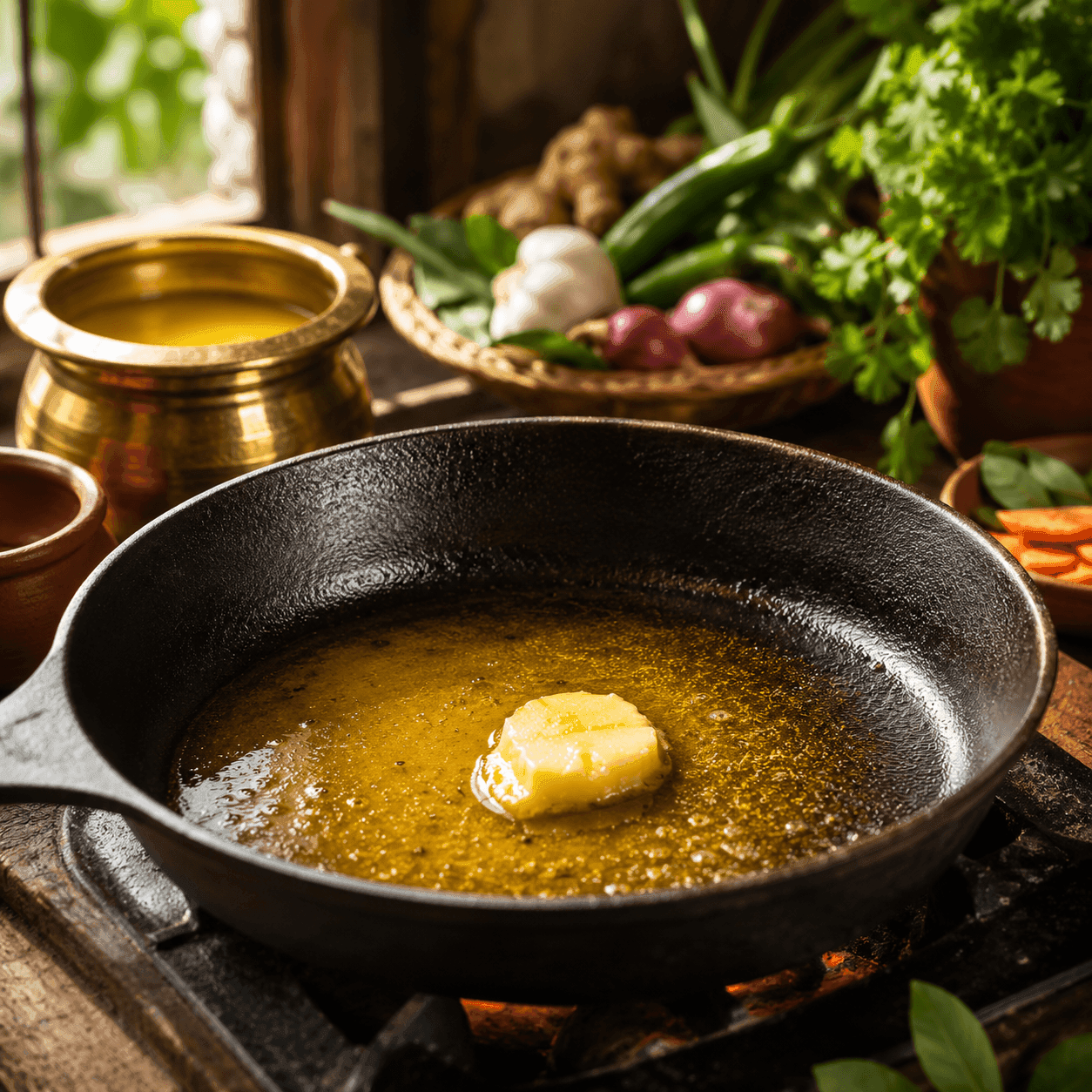
Ghee has a smoke point around 480°F, substantially higher than butter (around 350°F, because the milk solids are what burn first). This means ghee handles the searing and high-heat sautéing that butter can’t. For eggs in a hot pan, ghee gives you the butter flavor without the brown specks that come from milk solids burning. For roasting vegetables, ghee’s flavor is more complex than tallow and pairs differently with sweeter root vegetables — carrots, parsnips, sweet potatoes — in a way many cooks prefer.
For anything Indian or Middle Eastern — dal, curry, basmati rice, flatbreads — ghee is the authentic fat and the result is genuinely different from the same dish made with butter or olive oil. A spoonful of ghee stirred into a finished dal lifts the flavor and the spice penetration in a way that substitutes can’t replicate.
One small habit: a teaspoon of ghee stirred into coffee or tea in the morning, often with a small amount of MCT oil, is the simplified Bulletproof- coffee idea. You don’t need to blend it — stirring works fine. The fat slows caffeine absorption slightly and gives you a longer, smoother lift instead of the spike-and-crash that black coffee can produce on an empty stomach.
Products I’d recommend
If you can make it at home, do that — it’s cheaper and the quality is whatever the quality of your starting butter is. For commercial ghee, the options below are all from grass-fed cows and made without seed oil contamination.
Ancient Organics Grass-Fed Ghee is the one I keep coming back to. Made in small batches from California grass-fed butter, cooked on full moons (a traditional Ayurvedic practice that doesn’t make a measurable difference but doesn’t hurt anything either), and tastes cleaner than most of what’s on the shelf.
Pure Indian Foods Grass-Fed Cultured Ghee is family-run, five generations of ghee makers, and uses cultured butter as the starting point. Cultured means the cream was fermented before churning, which develops more complex flavor compounds and pushes the ghee toward the deeper, tangier profile traditional Indian ghee has.
4th & Heart Original Grass-Fed Ghee is the brand most likely to show up in a regular grocery store. Grass-fed New Zealand butter, reliable quality, and they make a number of infused varieties (garlic, vanilla, Himalayan pink salt) that are useful as finishing fats.
Organic Valley Purity Farms Ghee is the accessible, mid-priced option in most natural grocery stores. Organic, grass-fed, USDA certified. Not quite as flavorful as the small-batch options but substantially better than feedlot ghee and easier to find.
Bulletproof Grass-Fed Ghee comes from the same lineage as Bulletproof coffee — third-party tested for purity, grass-fed New Zealand sourcing. Premium price, but the testing standards are real.
The bottom line
Ghee is the form of dairy fat that 5,000 years of Ayurvedic medicine identified as the most medicinal and the most digestible. It removes the components of butter that most people react to, concentrates the fat-soluble vitamins that grass-fed dairy supplies, and tolerates high-heat cooking in a way butter can’t. It’s shelf-stable for months. It tastes better than butter on most things and gives you back access to a category of cooking — Indian, Middle Eastern, North African — that requires it to taste right.
Buy it grass-fed. Make it yourself when you have twenty minutes. Keep a jar on the counter. Use it for roasting, sautéing, eggs, and finishing.
Sources & further reading
Vitamin K2 and grass-fed dairy
- Geleijnse JM, Vermeer C, Grobbee DE, et al. Dietary intake of menaquinone is associated with a reduced risk of coronary heart disease: the Rotterdam Study. Journal of Nutrition. 2004;134(11):3100-5.
- Beulens JW, Bots ML, Atsma F, et al. High dietary menaquinone intake is associated with reduced coronary calcification. Atherosclerosis. 2009;203(2):489-93.
- Price WA. Nutrition and Physical Degeneration. 1939 — original documentation of grass-fed butterfat as a source of what we now know is vitamin K2.
Saturated fat reassessment
- Astrup A, Magkos F, Bier DM, et al. Saturated fats and health: a reassessment and proposal for food-based recommendations. Journal of the American College of Cardiology. 2020;76(7):844-857.
- Siri-Tarino PW, Sun Q, Hu FB, Krauss RM. Meta-analysis of prospective cohort studies evaluating the association of saturated fat with cardiovascular disease. American Journal of Clinical Nutrition. 2010;91(3):535-46.
Ayurvedic tradition and books
- Lad V. The Complete Book of Ayurvedic Home Remedies. Three Rivers Press, 1999 — standard reference for ghee as rasayana.
- Caraka Samhita. Classical Ayurvedic text (c. 1st millennium BCE) — describes ghee preparation, aging, and clinical uses.
- Fallon S, Enig MG. Nourishing Traditions. NewTrends Publishing, 2001 — Western nutritional case for grass-fed butterfat and ghee.