
Health · Whole Food · ~9 min read
Ginger — inflammation, digestion, circulation, in one rhizome.
Why ginger is the most reliable anti-nausea food in the world, how it works on joint pain like a gentler NSAID, and what to do with it daily.
By George Hinestrosa · Personal experience & independent research
Ginger is the kind of food that mainstream medicine has never been able to dismiss because the effects are too obvious to deny. It stops nausea. It eases joint pain. It improves digestion. It warms cold hands. It lowers blood sugar. It does most of what an over-the-counter anti-inflammatory does and a few things they can’t, with a safety profile that’s essentially unblemished after several thousand years of human use across China, India, the Mediterranean, the Middle East, and most of Africa.
What sits underneath it is a small family of compounds — gingerols, shogaols, zingerone — that modulate inflammation, calm the vagus nerve, improve blood flow, and act on receptors mainstream pharmacology has only recently characterized.
Gingerols and shogaols
Fresh ginger contains gingerols — mainly 6-gingerol, the compound responsible for most of fresh ginger’s pungency. When ginger is dried or heated, gingerols undergo a dehydration reaction and convert to shogaols, which are more pungent and, for several effects (anti- inflammatory, anti-cancer, anti-emetic), more potent.
Cooked or dried ginger is therefore not weaker than fresh — it’s a different compound profile. Fresh ginger is best for the bright pungency and certain digestive effects; dried and cooked ginger delivers stronger anti-inflammatory and anti-nausea action through shogaols. The traditional cuisines that use both forms (Indian, Chinese, Caribbean) get the full spectrum.
A third compound, zingerone, forms when ginger is cooked at higher temperatures. It’s less pungent, sweeter, and contributes to the warming flavor of long-cooked ginger dishes.
The nausea story — what ginger does best
If ginger had only one well-documented effect, it would be its action on nausea. The evidence base here is unusually strong — multiple meta-analyses across different populations have confirmed substantial benefit:
- Morning sickness / pregnancy nausea. The clearest evidence base. 1–1.5 grams of ginger per day (usually divided into smaller doses) reduces nausea and vomiting in early pregnancy roughly as well as the prescription antihistamines typically offered, with no documented harm to the pregnancy. Several obstetric practices now recommend ginger as the first-line intervention.
- Motion sickness. A 1–2 gram dose 30–60 minutes before travel substantially reduces nausea in car, boat, and air travel. As effective as Dramamine in head-to-head trials, without the sedation.
- Chemotherapy-induced nausea. Adjunctive ginger reduces nausea severity and frequency in patients on chemotherapy regimens. Documented in multiple controlled trials.
- Post-operative nausea. 1 gram of ginger 30 minutes pre-op reduces the incidence of post-anesthesia nausea by roughly 50% in the cleanest trials.
- General digestive upset. The everyday cup of ginger tea for an unsettled stomach has the same mechanism — the gingerols and shogaols act on serotonin receptors in the gut and vagus nerve pathways that drive nausea signaling.
Anti-inflammatory action — the gentle NSAID
Gingerols and shogaols inhibit COX-2, the enzyme that produces inflammatory prostaglandins — the same target as ibuprofen, naproxen, and the rest of the NSAID family. The difference is that NSAIDs hit both COX-1 and COX-2, which is why long-term use damages the stomach lining and stresses the kidneys. Ginger selectively favors COX-2 inhibition without the COX-1 collateral damage.
Clinical effects that follow:
- Osteoarthritis. Multiple trials have documented modest but reliable pain reduction in knee and hip osteoarthritis with 2–4 grams of ginger daily. The effect builds over weeks; it’s not an acute-relief drug.
- Muscle soreness after exercise. 2 grams of ginger daily reduces delayed-onset muscle soreness (DOMS) by roughly 25% in clinical trials.
- Menstrual pain. 1–2 grams daily during the first three days of menstruation is comparable to ibuprofen for cramps in head-to-head trials. No GI side effects.
- Migraine. 250 mg of ginger powder at headache onset has been compared favorably to sumatriptan in at least one trial, with fewer side effects.
- Systemic inflammation. Daily ginger lowers inflammatory markers (CRP, IL-6, TNF-alpha) in clinical trials — useful as part of a broader anti-inflammatory protocol.
Digestion — beyond nausea
Ginger’s digestive effects extend past anti-nausea. It speeds gastric emptying (food moves through the stomach faster), reduces bloating, supports bile flow, and has mild antimicrobial action against several gut pathogens including H. pylori.
Practical applications:
- A cup of ginger tea before meals supports digestion for people prone to bloating or feeling full early.
- A 1-inch piece of fresh ginger, sliced thin and chewed, before a heavy meal serves the same function.
- Pickled ginger (gari, the Japanese sushi accompaniment) traditionally clears the palate between dishes and supports digestion of the meal.
- Ginger tea after meals reduces post-meal heaviness and bloat for many people.
Circulation — the warming effect
Traditional medicine across cultures classifies ginger as a “warming” herb. In modern terms, that translates to improved peripheral circulation. Ginger mildly dilates peripheral blood vessels, improves blood flow to the extremities, and has a slight antiplatelet effect that further supports circulation.
For people who run cold — cold hands, cold feet, poor circulation in winter — daily ginger is one of the simplest reliable interventions. The effect is subjective and modest individually, but consistent over time.
The same circulatory action helps with cold and flu recovery — ginger tea induces mild sweating (diaphoresis), which traditional medicine considered useful for “moving” an early-stage cold. Modern interpretation: improved peripheral blood flow supports immune-cell distribution and metabolic clearance of the infection.
Blood sugar
A growing literature documents ginger’s effect on insulin sensitivity and fasting blood glucose. The cleanest recent trial (Khandouzi et al., 2015) found that 3 grams of ginger powder daily for 12 weeks reduced fasting blood sugar by 12% and HbA1c by roughly 10% in type 2 diabetic patients.
The mechanism appears to involve improved insulin receptor sensitivity plus reduced glucose absorption in the gut. Ginger isn’t a replacement for the broader metabolic protocol — carbs, sleep, exercise, magnesium, chromium — but it’s a useful addition.
Forms
- Fresh ginger root. The everyday form. Highest gingerols, brightest flavor. Sliced into tea, grated into food, juiced with vegetables, candied at home. Stores 2–3 weeks in the refrigerator, longer in the freezer (grates easily from frozen).
- Dried / powdered ginger. Concentrated shogaols. Stronger anti-inflammatory and anti-nausea action per gram than fresh. Use in baking, in spice blends, in capsule form. Buy whole dried slices and grind as needed for maximum potency.
- Crystallized ginger. Candied with sugar. Less potent per gram (the sugar dilutes), but a remarkably convenient form for travel — chew a piece at the first sign of motion sickness or nausea. The Ginger People brand is the standard.
- Pickled ginger (gari). Vinegar-pickled fresh ginger, traditional in Japanese cuisine. Retains gingerols, easy on the stomach, the vinegar adds gut-friendly action. Eat with sushi or alongside meals as a daily digestive aid.
- Ginger essential oil. Topical use only. Diluted in a carrier oil (jojoba, coconut), applied to joints or sore muscles, the warming and anti-inflammatory action is local and real. Not for internal use.
- Standardized ginger extract. Capsules standardized to specific gingerol / shogaol percentages. Useful for clinical-dose protocols (osteoarthritis, migraine) when eating 3–4 grams of fresh ginger daily isn’t practical.
Traditional pairings
- Ginger + turmeric. The two most powerful anti-inflammatory rhizomes, traditionally combined across Indian and Southeast Asian cuisines. Synergistic action on inflammatory pathways. The base of many golden milk recipes.
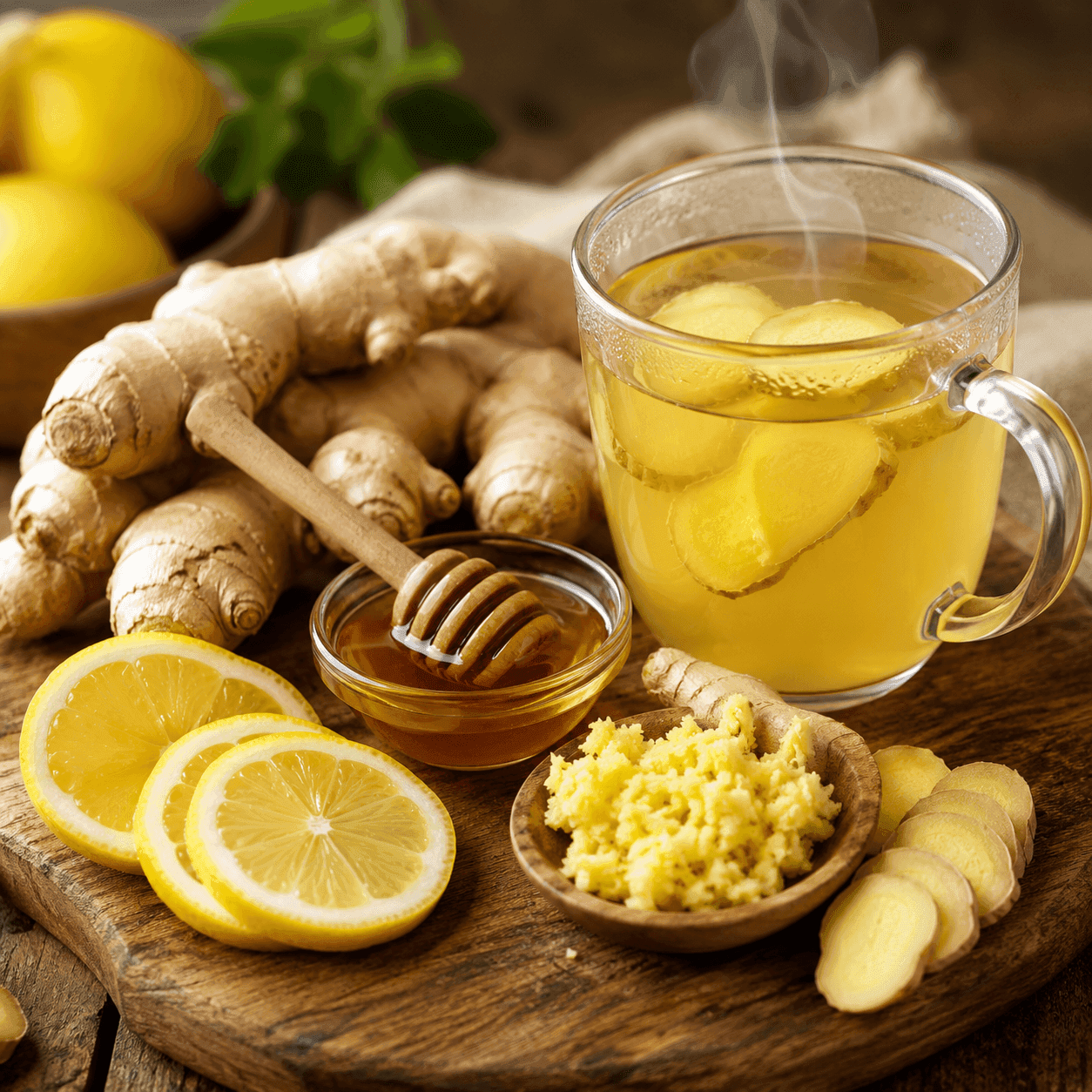
- Ginger + lemon + raw honey. The classic cold remedy. Each ingredient contributes real antimicrobial and supportive action; combined in hot water as a tea, the effect is greater than any one alone.
- Ginger + cinnamon. Blood-sugar support and warming combination. Often taken together in morning tea for metabolic and circulatory support.
- Ginger + garlic. The base of most South and East Asian cooking; both are immune-supportive, anti-inflammatory, and cardiovascular-protective. The everyday culinary version of an immune stack.
Ginger in pregnancy
Worth its own note because the evidence base is unusually strong: ginger at doses up to 1 gram per day is one of the most thoroughly studied interventions for morning sickness, and the trials consistently show it’s effective and safe. Several systematic reviews have concluded it’s comparable to the prescription antihistamines (Diclegis/Bonjesta) typically offered for severe morning sickness.
Practical: 250 mg four times daily, or 500 mg twice daily, of dried ginger or standardized extract. Or equivalent in fresh ginger tea. Doses above 1 gram per day in pregnancy don’t have the same depth of evidence and should be discussed with a practitioner, but the foundational 1 g/day dose is well-validated.
Where I buy ginger
Fresh ginger root from any reasonable grocery store. Look for firm rhizomes with smooth, taut skin — wrinkled skin means the ginger is past its prime. Buy organic when possible; non-organic ginger has higher pesticide residues than most root vegetables.
Storage: refrigerator in a paper bag (paper, not plastic — ginger needs to breathe), or in the freezer wrapped tightly. Frozen ginger grates beautifully and retains most of its compounds.
- Pure Encapsulations Ginger Extract — standardized to 5% gingerols, clean formulation. The capsule form for clinical-dose anti-inflammatory or pregnancy-nausea use.
- NOW Foods Ginger Root, 550 mg — budget-friendly capsule form, whole-root powder. Useful for motion sickness travel kits.
- Frontier Co-op Organic Ginger Powder — organic, fresh-tasting bulk powder for cooking and tea. The pantry staple.
- The Ginger People Crystallized Ginger — for travel, motion sickness, and as the easiest portable form. Australian-grown ginger, clean ingredients.
Where to start
Ginger tea makes an easy morning baseline — a 2-inch piece of fresh ginger sliced into hot water with a squeeze of lemon and a teaspoon of raw honey, steeped 10 minutes. The morning version sets up digestion for the day.
From there, fresh ginger grates into stir-fries, soups, and marinades for daily use; pickled gari turns up at sushi meals; and crystallized ginger is a handy thing to keep in a carry-on for flights.
For acute issues, 1–2 grams of dried ginger powder mixed in water helps with menstrual pain, joint flares, or the early signs of illness. Standardized extract capsules deliver a clinical-trial dose without the cooking.
Closing
Ginger is one of the highest-leverage daily foods in the traditional medicine repertoire. It does five things reliably — nausea, inflammation, digestion, circulation, blood sugar — and it does them with a safety profile that makes it appropriate for nearly anyone, including pregnant women.
Eat it. Drink it. Grate it into your cooking. Keep dried ginger in the spice cabinet and fresh ginger in the refrigerator. The rhizome does its work quietly, every day, for the people who let it.
Sources & further reading
Studies cited
- Viljoen, E. et al. (2014). A systematic review and meta-analysis of the effect and safety of ginger in the treatment of pregnancy-associated nausea and vomiting. Nutrition Journal. — The standard meta-analysis on ginger and morning sickness; effective, safe at doses ≤1 g/day.
- Khandouzi, N. et al. (2015). The effects of ginger on fasting blood sugar, hemoglobin A1c, apolipoprotein B... in type 2 diabetic patients. Iranian Journal of Pharmaceutical Research. — 3 g/day of ginger powder for 12 weeks lowered fasting glucose by ~12% and HbA1c by ~10% in type 2 diabetics.
- Black, C.D. et al. (2010). Ginger reduces muscle pain caused by eccentric exercise. The Journal of Pain. — Documented the DOMS-reducing effect of 2 g/day ginger.
- Maghbooli, M. et al. (2014). Comparison between the efficacy of ginger and sumatriptan in the ablative treatment of the common migraine. Phytotherapy Research. — Head-to-head trial of 250 mg ginger powder vs. sumatriptan for migraine; comparable efficacy, fewer side effects.
Authorities & further reading
- NutritionFacts.org — ginger video archive — Dr. Michael Greger’s curated review of the published ginger literature.
- Linus Pauling Institute Micronutrient Information Center — Ginger — Standard biochemistry reference on gingerols, shogaols, and zingerone.
- Ginger: The Ancient Remedy — Paul Schulick — Book-length traditional and clinical overview of ginger’s applications.