

Health · Mineral · ~13 min read
Iodine — the mineral modern medicine forgot.
What Dr. Mark Sircus has been saying for thirty years, what Dr. David Brownstein has measured in five thousand patients, and what most of us are running on empty without realizing.
By George Hinestrosa · Personal experience & independent research
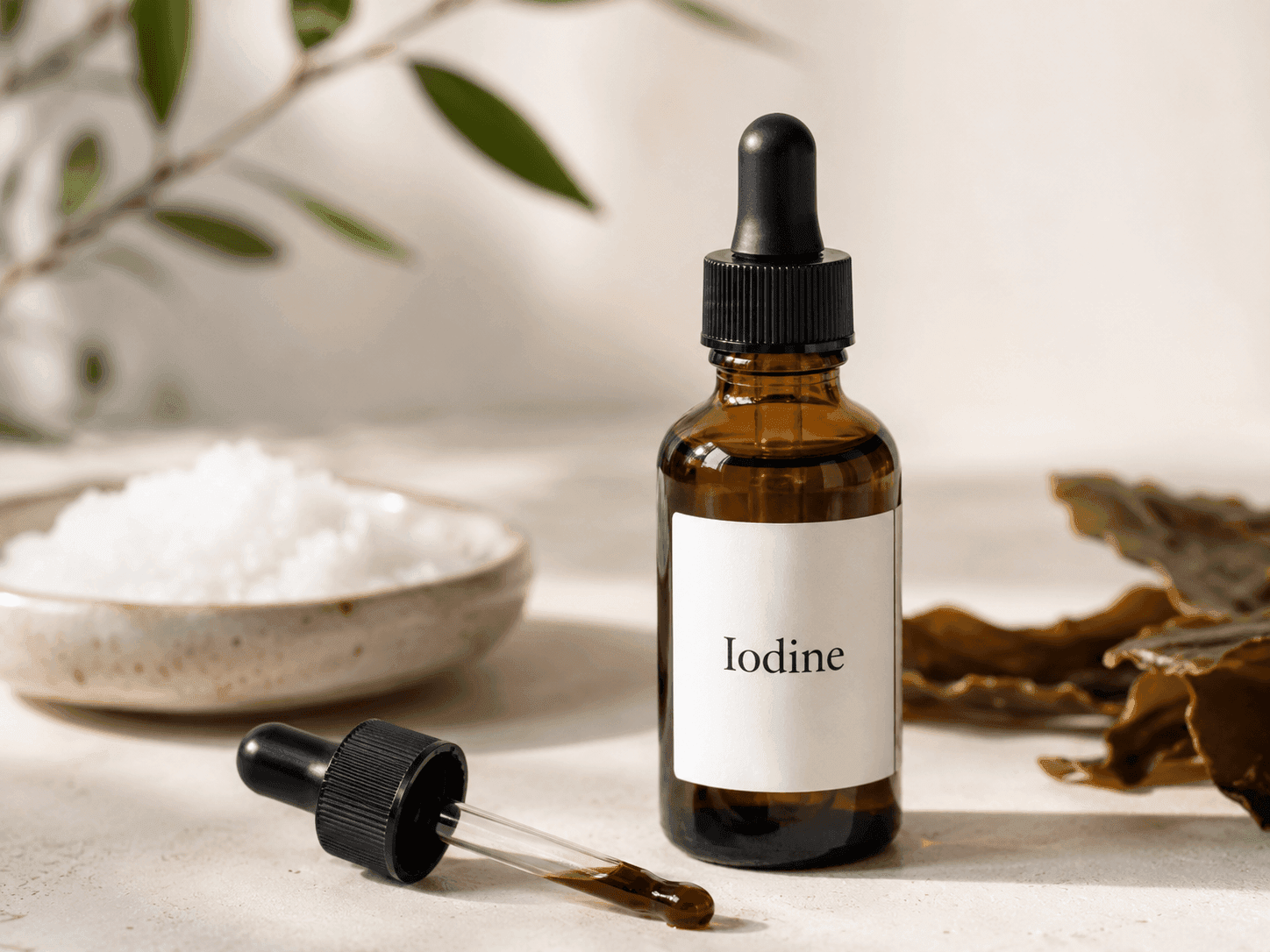

Of all the mineral deficiencies running underneath the modern epidemic of fatigue, hormonal dysfunction, weight gain, foggy thinking, and the steady creep of breast, prostate, and thyroid disease — iodine is the one mainstream medicine has decided isn’t worth measuring.
The RDA for iodine is 150 micrograms per day. That’s the dose that prevents goiter — visible swelling of the thyroid — in a population that hasn’t seen real dietary iodine in two generations. It’s the dose that keeps your neck from getting bigger. It is not the dose that saturates the tissues that actually need iodine, and there are more of those than you might think.
Iodine receptors aren’t just in the thyroid. They’re in the breasts, the ovaries, the prostate, the stomach lining, the eyes, the salivary glands, the bones, every endocrine gland, and (in significant concentrations) the brain. The thyroid uses iodine to make hormones. Every other organ uses iodine for something — and most of them have been running on empty for decades.
Dr. Mark Sircus has been writing about this since the early 2000s, primarily through drsircus.com. His framing is consistent: iodine is the universal medicine that modern industrial food and modern industrial water have systematically removed from the human diet, and most modern disease can be traced to that removal plus the displacement of the iodine that remains.
The halide displacement problem
Iodine sits in the periodic table next to three other elements: fluorine, chlorine, and bromine. They’re chemically similar enough that the body’s iodine receptors don’t tell them apart. If iodine isn’t available, the receptor accepts whichever halide is.
That’s the problem. The other three halides are everywhere.
Bromide is in brominated flour (most commercial bread until the 1980s, still common today), brominated vegetable oil (BVO, in many citrus sodas until recently — the FDA finally banned it in 2024, decades after Europe), brominated flame retardants in mattresses, carpets, electronics, and pesticides. Bromide accumulates in tissue. It doesn’t have a known biological function in humans, but it occupies iodine receptors and competes for the small amount of iodine the body does manage to get.
Fluoride is in municipal water in most of the United States, in toothpaste, in many SSRI medications, in non-stick cookware. Same story — competes for the same receptors.
Chloride is the least problematic of the three because the body does use chloride functionally (stomach acid, electrolyte balance). But it still occupies iodine receptors at the margins.
The result is a population running on chronically suppressed iodine signaling, with two halides actively interfering. Dr. David Brownstein — a clinician who’s tested upwards of five thousand patients for iodine status — has reported for years that more than 95% of the people walking through his door are deficient. That number tracks across the alt-health iodine literature.
Mainstream medicine doesn’t test for iodine because, by the metric that matters to mainstream medicine, almost everyone has enough. The metric mainstream uses is “do you have a goiter.” The metric Sircus and Brownstein use is “are your tissues saturated.” These produce very different answers.
What iodine does in the body
Thyroid hormone is the headline. T4 is four iodine atoms wrapped around a tyrosine. T3 is three. Without iodine, the thyroid cannot make either, and the entire metabolism slows — energy down, weight up, body temperature down, mood down, hair thinner, cycle disrupted, libido gone.
That’s just the thyroid. Iodine also:
- Protects breast tissue. Cystic and fibrocystic breast changes correlate strongly with iodine deficiency. Brownstein has written extensively about reversing fibrocystic disease with iodine alone in many cases.
- Supports ovarian function. The ovaries concentrate iodine almost as aggressively as the thyroid does, and ovarian cysts often respond to iodine supplementation.
- Maintains prostate health. The prostate is another high-iodine-uptake gland. Benign prostatic hyperplasia and prostatitis sit in the same family of iodine-deficient conditions.
- Acts as an antimicrobial in the stomach lining and respiratory tract. Iodine kills bacteria, viruses, and fungi on contact — which is why it’s been used as a topical antiseptic for over a century.
- Supports neurological development and cognition. Iodine deficiency in pregnancy is the leading preventable cause of cognitive impairment globally.
- Mobilizes and helps excrete heavy metals — particularly mercury and lead, in conjunction with selenium.
Modern medicine treats most of these conditions one at a time, with different drugs, different specialists, different bills. Sircus’s frame is that they’re often the same condition: insufficient iodine signaling in tissues that need it.
What deficiency looks like
Here’s what iodine deficiency looks like in a person who’s never been diagnosed with anything specific:
- Cold hands and feet, low body temperature
- Fatigue that sleep doesn’t fix
- Brain fog, slower recall, the feeling that thinking is harder than it used to be
- Hair thinning, dry skin, brittle nails
- Weight gain that doesn’t respond to the usual diet-and-exercise interventions
- Cystic breasts in women, BPH in men
- Irregular cycles, heavy or painful periods
- Mood low without obvious cause
- The sense that something is off but the bloodwork is “normal”
That last one is the giveaway. Standard thyroid bloodwork is TSH, sometimes free T4, occasionally free T3, almost never reverse T3 or thyroid antibodies. None of those measure iodine directly. A person can be profoundly iodine-deficient with bloodwork that reads as “fine.”
If you want an actual measure of iodine status, the test is the 24-hour iodine loading test — you take a 50 mg dose and collect urine for 24 hours to see what percentage of the dose you excrete. A saturated body excretes 90%+. A deficient body holds onto most of it. Hakala Research Laboratories, Doctor’s Data, and ZRT Laboratory all run this test. Most regular doctors have never heard of it.
Dosing — how Sircus thinks about it
The RDA is 150 mcg. Sircus, Brownstein, and Guy Abraham — the physician who reconstructed the iodine protocol in the 1990s based on the original work of Jean Lugol — all agree the optimal whole-body dose sits in the range of 12.5 to 50 milligrams per day. Roughly 80 to 330 times the RDA.
That number scares people who weren’t expecting it. It scared mainstream medicine into ignoring the protocol entirely. But the dose has historical backing. Pre-1948, doctors in the United States routinely prescribed Lugol’s solution at doses in this range, and Japan’s average daily iodine intake from seaweed has been estimated at 1–13 mg per day for generations — with corresponding rates of breast, prostate, and thyroid disease that are a fraction of American rates.
There are two practical forms most people use:
- Iodoral — a tablet form of Lugol’s solution. Each tablet is 12.5 mg total (5 mg iodine + 7.5 mg potassium iodide). Tasteless, convenient, easy to dose precisely.
- Lugol’s solution 2% — a liquid, most commonly J. Crow’s brand. Each drop is roughly 2.5 mg iodine + iodide. Cheaper, more flexible dosing, but you have to put up with the taste (it’s metallic).
A reasonable loading protocol, following Brownstein’s clinical approach:
- Week 1–2: Start at one Iodoral (12.5 mg) per day, or 5 drops of Lugol’s 2%. Take it in the morning with food.
- Add the cofactors below in week one before raising the dose.
- Week 3+: Increase to 25 mg per day if tolerated. Some practitioners go to 50 mg for the loading phase.
- Stay at the loading dose for 3–6 months, then drop to a maintenance dose of 6.25–12.5 mg per day.
- Re-test with a loading test at 6 months.
Cofactors — what makes the protocol work
Iodine alone is not the protocol. The protocol is iodine plus a stack of cofactors the body needs to use it properly. Skip them and you can run into trouble. Include them and the protocol is forgiving.
- Selenium — 200 mcg per day, as selenomethionine or from two Brazil nuts. Selenium is required for the enzymes that convert T4 to T3 and for the antioxidant system that protects the thyroid during iodine repletion. Brownstein lists selenium as the single most important cofactor.
- Magnesium — 300–600 mg per day, ideally as glycinate, malate, or transdermal. Magnesium runs more than 300 enzymatic reactions, several of which intersect with thyroid function and detoxification pathways.
- Vitamin C — 1,000–3,000 mg per day, in divided doses. Vitamin C supports the detoxification of bromide as iodine displaces it from receptors. Without enough vitamin C, the bromide detox phase is harder than it needs to be.
- Unrefined salt (sea salt, Himalayan, Celtic) — 1/2 teaspoon per day in water, or generously on food. Sodium and chloride are required for adrenal function and for the mobilization of bromide. Mainstream salt restriction has done damage here.
- B-complex with B2 and B3 — riboflavin and niacin in particular support iodine utilization. A quality B-complex covers this.
That stack — iodine plus selenium plus magnesium plus vitamin C plus salt plus B-complex — is the iodine protocol. Iodine alone isn’t.
The bromide detox question
When you start iodine, you may feel worse before you feel better. That’s the most common reason people quit the protocol on day five and go on the internet to write that iodine made them sick.
What’s actually happening: iodine is displacing bromide from receptors and pulling it out of tissue storage. Bromide is toxic. As it mobilizes, you feel it — headaches, brain fog, body aches, mood dips, a metallic taste, sometimes acne or a rash. These are bromide detox symptoms, not iodine toxicity symptoms.
The way through is to support the elimination. Salt water (the sea salt cofactor above) helps the kidneys excrete mobilized bromide. Vitamin C helps. Magnesium helps. If symptoms are sharp, drop the iodine dose temporarily, hold the cofactors, ride it out, and ramp back up.
Sircus has written that the bromide detox response is, paradoxically, evidence that the protocol is working. The bromide load people are carrying is real, and getting rid of it takes time.
Where I buy iodine
Two products cover most of the practical territory.
- Iodoral 12.5 mg, 90 tablets (Optimox) — tasteless, convenient, easy to titrate. Made by the company Guy Abraham co-founded specifically to produce the original iodine protocol formulation. The most commonly recommended starting product.
- J. Crow’s Lugol’s Solution 2%, 2 oz — liquid form, taste is metallic but tolerable in water or juice, 2.5 mg per drop, lasts months. Cheaper per milligram than Iodoral.
- For higher dosing during loading, J. Crow’s Lugol’s 5% gives roughly 6.25 mg per drop. Same brand, same reliability.
Skip kelp tablets and seaweed capsules as your primary iodine source if you’re trying to reach therapeutic doses. They’re useful as dietary iodine — eat seaweed when you can — but doses are inconsistent, and contamination with heavy metals from oceanic pollution has become a real concern.
Where to start
A common loading stack looks like this: 12.5 mg of Iodoral with breakfast; 200 mcg of selenium at the same time (or two Brazil nuts on the days they’re on hand); 1,000 mg of vitamin C with the iodine and another 1,000 mg later in the day; half a teaspoon of unrefined Celtic salt dissolved in 16 oz of water midmorning; magnesium glycinate at night; and a B-complex with breakfast.
That’s the daily protocol the iodine literature has converged on. Kept up consistently, the commonly reported effects are better body composition, deeper sleep, steadier mood, and sharper thinking; let it lapse for a few weeks and the difference is usually felt. That has been the consistent feedback across the iodine community for two decades.
Closing
Iodine is the kind of mineral that doesn’t make headlines because it doesn’t generate a patent. There’s no proprietary molecule, no blockbuster drug, no pharmaceutical incentive to study it at the doses that actually saturate the body. The protocol has been carried forward by a handful of clinicians — Abraham, Brownstein, Sircus, Farrow — and the patients who experienced it working.
If you’ve been told your thyroid panel is normal but you feel like everything I described in the deficiency section, get the iodine loading test done. Look at the result. Read Brownstein’s book or Sircus’s. Decide for yourself whether the protocol is worth running.
The mineral hasn’t gone anywhere. It’s still on the periodic table. The body still wants it. The only thing that’s changed is whether we’re getting it.
Sources & further reading
Authorities cited
- Dr. Mark Sircus — International Medical Veritas Association. The primary voice on iodine, magnesium, and halide displacement in the alt-health literature.
- Dr. David Brownstein — Family physician in West Bloomfield, MI. Tested several thousand patients for iodine status; standard reference on clinical use.
- Dr. Guy Abraham (1933–2013) — Co-founder of Optimox; reconstructed the iodine protocol from Lugol's original work in the 1990s.
- Lynne Farrow — Author and patient-advocate; documented the modern iodine-deficiency story for general audiences.
Books & reading
- Iodine: Why You Need It, Why You Can't Live Without It — David Brownstein, MD — The standard clinical reference. Start here if you only read one.
- Iodine: Bringing Back the Universal Medicine — Mark Sircus — Sircus's full case for iodine, in his own voice.
- The Iodine Crisis — Lynne Farrow — Accessible patient-side account of the protocol and the deficiency epidemic.
Testing
- Hakala Research Laboratories — 24-hour iodine loading test by mail.
- Doctor's Data — Also runs the iodine loading panel.
- ZRT Laboratory — Iodine + cofactor testing.