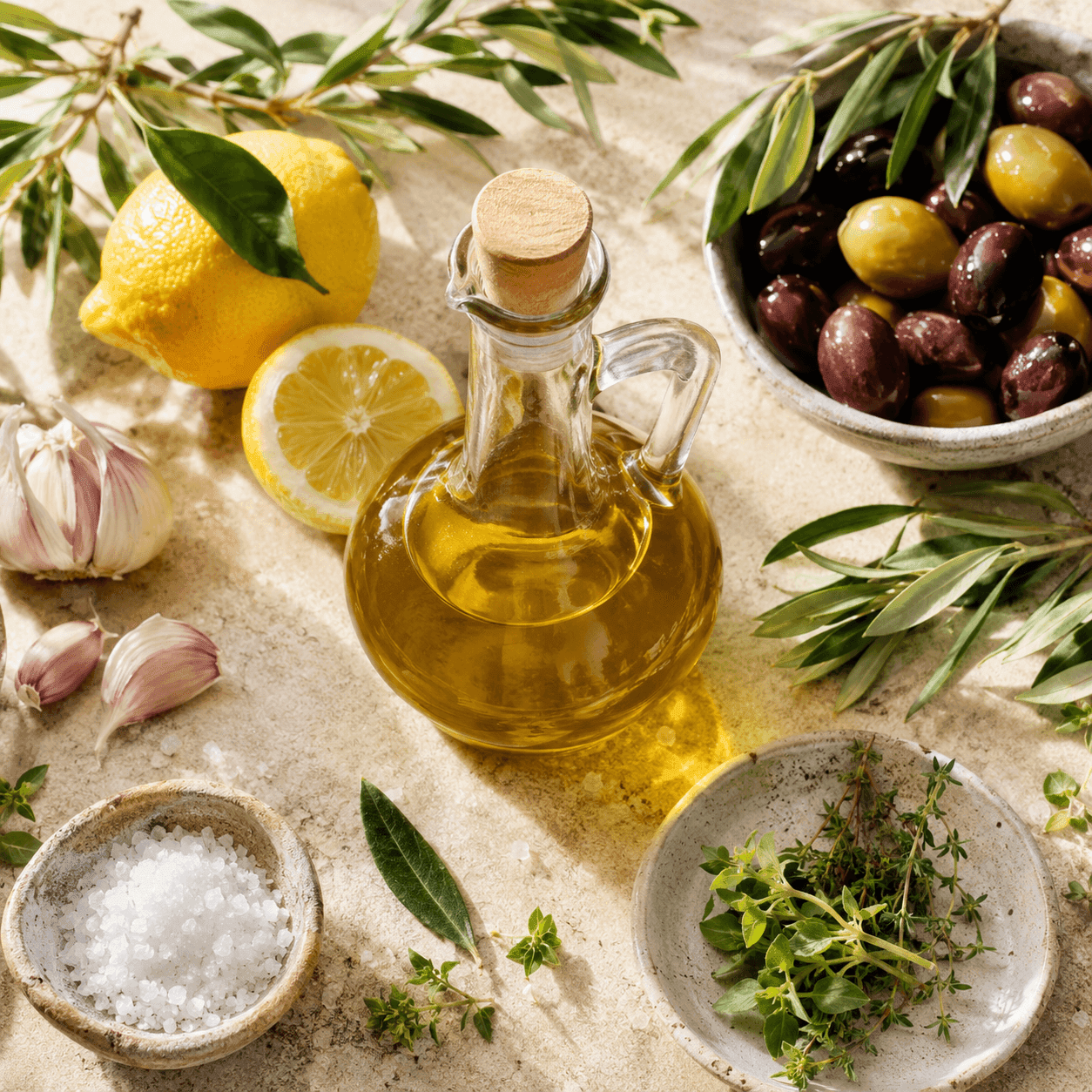

Health · Fat · ~12 min read
Olive oil — and why most supermarket olive oil is fake.
Why 60–70% of “extra virgin” on American shelves fails the standards, what real cold-pressed olive oil actually delivers, and the pepper-throat test that tells you whether you got the real thing.
By George Hinestrosa · Personal experience & independent research
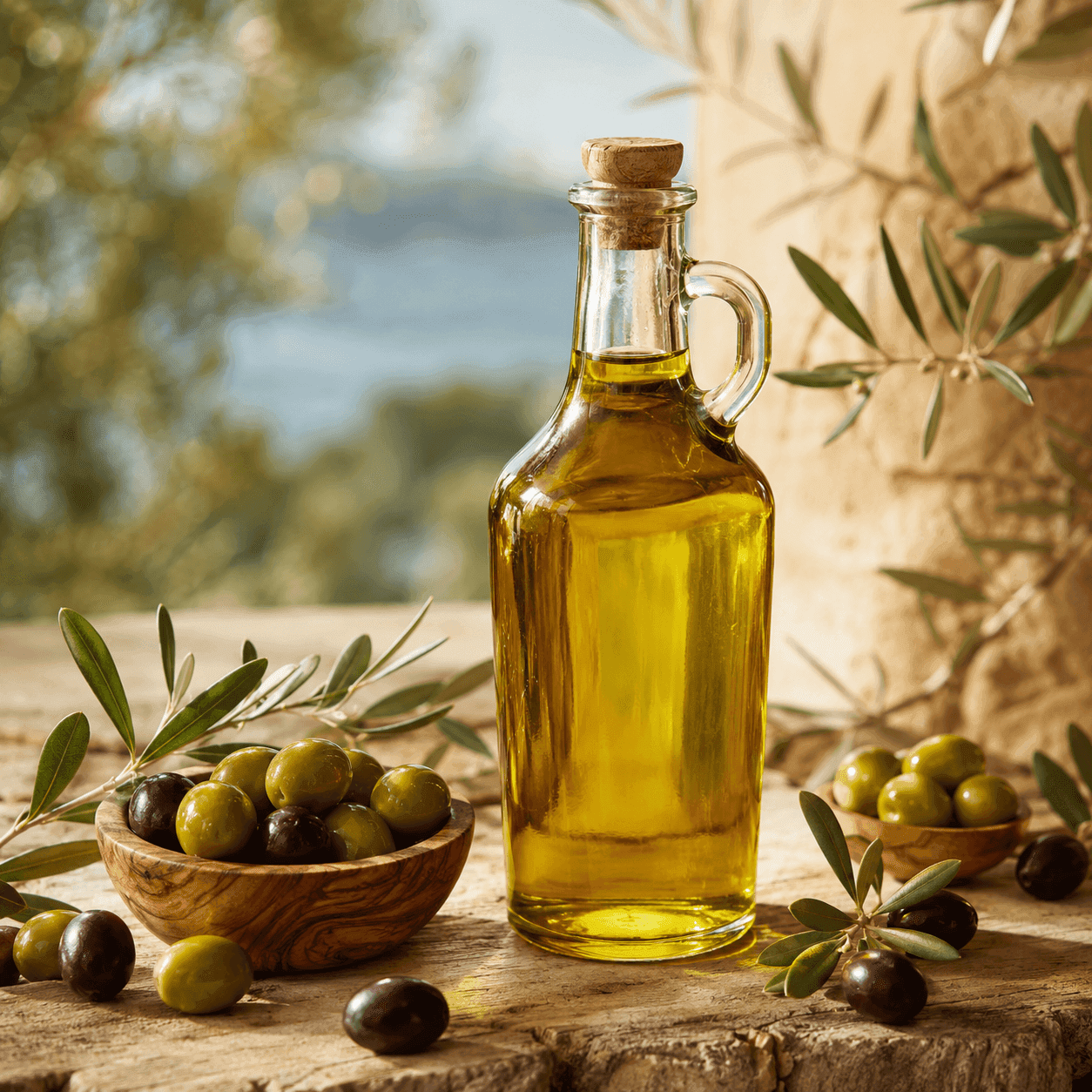
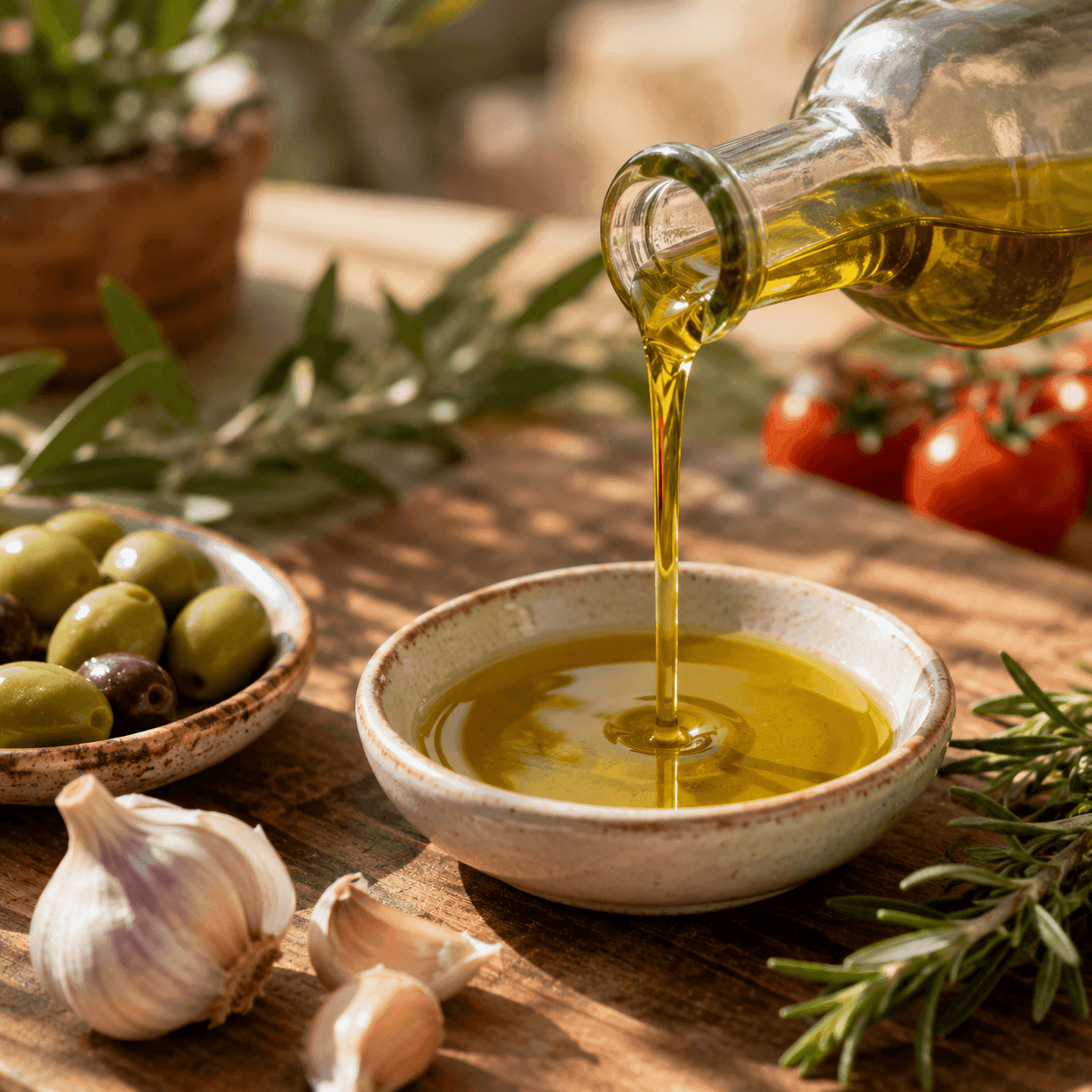
Olive oil has been pressed from olives for at least six thousand years. Egyptian tombs contained jars of it. The Greeks built civic identity around it. The Romans graded it. The Bible references it constantly (anointing oil, lamp oil, sacrificial offering, cooking medium). Every Mediterranean culture has organized its food, its medicine, and substantial parts of its religious practice around the oil from this one fruit.
And in the modern global food supply, olive oil has become one of the most counterfeited products on earth. University of California, Davis testing has repeatedly documented that 60–70% of olive oil sold as “extra virgin” in U.S. supermarkets fails the international standards for that label. The oil in the bottle is often heat-extracted (destroying the polyphenols), oxidized (rancid), cut with cheaper oils like canola or soybean, or simply not from olives at all. The labels say one thing; the chemistry says another.
This article is in two parts. First, what real extra-virgin olive oil actually does for the body — which is genuinely a lot. Second, how to find the real thing in an industry where finding it is harder than it should be.
What real extra-virgin olive oil actually is
The legal definition of extra-virgin olive oil (EVOO) under the International Olive Council standards requires three things:
- Mechanical extraction only. First-press, cold-pressed, no chemical solvents, no heat above about 80°F. The oil that comes out of the press the first time.
- Free fatty acid content below 0.8%. A chemistry measure of how degraded the oil is. Real EVOO is well below this threshold; degraded or improperly processed oil exceeds it.
- No sensory defects. The oil must pass evaluation by a trained tasting panel for the absence of rancidity, mustiness, fustiness (oxidation), and other documented defects.
Oil that fails any of these three criteria isn’t legally extra virgin, even if the label says so. The UC Davis testing simply applied these existing standards to bottles purchased off American supermarket shelves — and found that the majority failed.
The fraud story — what Tom Mueller documented
The most-cited investigation of the global olive oil fraud industry is journalist Tom Mueller’s 2011 book Extra Virginity: The Sublime and Scandalous World of Olive Oil. Mueller spent years inside the Italian olive oil industry — with Italian customs investigators, with adulteration prosecutors, with both real and fraudulent producers — and documented an industry-wide criminal pattern that spans countries.
The mechanics of the fraud:
- Blending with refined oils. Cheap refined olive oil (deodorized, heat-extracted, stripped of polyphenols) is blended with smaller amounts of real EVOO to give it some flavor, then labeled as extra virgin.
- Blending with non-olive oils. In more egregious cases, soybean, canola, sunflower, and even hazelnut oils get mixed in — often colored with chlorophyll and beta-carotene to mimic the appearance of EVOO.
- Country-of-origin laundering. Oil from Tunisia, Morocco, Spain, or Turkey gets imported into Italy, repackaged, and exported as “Italian.” The container ship the oil arrived in is the only Italian thing about it.
- Old oil sold as fresh. EVOO is at its peak in the months right after harvest. Real producers print a harvest date. Fraudulent producers don’t — the oil in the bottle could be from any year, in any condition.
Italian customs investigators have raided major producers and seized millions of liters of fraudulent product. The U.S. International Trade Commission has documented the same issues. The fraud has been characterized by Italian prosecutors as “agromafia” and is one of the largest food-fraud industries globally. Mueller’s book remains the standard reference on the scale of the problem.
None of this means good olive oil doesn’t exist. It means good olive oil takes deliberate sourcing.
Monounsaturated fats — the Mediterranean foundation
Real EVOO is roughly 70–80% monounsaturated fat, primarily oleic acid. Monounsaturated fats are chemically stable (single double bond, not vulnerable to oxidation the way polyunsaturated fats are), cardiovascularly protective, anti-inflammatory at the tissue level, and metabolically clean — the body uses oleic acid efficiently without the inflammatory signaling that excess polyunsaturated fats can drive.
This is the foundation of the Mediterranean diet’s cardiovascular reputation. Greek Crete in the 1950s had among the lowest cardiovascular death rates ever documented in a developed population. Per-capita olive oil consumption was roughly 26 liters per year. The United States in the same era was on industrial seed oils and animal fats in different ratios, and the cardiovascular gap was stark.
The 2013 PREDIMED trial is the modern landmark study: 7,447 high-cardiovascular-risk Spanish adults randomized to a Mediterranean diet supplemented with either EVOO (1 liter per week per household) or mixed nuts, versus a low-fat control diet. The EVOO group had a 30% reduction in major cardiovascular events over 5 years. The trial was stopped early because the results were so unambiguous it was considered unethical to continue the control group on the lower-EVOO diet.
Polyphenols — the medicinal compounds
The monounsaturated fats explain much of olive oil’s cardiovascular profile. The polyphenols explain almost everything else:
- Oleocanthal. The compound responsible for the peppery sting at the back of the throat that real EVOO produces. Mechanically equivalent to ibuprofen as a COX-1 and COX-2 inhibitor — a 50ml dose of EVOO with high oleocanthal content has roughly the anti-inflammatory effect of 10% of a standard ibuprofen dose. Daily consumption produces a cumulative anti-inflammatory state similar to low-dose chronic NSAID use, without the GI damage NSAIDs cause.
- Oleuropein. The signature olive polyphenol. Anti-inflammatory, antioxidant, antimicrobial. Modulates blood pressure, supports endothelial function, and has documented effects on cholesterol oxidation (the key step in atherosclerosis development).
- Hydroxytyrosol. One of the most powerful natural antioxidants ever characterized. Protects mitochondrial function, supports nervous-system health, has documented effects on bone density and immune function.
- Squalene. Cardioprotective, anti-cancer in animal models, the same compound the skin naturally produces for barrier function.
- Vitamin E. Real EVOO is a meaningful source. Refined oils destroy most of it in processing.
Ultra-refined olive oils — the kind that come from heat extraction and chemical processing of olive pomace — lose nearly all of these polyphenols. The fat is still there (and still monounsaturated), but the medicinal compounds that distinguish EVOO from generic vegetable fat are largely gone. This is most of why supermarket “light olive oil” or “pure olive oil” is essentially a different product than real EVOO.
The pepper-throat test
The single most useful at-home test for real extra-virgin olive oil is the throat-burn test. Genuine EVOO with intact oleocanthal content produces a distinct peppery sting at the back of the throat — sometimes enough to make you cough. That sting is the oleocanthal acting on receptors that also detect capsaicin (the heat in chile peppers) and mustard oil.
How to do it:
- Pour a teaspoon of olive oil into a small glass. Warm slightly in your cupped hand if you can.
- Smell first. Real EVOO smells fresh, grassy, slightly fruity, slightly bitter. Off-smelling means oxidized.
- Sip and roll across the tongue.
- Swallow — pay attention to the back of the throat for 5–10 seconds after.
Real EVOO produces a noticeable peppery burn in the back of the throat. The Italian sommelier tradition calls this pizzica — “it bites.” The stronger the burn, the higher the oleocanthal content, the more anti-inflammatory the oil.
Adulterated, oxidized, or refined olive oil doesn’t produce the burn. It tastes flat, sometimes greasy, sometimes with a slight stale or crayon-like note. The throat stays quiet.
This test isn’t laboratory-grade, but it’s surprisingly reliable. A bottle of olive oil that doesn’t make you cough at least a little isn’t doing the medicinal work you bought it for.
Health benefits beyond cardiovascular
- Anti-inflammatory. The oleocanthal mechanism produces measurable reductions in systemic inflammatory markers (CRP, IL-6, TNF-alpha) with daily intake. The same effect behind the cardiovascular protection drives improvements in arthritis, autoimmune conditions, and chronic-inflammation-driven disease broadly.
- Cognitive protection. The Three-City Study and the PREDIMED follow-ups documented reduced cognitive decline and lower dementia risk in adults with high EVOO consumption. Mediterranean populations have substantially lower Alzheimer’s rates than American populations, and EVOO is implicated as one of the central dietary differences.
- Cancer prevention. Strong epidemiological signal for breast and colon cancer prevention in high-EVOO populations. Mechanism is some combination of the polyphenols’ effect on cancer cell biology and the anti-inflammatory action.
- Diabetes prevention. PREDIMED documented a 40% reduction in type 2 diabetes incidence in the EVOO group versus low-fat control. The monounsaturated fat improves insulin sensitivity directly.
- Bone health. The polyphenols (particularly hydroxytyrosol) support bone formation. Mediterranean populations have lower osteoporosis rates than expected for their other dietary characteristics.
- Skin and hair. Topical olive oil is one of the oldest skin and hair treatments in the Mediterranean tradition. Squalene supports skin barrier function; vitamin E and polyphenols support the same antioxidant defenses the skin needs.
The smoke-point myth
One of the most-repeated pieces of bad nutrition advice is that you can’t cook with extra-virgin olive oil because its smoke point is too low. This is largely wrong.
Real EVOO has a smoke point of roughly 375–405°F — well above the temperature of most home cooking (sautéing happens around 280–320°F). Even moderately aggressive cooking like pan-roasting stays within the safe range.
Better than smoke-point alone, real EVOO is unusually oxidation-resistant during cooking because the polyphenols themselves act as antioxidants in the oil. Multiple studies have shown EVOO is more stable during heating than seed oils with nominally higher smoke points. The antioxidants protect the fat from the oxidative damage that high-heat exposure normally causes.
Practical implications:
- EVOO is fine for everyday sautéing, pan cooking, roasting, and baking
- EVOO is also excellent for finishing dishes, dressings, and dipping — the polyphenol load is highest when raw
- For very high heat (deep frying at 375°F+, extended searing), avocado oil or ghee are better choices because they cleanly tolerate higher temperatures and aren’t wasting the EVOO polyphenols on heat that destroys them
- The “use refined olive oil for cooking, extra-virgin for finishing” rule is largely outdated and rests on bad assumptions
How to identify real EVOO at the store
- Dark glass bottle. Light degrades olive oil polyphenols. Clear bottles and plastic containers signal a producer who doesn’t care about quality.
- Harvest date on the label. The single most important quality indicator. Real producers print the harvest date proudly; fraudulent producers don’t. If the label only has a “best by” date but no harvest date, skip it. EVOO is at peak within 12–18 months of harvest.
- Single estate or single country. “Bottled in Italy from oils sourced from Italy, Spain, Tunisia, and Morocco” is the classic adulteration tell. Look for single-estate oils or single-country oils with traceable producers.
- Specific country of origin. Reliable producing regions include California, Australia, Chile (Southern Hemisphere harvest gives fresh oil during the Northern Hemisphere off-season), Greece, southern Spain, and high-end Italian estates. Italian-bottled but multi-country sourced is the highest fraud-risk category.
- Third-party certifications. California Olive Oil Council (COOC) certification for California-produced oils. PDO (Protected Designation of Origin) and PGI (Protected Geographical Indication) certifications for European oils. These require regional verification and chemistry testing.
- Reasonable price. Real EVOO costs $15–30+ per liter at retail. Oil priced like supermarket vegetable oil isn’t real EVOO; the production economics don’t support it.
Storage
- Cool, dark place. Not next to the stove — the heat from cooking degrades the oil over time. A pantry cabinet away from the heat sources is the standard placement.
- Use within 12–18 months of harvest for peak quality. Within 6 months of opening for best polyphenol retention.
- Keep the bottle tightly closed between uses. Oxygen exposure accelerates oxidation.
- Don’t refrigerate — cold makes EVOO cloudy and stiff, and the temperature changes from refrigerator to counter cycle the oil through condensation that introduces water.
- Buy in quantities you’ll finish in 2–3 months. The big restaurant-supply tins are great for restaurants and a slow waste of polyphenols in a home kitchen.
Brands worth buying
- California Olive Ranch — California-grown, COOC-certified, harvest date on every bottle, reliably high quality at accessible price. The everyday default for high-volume use. The “Reserve” bottlings are higher-end. The standard against which other accessibly-priced American EVOOs measure themselves.
- Cobram Estate — Australian-grown, Southern Hemisphere harvest means oil is fresh during the Northern-Hemisphere off-season. Single-estate traceability, high polyphenol content (their oils consistently test among the highest oleocanthal in the world). My top recommendation for serious users.
- Kosterina — Greek (Koroneiki olives), single-estate, very high polyphenol content (often 400+ mg/kg vs the 100–200 typical of mass-market oils). Premium-priced but the chemistry justifies it for medicinal-grade use.
- Bono Extra Virgin (Sicily) — Sicilian single-region, traceable production, accessible price point. One of the cleaner authentically-Italian options on American shelves.
- Costco Kirkland Signature EVOO — surprising inclusion: Costco’s house-brand EVOO has tested unusually well in independent quality assessments. Not premium, but reliably real, traceable to actual olive sources, and substantially cheaper than the premium options. The default for high-volume cooking use if a Costco membership is in the picture.
Brands to be skeptical of without verification: generic store brands (Walmart, Kroger, CVS), “extra virgin” oils priced like supermarket vegetable oil, brands without harvest dates, oils sourced from “multiple countries.” If you can’t verify the producer and the harvest, the UC Davis testing pattern suggests skepticism is warranted.
Where to start
A solid, mid-tier extra-virgin olive oil works as the everyday cooking and finishing oil. Two tablespoons daily across the day is a sensible minimum — sautéing vegetables, finishing soups, on salads, dipping bread, drizzled over scrambled eggs. The PREDIMED trial used roughly 4 tablespoons per person per day, a reasonable target for active cardiovascular protection.
A high-polyphenol EVOO is worth keeping separately as a finishing oil for raw applications — salads, bread dipping, drizzled on cheese, on cold tomatoes with sea salt. The peppery throat-burn from a tablespoon of the real thing is the simplest reminder of what genuine olive oil tastes like.
A larger, well-priced bottle makes a good high-volume cooking backup for when the better oils run low faster than they can be replaced.
And a bulk bottle is the practical choice for batch-cooking sessions that use a cup of oil in a single recipe, where burning through the premium stuff at that volume doesn’t make sense.
Closing
Olive oil is one of those foods where the gap between the real product and the supermarket version is wide enough that most people have never actually tasted real EVOO. The pepper burn at the back of the throat, the grassy fruity aroma, the genuine medicinal polyphenol load — these are what real olive oil delivers. Most of what’s sold under that label doesn’t.
Find a producer with harvest dates on the bottle. Verify single-estate or single-country sourcing. Look for COOC, PDO, or PGI certification. Use it generously — the Mediterranean diet dose is multiple tablespoons per day, not the occasional-drizzle American pattern. Cook with it. Drizzle it raw. Dip bread in it. The body knows what to do with the rest.
Six thousand years of human civilization built substantial parts of medicine and food around this one oil. The honest version of it is still out there. You just have to know where to look.
Sources & further reading
Investigations & studies cited
- Mueller, T. (2011). Extra Virginity: The Sublime and Scandalous World of Olive Oil. W.W. Norton. — The standard journalistic investigation of the global olive oil fraud industry, including the “agromafia” documentation.
- Frankel, E.N. et al. (2010, 2011). Tests indicate that imported ‘extra virgin’ olive oil often fails international and USDA standards. UC Davis Olive Center. — The University of California, Davis research that documented the 60-70% adulteration rate in U.S. supermarket EVOO.
- Estruch, R. et al. (2018). Primary Prevention of Cardiovascular Disease with a Mediterranean Diet Supplemented with Extra-Virgin Olive Oil or Nuts (PREDIMED). New England Journal of Medicine. — The landmark trial documenting 30% reduction in major cardiovascular events with daily EVOO consumption. Stopped early due to clear benefit.
- Beauchamp, G.K. et al. (2005). Phytochemistry: ibuprofen-like activity in extra-virgin olive oil. Nature. — The Beauchamp study that identified oleocanthal’s ibuprofen-equivalent mechanism — the source of EVOO’s anti-inflammatory action.
- Martínez-Lapiscina, E.H. et al. (2013). Mediterranean diet improves cognition: the PREDIMED-NAVARRA randomised trial. Journal of Neurology, Neurosurgery & Psychiatry. — The cognitive arm of PREDIMED documenting reduced cognitive decline in the EVOO group over 6.5 years.
Certifications & quality bodies
- California Olive Oil Council (COOC) — Certification program for California-produced olive oils; the most rigorous American verification standard.
- International Olive Council — The international standards-setting body for olive oil; defines extra-virgin standards.
- UC Davis Olive Center — The academic research center behind much of the U.S. quality and fraud-testing work.
Further reading
- Extra Virginity: The Sublime and Scandalous World of Olive Oil — Tom Mueller — Long-form investigation of the olive oil fraud industry; the book worth reading if this article’s exposé section interested you.
- Olive Oil Times — Industry trade publication covering olive oil quality, producer profiles, and ongoing fraud cases.