
Health · Mineral · ~10 min read
Potassium — the mineral the modern plate doesn’t deliver.
Why Dr. Berg says you need 4,700 mg per day, why bananas aren’t the answer, and what to actually eat.
By George Hinestrosa · Personal experience & independent research
The adequate intake for potassium is 4,700 mg per day. The median American gets about 2,500–2,800 mg. That’s a daily shortfall of nearly half — for a mineral the body needs in roughly the same quantities as it needs sodium. And we don’t talk about it.
Dr. Eric Berg has been making this point for years on his channel and in his clinical practice. Potassium is the silent deficiency — silent because it doesn’t trigger a dramatic symptom on day one, and because mainstream medicine isn’t really equipped to test for it accurately. Serum potassium is tightly regulated within a narrow range. Even when tissue stores are depleted, the body keeps blood potassium normal by pulling from intracellular stores or by suppressing other functions. By the time blood potassium reads low, the deficiency has been running for a long time.
Berg’s framing is straightforward: most modern people are running their bodies on a third less potassium than they were designed for. Get that number up to 4,700 mg per day from food, and a lot of complaints quietly resolve.
What potassium does
Potassium is the principal intracellular cation. Sodium dominates outside the cell; potassium dominates inside it. The electrochemical gradient between the two is what makes nerves fire, muscles contract, the heart beat, and the kidneys regulate fluid balance.
Specifically:
- Muscle contraction and relaxation
- Nerve signaling
- Heart rhythm regulation
- Blood pressure control — potassium is the natural antagonist to sodium’s pressure effect
- Insulin sensitivity — the cell membrane needs adequate potassium to respond to insulin
- Fluid balance and edema prevention
- Acid-base regulation
- Aldosterone and the renin-angiotensin-aldosterone system
Berg has been particularly clear that potassium plays a role in insulin signaling that gets ignored. When you’re chronically low on potassium, the cell membrane doesn’t respond to insulin properly, contributing to insulin resistance over time. Restoring potassium often improves blood-sugar control in ways that surprise people who thought their problem was purely about carbs.
What deficiency looks like
- Muscle cramps and twitches
- Fatigue, particularly during exertion
- Constipation
- High blood pressure
- Heart palpitations or irregular heartbeat
- Edema and water retention (counterintuitive, but real — potassium deficiency drives fluid retention)
- Sugar cravings
- Anxiety
- Cognitive sluggishness
- Insulin resistance
- Increased risk of kidney stones — low potassium drives the calcium-loss-from-bone pathway that contributes to stones
Many of these overlap with magnesium deficiency. The two minerals work together. People who are short on one are usually short on the other, and improving one often unmasks how short you were on the other.
Why supplementation is hard
Walk into a pharmacy and look at potassium supplements. Every bottle is capped at 99 mg per tablet. That isn’t a coincidence — the FDA limits over-the-counter potassium to that dose because high single doses of concentrated potassium can cause GI ulceration. To hit 4,700 mg through 99 mg tablets, you’d need to take 47 pills a day.
So you can’t supplement your way out of a potassium deficit, not really, not from a standard pharmacy bottle. Berg has been emphatic about this for years: the only way to actually meet the potassium target is through food — or through electrolyte products specifically designed to deliver higher potassium doses safely (as potassium citrate or potassium chloride dissolved in water, not concentrated in a tablet).
The food-first approach is correct anyway. Whole-food potassium comes packaged with magnesium, B vitamins, polyphenols, fiber, and the cofactors the body uses to absorb and use it properly. Tablet potassium does none of that.
Foods that actually deliver
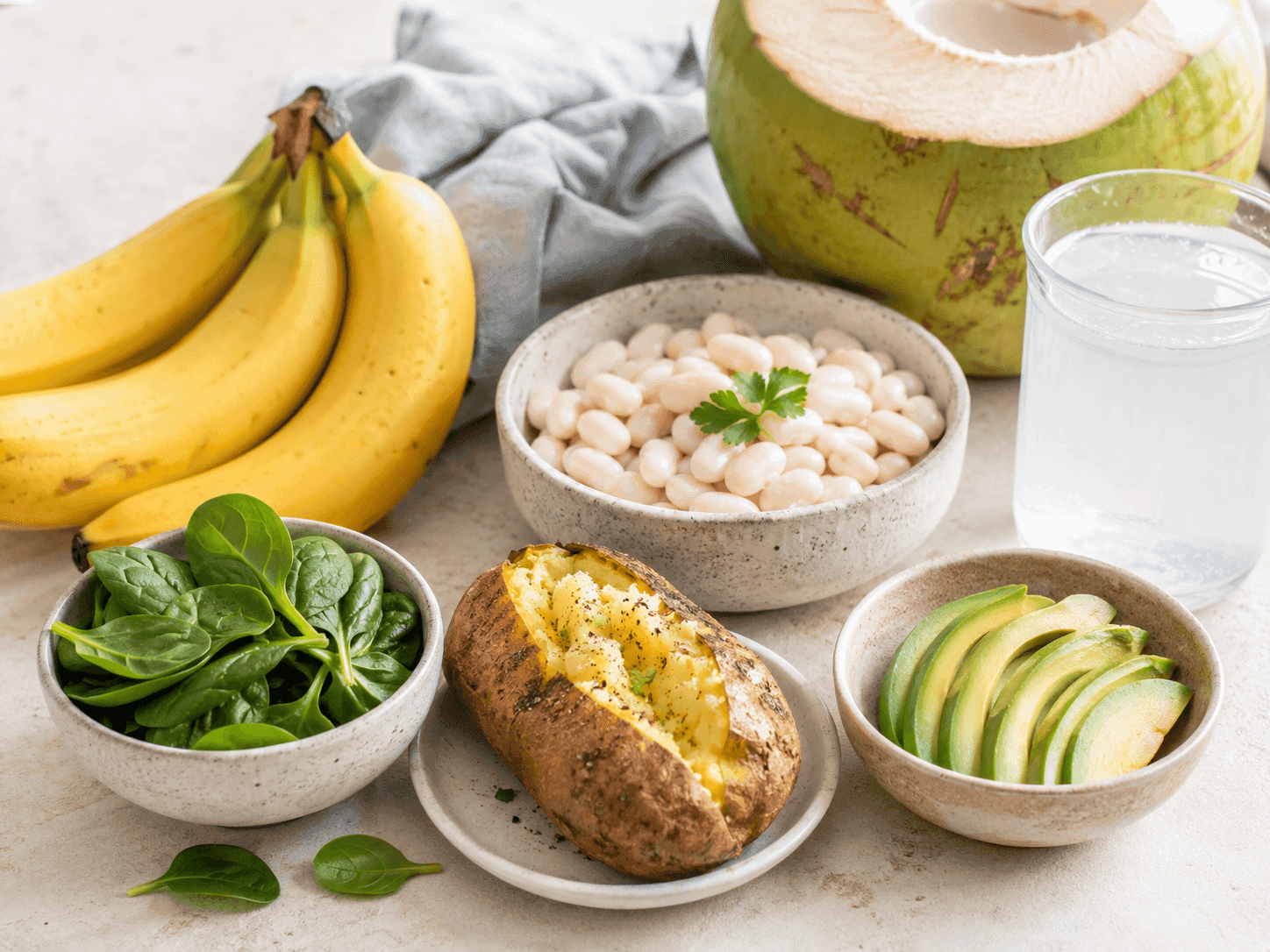
Bananas have a reputation they don’t quite earn. A medium banana has about 400–450 mg of potassium. To hit 4,700 from bananas alone, you’d eat eleven of them. The real potassium dense foods are different.
Per Berg’s framing, the highest-density sources:
- Beet greens (cooked, 1 cup): 1,300 mg
- White beans (cooked, 1 cup): 1,189 mg
- Avocado (one whole fruit): 975 mg
- Swiss chard (cooked, 1 cup): 960 mg
- White potato with skin (medium baked): 925 mg
- Tomato sauce (1 cup, low sodium): 870 mg
- Spinach (cooked, 1 cup): 840 mg
- Coconut water (1 cup): 600 mg
- Pumpkin (1 cup cooked): 564 mg
- Sweet potato (medium baked): 540 mg
- Wild salmon (4 oz fillet): 470 mg
- Banana (medium): 422 mg
- Plain yogurt (1 cup): 380 mg
The strategy isn’t to eat one of these in heroic quantities. It’s to stack them across a day. An avocado at breakfast, a large salad with beet greens or chard at lunch, a baked sweet potato with dinner, and you’re at 2,500–3,000 mg just from those three meals. Add coconut water in the afternoon, add salmon, and you’re in range.
The sodium-potassium ratio
The standard American diet provides about 3,500 mg of sodium and 2,500 mg of potassium — a sodium-to-potassium ratio of roughly 1.4:1. The ancestral ratio, before processed food, was closer to 1:4 — four times more potassium than sodium. The shift over the past century has been one of the most dramatic dietary changes in human history, and the cardiovascular consequences have been documented.
Berg has been very clear: it isn’t sodium that’s the villain in modern blood pressure problems. It’s the ratio. Most people would benefit more from raising potassium than from cutting sodium, and many would benefit from doing both.
Real salt (sea salt, Celtic, Himalayan) supports adrenal function and isn’t the enemy. The missing potassium is.
Potassium, keto, and the “keto flu”
When you start cutting carbs — especially when starting keto or fasting — the body releases stored water along with sodium and potassium. The “keto flu” that hits in the first week of carb restriction is mostly electrolyte depletion. Muscle weakness, headaches, dizziness, fatigue, irritability — these are potassium-and-sodium symptoms, not signs that the dietary change is wrong.
The solution isn’t to abandon the dietary change. It’s to deliberately replenish the electrolytes the change pulls out. Berg’s own electrolyte powder was designed for exactly this — 1,000 mg of potassium per scoop, along with sodium and magnesium, in a form the body can use. There are alternatives (LMNT, Redmond Re-Lyte) but the principle is the same.
Where I get it
Mostly food. The breakfast-lunch-dinner stack above (avocado, leafy greens, sweet potato) covers most days. When I’m fasting, training hard, or in a heat wave, I’ll add an electrolyte scoop. When I’m cooking at home, I substitute potassium chloride salt (Morton Lite Salt or NoSalt) for part of my regular salt — it tastes slightly different but it’s an easy way to push the ratio.
- Dr. Berg’s Electrolyte Powder — 1,000 mg potassium per scoop, with sodium and magnesium. The product I keep on the shelf for fasting days, hot days, or after heavy training.
- Morton Lite Salt — roughly 50/50 sodium chloride and potassium chloride. Mix 1:1 with regular sea salt in the shaker for an easy daily increase.
- NoSalt — pure potassium chloride seasoning, no sodium. Use for finishing dishes when you specifically want to push potassium without adding more sodium.
Where to start
- Avocado most mornings, or eggs with spinach instead.
- A large salad at lunch, with whatever leafy greens are good that week — chard and beet greens when they’re available, spinach by default.
- Sweet potato or beets at dinner several times a week.
- Coconut water on training days.
- One scoop of Berg’s electrolyte powder in 16 oz of water on fasting days or after heavy training.
- Lite Salt mixed with regular sea salt in the home shaker, about 1:1.
That’s enough for most people — no need to count milligrams.
Closing
Potassium is the mineral the modern plate doesn’t deliver, and the deficiency is silent because the body fights to keep blood levels normal even when tissue is depleted. Mainstream bloodwork is misleading. Tablets are useless. The fix is food, every day, on purpose.
If your blood pressure is creeping up, your muscles cramp, your energy drops in the afternoon, or your sleep is restless — try a week of deliberate potassium-rich eating before you go looking for something more complicated. It costs almost nothing and resolves more than it should.
Sources & further reading
Authorities cited
- Dr. Eric Berg — Practicing chiropractor and clinical nutritionist; primary lay-audience voice on potassium, electrolytes, and the sodium-potassium ratio.
- Dr. James DiNicolantonio — Cardiovascular research scientist; The Salt Fix and The Mineral Fix are the standard modern references on sodium and potassium balance.
Books & reading
- The Mineral Fix — James DiNicolantonio, Siim Land — Modern survey of mineral nutrition; the potassium chapters are particularly strong on the sodium ratio question.
- The Salt Fix — James DiNicolantonio — The companion case on why salt restriction has been backwards; pairs naturally with raising potassium.
- Dr. Berg's YouTube channel — His potassium and electrolyte videos are short, practical, and the easiest way to absorb his framing without buying a book.