
Health · Whole Food · ~13 min read
Raw honey — and why most supermarket honey isn’t honey at all.
Why ultra-filtration strips honey of everything that makes it medicinal, why the FDA can’t legally call most store honey “honey,” and how to find the real thing.
By George Hinestrosa · Personal experience & independent research
Honey is one of the few foods on earth that doesn’t spoil. Archaeologists have found edible honey in Egyptian tombs sealed for three thousand years. The bees craft its chemistry as long-term hive storage — low water content, low pH, hydrogen peroxide production from an enzyme bees add to the nectar, and a sugar concentration that’s simply too high for most microbial life to survive in.
That same chemistry is what makes raw honey one of the most consistently useful medicinal foods in the traditional pharmacopeia. Antimicrobial. Wound-healing. Throat-soothing. Local-pollen-allergy desensitizing. Enzyme-rich. Mineral-dense relative to its calorie content. The reason your grandmother gave you a spoonful for a cough wasn’t superstition. It was three thousand years of accumulated practical knowledge about a food that genuinely does what it does.
And almost none of that medicinal value survives the supermarket. Most honey in American chain stores has been heated to high temperatures, ultra-filtered to remove all traces of pollen, and quietly diluted with corn syrup, rice syrup, or beet sugar. Lab testing has documented this repeatedly across the major retailers. The FDA considers most of it not even legally honey under U.S. standards. You wouldn’t know from the label.
What raw honey actually does
- Antimicrobial action. Raw honey is hostile to bacteria and many viruses through several independent mechanisms. The high sugar concentration creates osmotic pressure that pulls water out of microbial cells. The low pH (around 3.5–4.5) creates an environment most pathogens can’t tolerate. And the bee-deposited enzyme glucose oxidase continuously produces small amounts of hydrogen peroxide as the honey breaks down its own sugar. The combination is broad-spectrum — effective against MRSA, E. coli, Salmonella, Streptococcus, and other significant pathogens in clinical studies.
- Wound healing. Medical-grade manuka honey is FDA-approved as a wound dressing for chronic ulcers, burns, and surgical wounds that don’t heal with standard care. The antimicrobial action plus the osmotic effect that draws fluid (and bacteria) out of the wound bed plus the anti-inflammatory action of the polyphenols produces measurable improvements in healing rates documented in dozens of trials.
- Cough suppression. Several randomized trials — including a Pediatrics 2007 trial — have shown that a teaspoon of honey at bedtime suppresses nighttime cough in children better than dextromethorphan (the standard OTC cough suppressant), with fewer side effects. The WHO now recommends honey as a cough treatment in children over 12 months.
- Local allergy desensitization. Like bee pollen (see that article), raw honey from local bees contains small amounts of local flower pollen. Daily intake exposes the immune system to those allergens orally over months, gradually building tolerance. The clinical evidence is mixed but consistent enough that the practice has earned its place in the alt-health repertoire. Start before allergy season, not during.
- Live enzymes. Raw honey contains active diastase, invertase, glucose oxidase, and catalase — enzymes that support digestion and continue working in the body. All of these are destroyed by heat above about 95°F. Pasteurized supermarket honey, heated to 160°F or higher for filtration, has none of them left.
- Polyphenols and antioxidants. Honey carries phenolic compounds from the flowers the bees visited — pinocembrin, chrysin, galangin, caffeic acid, and others. Darker honeys (buckwheat, manuka, sourwood) generally have higher polyphenol content. The antioxidant activity is comparable per gram to many vegetables.
- Minerals. Trace amounts of potassium, calcium, magnesium, iron, zinc, copper, and manganese. Not significant by daily-need calculations, but a real nutritional contribution relative to refined sugar, which contains none.
- Prebiotic effect. The oligosaccharides in raw honey feed beneficial gut bacteria. Modest but real microbiome support, similar in mechanism to the inulin in onion.
The adulteration problem — what’s really on the supermarket shelf
This is the part of the honey story most people don’t know, and it’s the reason this article had to be longer than the others in this section.
In 2011, Food Safety News commissioned the palynology research lab at Texas A&M University to test honey samples from major American retailers for the presence of pollen. Pollen is honey’s natural fingerprint — it reveals what flowers the bees visited, what region the honey came from, and (most importantly) whether the honey was real honey or something heavily processed to hide its origin.
The results were ugly:
- 100% of honey samples from CVS and Walgreens contained zero pollen. Under FDA guidance, those products don’t legally qualify as honey.
- 77% of honey from big-box retailers (Sam’s Club, Costco, Walmart) had been ultra-filtered to the point of removing all natural pollen.
- Major store brands — Great Value (Walmart), Members Mark (Sam’s Club), Good & Gather (Target), Berry Hill (Aldi), Signature Select (Safeway/Albertson’s), Publix private label, Kroger, HEB, Sue Bee, Nature Nate’s — all named in subsequent lawsuits and follow-up testing for pollen removal, syrup adulteration, or both.
- Walmart’s Great Value Raw Honey tested at HMF (hydroxymethylfurfural) levels twice the normal range for raw honey — HMF rises when honey is overheated and is a standard quality marker. The organic version tested for added syrup at three times the normal level.
- Trader Joe’s “100% New Zealand Manuka Honey” tested at only 57–63% Manuka pollen content, triggering a class-action lawsuit. The court ruled the label legal under U.S. regulations, but the test numbers themselves stand.
- Smucker’s honey packets — the ones at fast-food chains — tested with zero pollen in 100% of samples.
The mechanism behind most of this is honey laundering: cheap honey from China (where syrup adulteration, banned antibiotic use, and heavy-metal contamination have been repeatedly documented) gets shipped to intermediate countries, ultra-filtered to remove pollen so its origin can’t be traced, and re-exported to the U.S. as generic “honey” that bypasses customs scrutiny and anti-dumping tariffs.
The FDA inspects approximately 5% of imported honey. Most of what gets through is what ends up on the supermarket shelf — relabeled, repackaged, often still containing illegal antibiotics like chloramphenicol (linked to bone-marrow damage) or undisclosed corn or rice syrup, but in jars that look indistinguishable from the real thing.
Senator Chuck Schumer warned about this on the floor of the Senate as far back as 2011. Nothing significant has changed in the supply chain since.
Why pollen matters — and why ultra-filtration is the giveaway
Pollen is honey’s traceability fingerprint. The specific mix of pollens in a jar of real honey tells laboratory analysts what plants the bees visited and therefore what region the honey came from. New Zealand Manuka pollen looks different from Texas wildflower pollen looks different from Bulgarian linden pollen.
Normal honey processing for the U.S. market involves light filtering — passing the honey through a coarse mesh to remove pieces of beeswax, bee parts, and large debris. Pollen passes through that mesh easily and stays in the product. This is what real raw honey looks like.
Ultra-filtration is a different process. The honey is heated (often to 150–180°F) to lower its viscosity, then forced under pressure through a fine filter that removes all particles — including pollen. There is no legitimate food-safety reason to do this. The pollen isn’t a contaminant; it’s the most nutritionally valuable solid in the jar.
What ultra-filtration does accomplish:
- Hides the honey’s origin so it can’t be traced back to a specific country
- Removes natural cloudiness so the product looks uniformly clear (which mainstream marketing has somehow trained consumers to think of as “quality”)
- Slows crystallization so the honey stays liquid on the shelf longer
- Allows blending with syrups without visible texture changes
- Strips out the enzymes, polyphenols, and aromatic compounds that make raw honey medicinal
The practical rule: if a jar of honey is crystal-clear, evenly colored, never crystallizes, and lists no specific geographic origin, it has been ultra-filtered, and you should put it back.
Manuka honey — the medicinal-grade variant
Manuka honey deserves its own section because it’s the one variant where the medicinal activity is high enough that it’s used in modern hospital wound care.
Manuka honey is produced by bees foraging on the manuka bush (Leptospermum scoparium), which grows wild in New Zealand and parts of Australia. The manuka flower’s nectar contains dihydroxyacetone, which converts in the finished honey into methylglyoxal (MGO) — an antimicrobial compound that’s substantially more potent than the hydrogen peroxide antimicrobial action of regular honey, and that doesn’t break down in wound environments the way peroxide does.
Grading systems to know:
- UMF (Unique Manuka Factor): the original grading system, established in New Zealand. UMF 10+ is roughly the threshold for medicinal activity. UMF 15+ is clinical-grade. UMF 20+ is therapeutic. Look for the UMF trademark on the jar.
- MGO (Methylglyoxal): the direct measurement in milligrams per kilogram. MGO 100+ matches roughly UMF 10+. MGO 400+ matches roughly UMF 15+. MGO 800+ is very high.
- K Factor: Wedderspoon’s proprietary grading. K Factor 16 is roughly comparable to UMF 10+; K Factor 22 to UMF 15+.
For everyday use as a stronger honey, UMF 10+ / MGO 100+ is sufficient. For active immune support during illness, UMF 15+ / MGO 400+. For wound dressing or serious infection support, UMF 20+ / MGO 800+ (or medical-grade products like Medihoney).
Cost climbs steeply with grade. A jar of UMF 10+ runs $25–40; UMF 20+ runs $80–150. There’s no need to drink it daily — manuka is the form to keep in the cupboard for acute use, alongside regular raw honey for daily consumption.
How to tell real honey from fake honey
None of the home tests below are perfect, but together they’re a useful filter. If a sample fails several tests at once, it’s almost certainly adulterated.
- The visual test. Real raw honey is slightly cloudy, uneven in color, may have visible bits of beeswax or pollen. Fake or ultra-filtered honey is uniformly crystal clear and glossy. Crystal clarity is a red flag, not a quality signal.
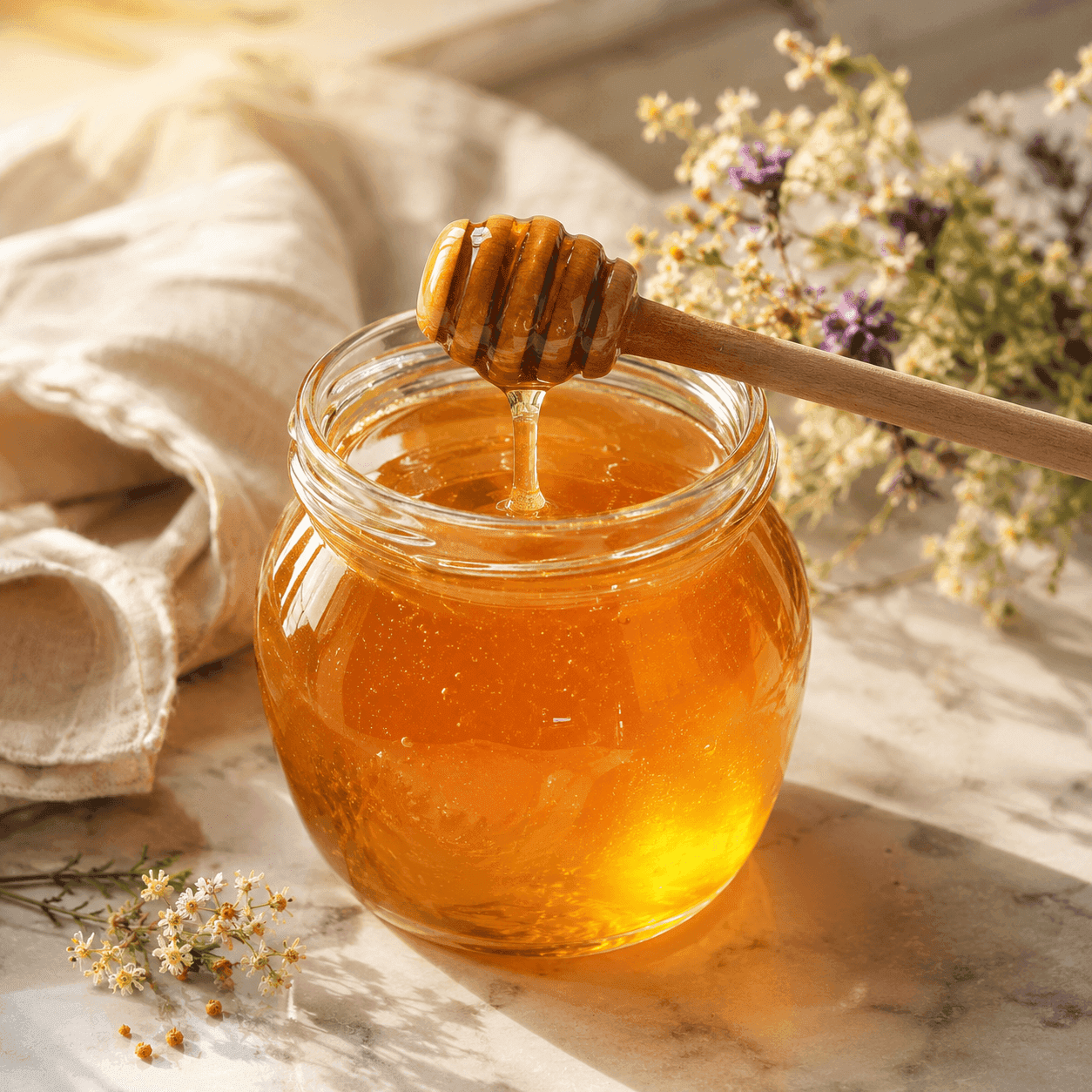
- The thread test. Dip a spoon into the honey and lift it out. Real honey forms a long continuous thread that ribbons and curls before breaking. Adulterated honey breaks into droplets quickly.
- The water test. Drop a spoonful into a glass of room-temperature water without stirring. Real honey sinks as a mass and dissolves slowly when stirred. Syrup-adulterated honey dissolves quickly and spreads sugary streaks.
- The flame test. Dip a dry wooden match in the honey, then try to light it. Real honey contains almost no water and ignites readily. Adulterated honey contains added water and dampens the match.
- The paper towel test. Drop a few drops on a paper towel. Real honey beads up and holds its shape. Syrup-diluted honey soaks through and forms a wet ring.
- The refrigerator test. Real raw honey crystallizes over time, especially when cold. Put the jar in the fridge for a week or two. Real honey turns cloudy and starts forming fine, uniform crystals. Honey that stays perfectly liquid and clear after weeks of refrigeration is either heavily processed or adulterated.
Certifications worth looking for
- True Source Certified. The most important honey-specific certification. The True Source program verifies the full supply chain from hive to packer and requires authenticity testing for adulteration. About 40% of honey sold in the U.S. and Canada now carries this seal. If a jar has it, the probability of adulteration drops substantially.
- USDA Organic. Indicates organic methods through beekeeping and processing. Useful but not honey-specific — the USDA doesn’t have a domestic organic standard for honey, so the certification typically comes from foreign equivalents. Pair with True Source when you can.
- UMF / MGO (for manuka). Specific to New Zealand manuka. Verifies the methylglyoxal content. Look for the UMF trademark specifically, not just “UMF-style” or proprietary alternatives.
- Non-GMO Project Verified. Indicates the bees weren’t fed GMO-derived supplements and the honey wasn’t blended with GMO syrups. A useful indirect purity signal.
- Specific floral and geographic origin on the label. “Texas Wildflower Honey” or “Sourwood Honey from North Carolina” is a stronger trust signal than “Pure Honey” or “Packed in USA from imported honey.” Vagueness is the warning sign.
Brands worth buying
For seasonal-allergy desensitization, the best honey is always local honey from a beekeeper within roughly 50 miles of where you live. Farmers’ markets, beekeeper associations, and local natural-food stores are the best sources. The local pollen is what does the immune-training work.
For general medicinal and culinary use, when local isn’t available:
- YS Eco Bee Farms Raw Honey — four generations of beekeeping, family-run, no pasteurization or filtration. The Spruce Eats named it best overall raw honey. Thick, creamy texture; crystallizes naturally. The benchmark for what raw honey is supposed to be.
- B Well Honey — South Carolina-based, truly raw and unfiltered, multi-floral (blackberry, sugar maple, holly, tulip poplar, blueberry blossom). Their award- winning sourwood honey is particularly notable for flavor and antioxidant content.
- Local Hive Honey (by Rice’s) — True Source Certified, partners with hundreds of regional U.S. beekeepers, 23+ regional varieties (California, Pacific Northwest, Florida, Midwest, etc.). 100% raw, unblended, unpasteurized. The closest thing to local honey that’s also available nationally. Founded in 1924 as Rice’s Honey, rebranded as Local Hive in 2018.
- Lineage Provisions Raw Organic Honey — hand-harvested from remote wild areas, USDA Organic and True Source Certified, tested for glyphosate and 390+ contaminants. Premium-priced but the testing rigor is unusually serious.
- Wedderspoon Raw Manuka Honey K Factor 16 — the trusted everyday manuka option for medicinal use. Never blended with cheaper honey. Each batch tested independently for manuka pollen content and antimicrobial activity. K Factor 16 is roughly comparable to UMF 10+ for everyday use; step up to K Factor 22 for active illness support.
Traditional uses
The medicinal applications of raw honey go back at least to ancient Egypt — honey-based wound dressings appear in the Edwin Smith Papyrus from 1700 BC. Most of the traditional protocols are validated by modern research:
- Wound dressing. Apply medical-grade manuka (or high-UMF manuka) to minor wounds, burns, or slow-healing skin. Cover with gauze. Change daily. The antimicrobial action plus osmotic fluid draw plus polyphenol anti-inflammation produces faster healing than most pharmaceutical ointments.
- Cough at bedtime. One teaspoon of raw honey before bed for children over 12 months (and adults). Better than dextromethorphan in randomized trials. The mechanism is part demulcent (coating the throat) and part vagal-nerve modulation from the sweet stimulus.
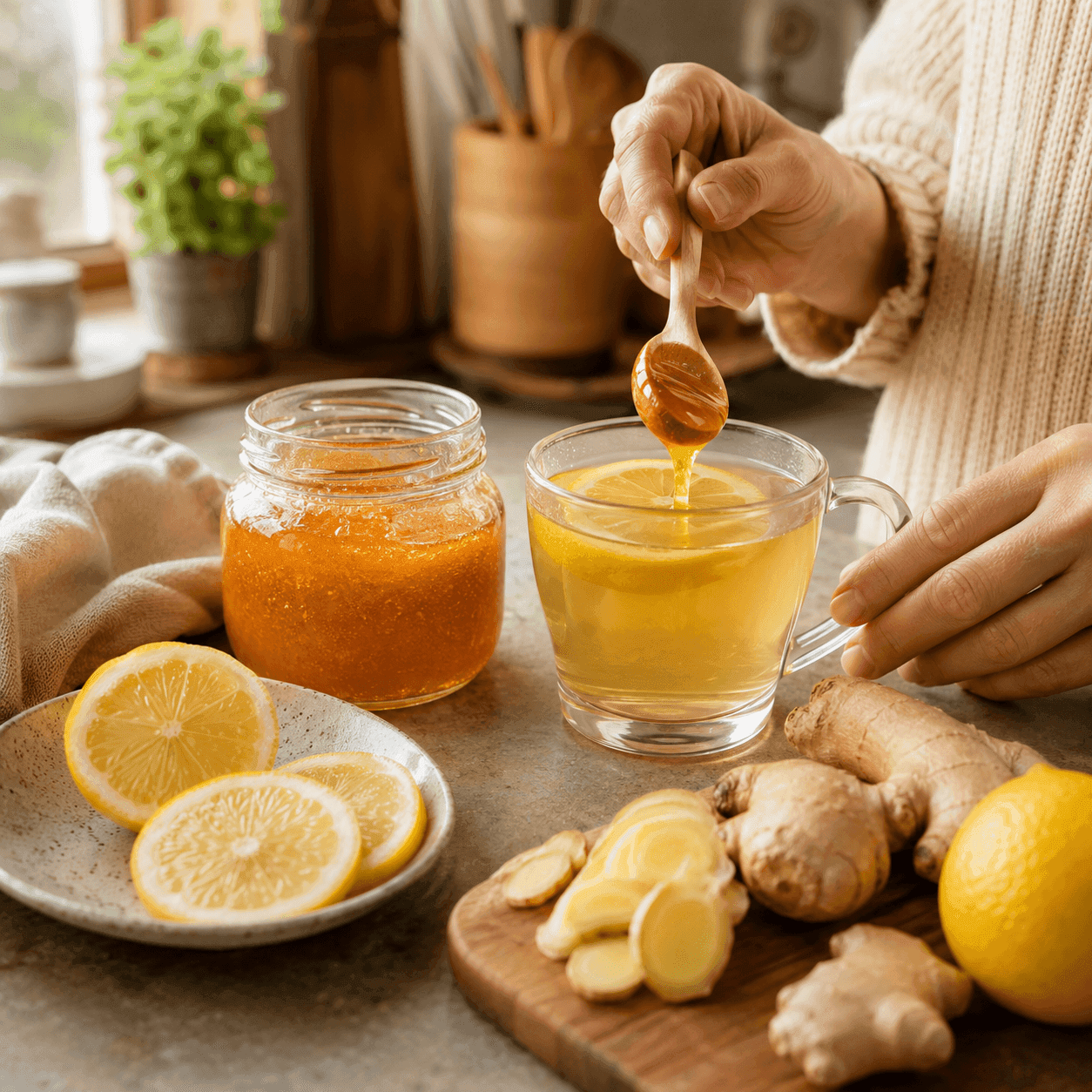
- Sore throat tea. One tablespoon of raw honey plus the juice of half a lemon plus optionally a slice of fresh ginger, all in 8 oz of hot (not boiling — preserves enzymes) water. The honey-lemon-ginger trio appears in traditional medicine across nearly every food culture for good reason.
- Garlic-honey immune syrup. See the garlic article. A few peeled raw garlic cloves submerged in raw honey, left at room temperature for a week or more. The honey draws out the garlic’s allicin and stable derivatives, producing one of the most effective natural cold and flu remedies in the household repertoire.
- Onion-honey cough syrup. See the onion article. Sliced raw onion layered with raw honey overnight produces a remarkably effective cough syrup the next morning. Cuban and Eastern European folk medicine staple.
- Local-pollen allergy desensitization. One teaspoon of local raw honey daily, starting at least three months before peak allergy season. Same mechanism as the bee pollen protocol — oral tolerance induction through repeated low-dose pollen exposure.
- Pre- and post-workout fuel. A tablespoon of raw honey 15–30 minutes before endurance training provides easily-absorbed glucose and fructose plus the trace nutrients. Used by ultra-endurance athletes for decades; the glycemic load is real but useful in this specific context.
- Sleep support. A teaspoon of raw honey before bed has been popularized by Mike Mashé (the “Honey Revolution”) as supporting overnight liver glycogen and reducing cortisol spikes that wake people at 3 AM. Anecdotal but consistent reports of improved sleep quality from the practice.
Storage and handling
- Room temperature, in a sealed jar, away from direct sunlight. Raw honey keeps essentially forever this way.
- Don’t refrigerate (except for the authenticity test) — the cold accelerates crystallization, which doesn’t hurt the honey but makes it stiff to use.
- Crystallized honey is real honey doing what real honey does. Warm the jar gently in a bowl of warm water if you want to re-liquefy it — do not microwave (destroys enzymes) and do not boil (destroys enzymes and polyphenols).
- Use a clean dry spoon every time. Water introduced into the jar accelerates fermentation.
- Don’t add honey to boiling tea. Let the tea cool to drinkable temperature first, then stir in the honey, to preserve the enzymes.
Where to start
A jar of genuine raw honey — from a trusted brand or a local beekeeper — kept in the cupboard covers the everyday use: a teaspoon stirred into morning herbal tea (cooled below boiling), a teaspoon into yogurt or oatmeal a few mornings a week, and a garlic-honey infused syrup on the counter, refreshed every couple of months.
A jar of high-grade manuka (look for a K Factor 16 or comparable UMF rating) is worth keeping for sore throats, slow-healing minor wounds, and the first signs of a cold or flu. A spoonful held in the mouth and slowly swallowed at the first scratch of a sore throat works better than most pharmaceutical alternatives.
Local honey through allergy season is the other use — one teaspoon every morning starting in late winter and continuing through summer.
Closing
Honey is one of the foods where the gap between the mainstream product and the real product is widest. Most supermarket honey isn’t honey in any meaningful sense — the FDA wouldn’t legally call it that if it were inspected. It’s a heated, ultra-filtered, often syrup-blended sweetener that happens to come in a bear-shaped bottle.
Real raw honey is a different food entirely. Antimicrobial. Wound-healing. Throat-soothing. Enzyme-rich. Three thousand years of practical medicine built around it, and modern science quietly confirming most of what the traditions said.
Find a beekeeper within 50 miles of where you live. Buy from them. Keep a jar of YS or Local Hive in the cupboard for everyday cooking and tea. Keep Wedderspoon manuka in the cabinet for when illness comes. Skip the supermarket aisle entirely.
The bees worked hard for this. The least we can do is buy it from people who didn’t bleach it on the way to the shelf.
Sources & further reading
Investigations & studies cited
- Schneider, A. (2011). Tests show most store honey isn't honey. Food Safety News. — The Texas A&M palynology lab study that documented widespread pollen removal across major U.S. retailers; the foundational investigation behind the modern honey-fraud literature.
- Paul, I.M. et al. (2007). Effect of honey, dextromethorphan, and no treatment on nocturnal cough and sleep quality. Archives of Pediatrics & Adolescent Medicine. — The Pediatrics-published trial showing honey outperformed dextromethorphan for nighttime cough in children over 12 months.
- Molan, P.C. (1992). The antibacterial activity of honey: 1. The nature of the antibacterial activity. Bee World. — The foundational research on honey's antimicrobial mechanisms by Peter Molan, the New Zealand researcher who established manuka honey's medical credibility.
- Mandal, M.D. & Mandal, S. (2011). Honey: its medicinal property and antibacterial activity. Asian Pacific Journal of Tropical Biomedicine. — Comprehensive review of honey's antimicrobial spectrum and mechanisms, including MRSA, E. coli, and resistant organism activity.
Authorities & certifications
- True Source Honey — The industry-standard supply-chain traceability certification; the most useful single label to look for on a honey jar.
- UMF Honey Association — The New Zealand organization that governs the Unique Manuka Factor grading standard.
- Dr. Peter Molan (1942–2015) — University of Waikato; the researcher who established manuka honey's medical credibility and developed the UMF grading system.
Further reading
- The Honey Revolution — Ron Fessenden, MD, and Mike McInnes — The case for pre-bed raw honey as metabolic and sleep support; controversial but influential in alt-health practice.
- Honey: A Comprehensive Survey — Eva Crane (editor) — The definitive academic reference on honey biology, history, and use; the deep technical text behind everything else.