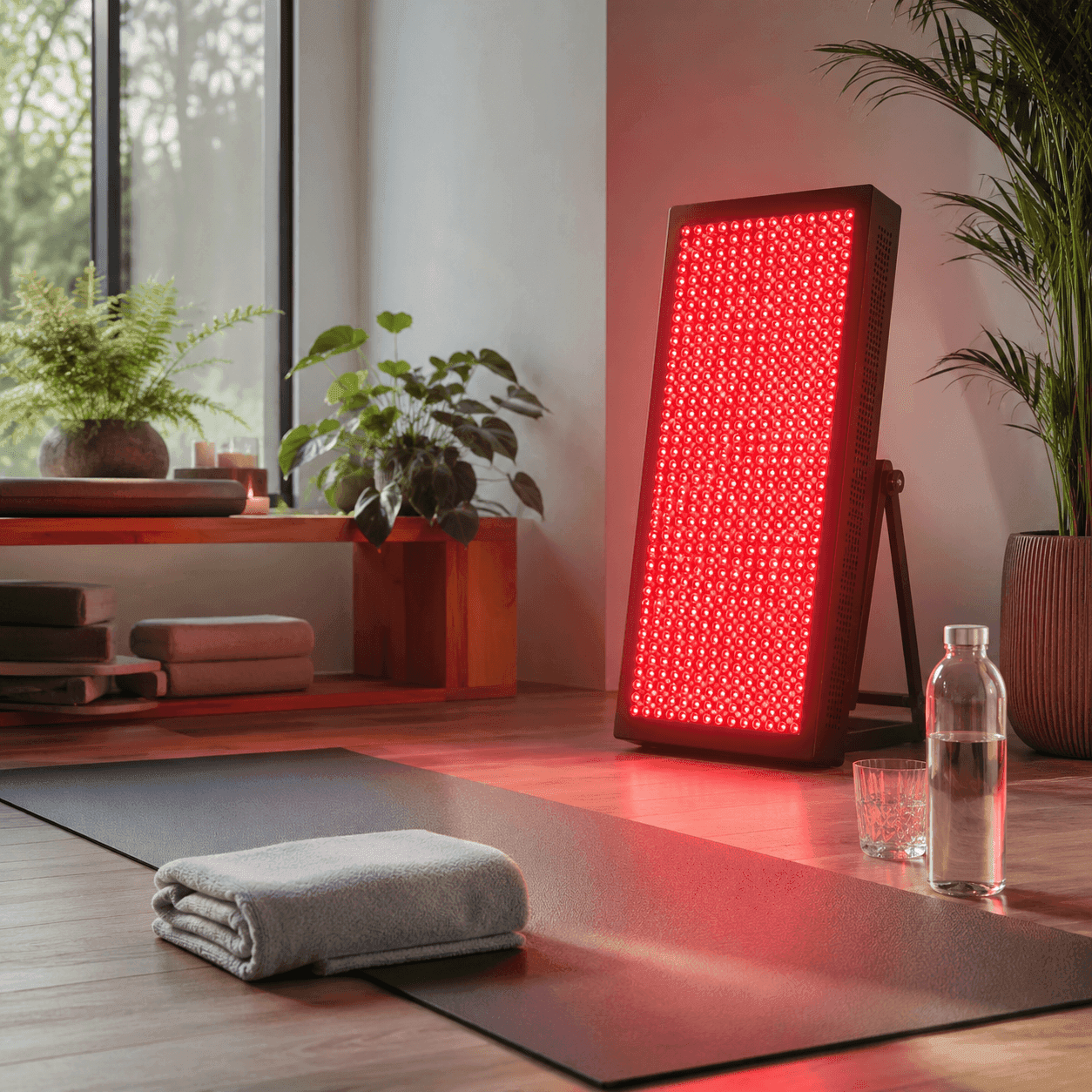

Health · Protocol · ~11 min read
Red light therapy — mitochondrial function, skin, recovery, and how to actually dose it.
Why red and near-infrared light is the most under-rated mitochondrial intervention available, the dosing most people get wrong, and which panels are actually worth the price.
By George Hinestrosa · Personal experience & independent research
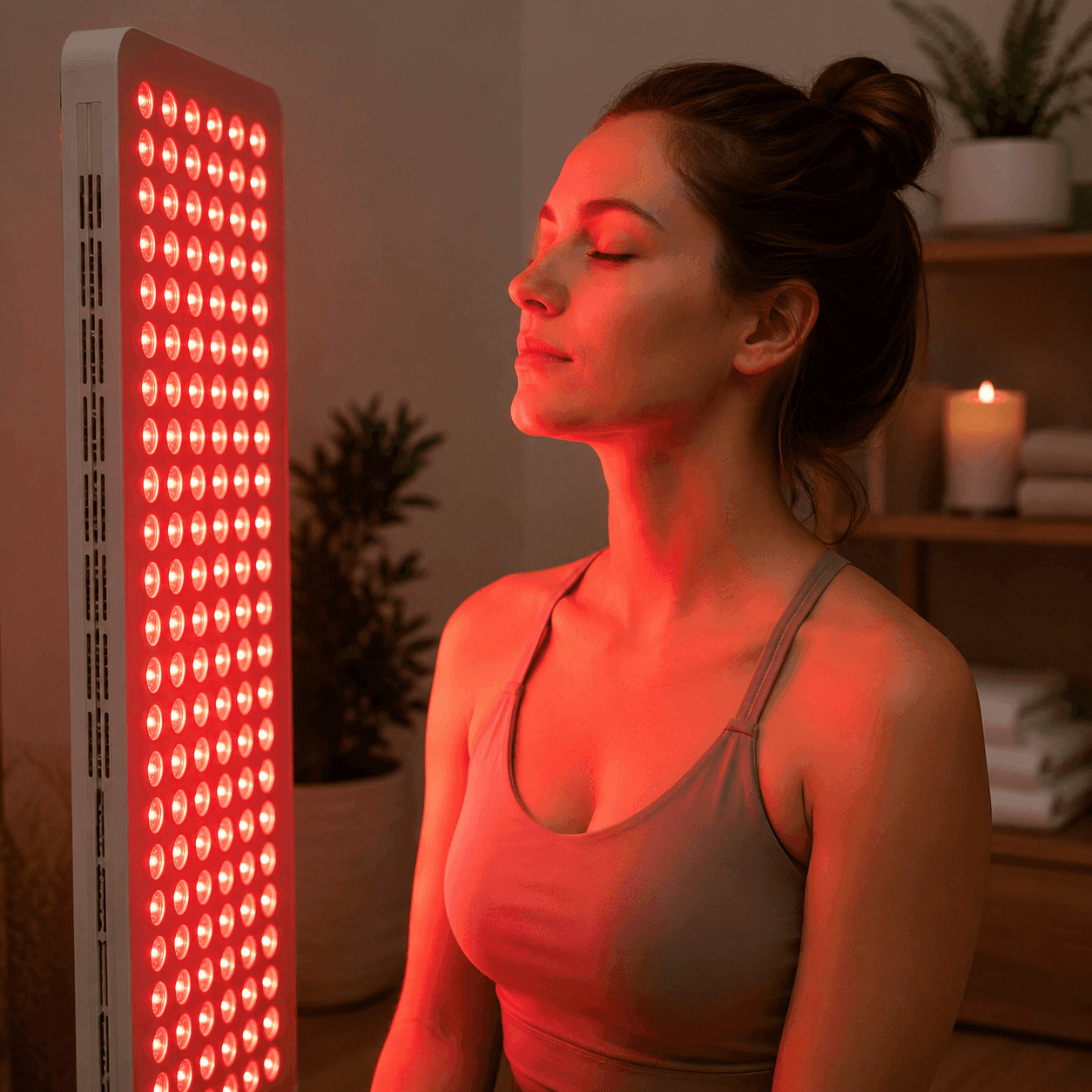
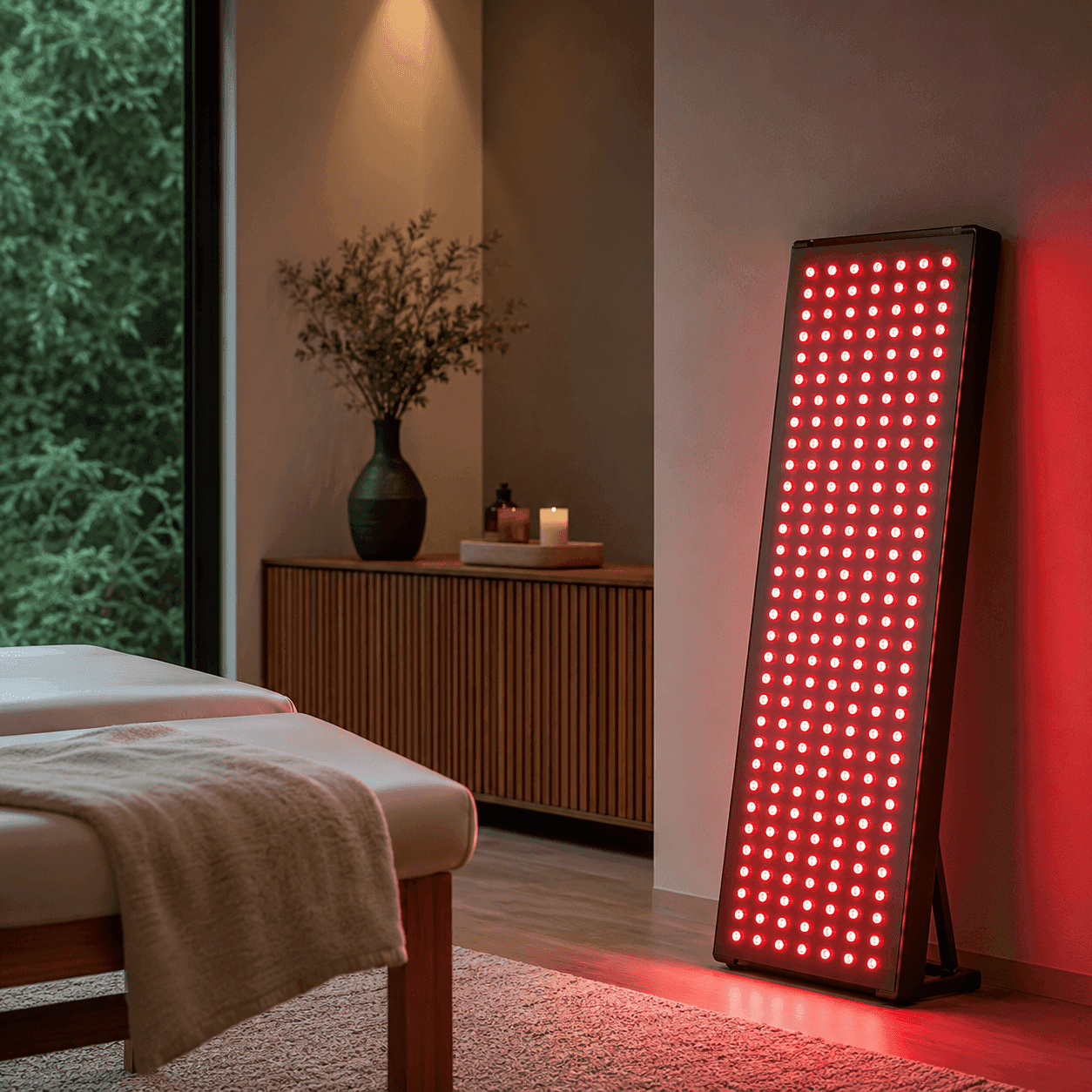
Red light therapy — clinically called photobiomodulation, or PBM — is the use of specific wavelengths of red and near-infrared light to produce biological effects in tissue. The short version of the mechanism: certain wavelengths of light penetrate the skin and are absorbed by cytochrome c oxidase, a key enzyme in the mitochondrial electron transport chain. Absorption of those photons increases ATP production, reduces oxidative stress, and triggers a cascade of downstream effects in skin, muscle, brain, and connective tissue.
That sounds like marketing, except it isn’t. There are over 6,000 peer-reviewed studies on photobiomodulation across forty years of research, much of it conducted by Michael Hamblin’s group at the Wellman Center for Photomedicine at Harvard. The mechanism is genuinely well characterized at this point. What’s consistently overstated is the breadth of applications it’s good for; what’s consistently understated is how meaningful the validated applications actually are.
This article walks through what red light therapy actually does mechanistically, which wavelengths matter and why, the dosing math most consumer users get wrong, the genuine applications (skin, recovery, hair, mood, thyroid) versus the marketing-only claims, and what to look for in a panel that’s actually delivering a clinical dose.
The mechanism, plainly
Mitochondria — the energy-producing organelles in every cell — run their electron transport chain through four protein complexes, ending in Complex IV (cytochrome c oxidase), where oxygen is reduced to water and the proton gradient that drives ATP synthesis is built. Cytochrome c oxidase contains chromophores that absorb light at two specific wavelength ranges: roughly 600-700 nanometers (red) and roughly 800-900 nanometers (near-infrared). When photons at these wavelengths hit the enzyme, electron flow through the chain accelerates, ATP output rises, and nitric oxide displaced from the enzyme produces local vasodilation.
That single mechanism — modest mitochondrial upregulation in the tissue exposed — is responsible for most of the downstream effects. Tissues with higher metabolic demand or impaired mitochondrial function respond more. Tissues at baseline get a smaller bump.
The depth of penetration depends on wavelength. Red light (600-700nm) penetrates the skin to about 5mm — ideal for skin, hair follicles, and surface wound healing. Near-infrared (800-900nm) penetrates 30-50mm — reaching deeper muscle, joints, organs, and, with sufficient power, even brain tissue. Most quality consumer panels combine both wavelength ranges to cover the full depth range.
Where the evidence is genuinely strong
Across the photobiomodulation literature, certain applications are well-supported by randomized trials. I’ll cover them honestly.
Skin and collagen. Multiple randomized trials show meaningful improvements in skin tone, wrinkle depth, elasticity, and acne over 8-12 week treatment courses. Wunsch and Matuschka 2014 in Photomedicine and Laser Surgery is the standard cite — statistically significant collagen-density increases and visible wrinkle reduction from consistent 633nm/830nm sessions. This is probably the best-validated cosmetic application red light has.
Wound and tissue healing. The original NASA work on PBM was specifically for accelerating wound healing in astronauts, and forty years of literature has extended it. Burns, surgical wounds, ulcers, and soft-tissue injuries all heal measurably faster with adjunctive red light. This is one of the more established clinical uses worldwide.
Hair regrowth. Low-level laser therapy (LLLT) for androgenetic alopecia has FDA clearance and the studies behind it are reasonable — meaningful hair-count increases at 16-24 weeks of consistent use. Won’t regrow hair on a fully bald scalp; will thicken and slow loss in the thinning-but-still-present range.
Muscle recovery and performance. Ferraresi’s work and a growing body of sports-medicine literature shows reductions in delayed-onset muscle soreness, faster recovery between training sessions, and modest performance improvements when applied before exercise. The effect is real but the magnitude is smaller than the marketing tends to imply.
Joint pain and osteoarthritis. Reasonable evidence for symptom reduction in knee osteoarthritis specifically, with both red and near-infrared light. Won’t reverse structural damage; will measurably reduce pain and improve function for many users.
Thyroid function. The Hofling group at the University of São Paulo published a series of papers showing substantial improvements in autoimmune thyroiditis — including reductions in TPO antibody levels and decreases in required medication doses — from low-level laser applied to the thyroid. This is one of the more striking applications and one of the least known.
Mood and seasonal depression. Less validated than bright-light therapy for SAD but a growing literature supports red and near-infrared light for mood, particularly when applied to the forehead/prefrontal cortex (transcranial PBM, Cassano et al. studies). Early but interesting.
Where the marketing has gotten ahead of the evidence
Honest treatment matters because the red-light industry has marketed essentially every health condition as red-light-treatable, and most of those claims rest on a single small study or on theoretical mechanism rather than reproducible clinical evidence.
Fat loss. A few small studies show modest circumferential reductions from red light applied to specific areas. The mechanism (transient lipid leakage from adipocytes) doesn’t produce sustained fat loss without caloric deficit, and the effects in the better-controlled studies are small. The marketing claims are well ahead of what the data supports.
Testosterone. The 1939 Myasnikov study often cited (testicular irradiation increasing testosterone in rats) is real but ancient and small. The modern human data is thin. Joovv built much of its marketing around this; the evidence is suggestive at best, and the magnitude of effect (if any) is small compared to the basics covered in the natural testosterone article.
Vision improvement. Glenn Jeffery’s UCL work on 670nm light and retinal mitochondrial function is interesting and preliminary. Calling it “vision restoration” is a stretch. Worth watching the literature; not worth treating as established yet.
The dosing math — what most consumers get wrong
This is the part nobody explains and the part that actually determines whether the panel you buy will do anything for you. PBM dose is measured in joules per square centimeter (J/cm²), which is a function of three things:
- Power density of the panel at a given distance (measured in mW/cm²)
- Time of exposure (in seconds)
- Distance from the panel (irradiance falls off rapidly with distance)
Typical clinical doses in the validated-application studies are 5-60 J/cm² per session. A panel with 100 mW/cm² at 6 inches delivers 6 J/cm² per minute at that distance. So 5 minutes at 6 inches with that panel = 30 J/cm², which sits in the therapeutic window for most applications.
The honest implication: the cheap panels that deliver 20-40 mW/cm² at six inches require three to five times longer sessions to produce the same dose. They’re not useless — you just have to know the math and sit there longer. The premium panels (Joovv, Mito, PlatinumLED at their higher tiers) deliver 100-200 mW/cm² at six inches, which produces a therapeutic dose in 5-15 minutes. The dose, not the brand, is what matters.
One critical point: more is not always better. The PBM dose-response curve is biphasic. Below the therapeutic window, nothing happens. In the window (roughly 5-60 J/cm² depending on application), you get the benefit. Above it (200+ J/cm²), the effect inverts and you can actually suppress mitochondrial function. Longer is not better past the window, and the people running 60-minute daily sessions on high-output panels are often doing themselves no favors.
Practical protocol
Distance. 6-12 inches from the panel is the standard therapeutic range. Closer than 6 inches risks over-dosing on high-output panels; further than 12 inches means most of the irradiance is lost and session times need to be much longer.
Time. 10-20 minutes per session for most quality panels at the standard distance. Specific clinical protocols vary by application — muscle recovery is shorter (5-10 minutes), skin and hair need consistent 15-20-minute sessions, deep joint/organ targeting may need 20+.
Frequency. 3-5 sessions per week is the typical clinical protocol. Daily works for shorter sessions but isn’t necessary for most applications. Consistency over months matters more than any single session.
Skin exposure. Light must reach skin to work. Clothing blocks most of the relevant wavelengths. Underwear or nothing is the dressing standard during a session. This isn’t marketing fluff — it’s the actual physics.
Eye protection. Higher-output panels are bright enough that direct staring isn’t comfortable. Most premium panels include goggles. Use them. Squinting through a session is not the protocol.
What separates a good panel from a marketing one
The red-light panel market exploded in the last few years and the quality variance is substantial. The dimensions that matter:
Measured irradiance at distance. Good brands publish independent third-party measurements of mW/cm² at 6 inches and 12 inches. Brands that don’t publish this number are usually hiding a low one. Solar-meter readings on Amazon reviews are sometimes useful as independent confirmation.
Wavelength specifications. The validated peaks are roughly 630nm, 660nm, 810nm, 830nm, and 850nm. Good panels combine red (typically 660nm) and near-infrared (typically 850nm). Panels marketing exotic wavelengths (730nm, 1050nm) outside the well-studied ranges are betting on novelty over evidence.
Flicker. Cheap drivers produce noticeable flicker, which triggers headaches in sensitive users and may blunt some of the benefit. Premium panels use high-frequency drivers that produce flicker-free light. The video-camera test on the panel running (look at the panel through a phone’s camera in slow-motion) will reveal flicker if it’s present.
EMF. High-quality panels keep electromagnetic field emissions low at the user-distance range. Most premium brands publish EMF measurements; budget brands generally don’t. The literature on chronic low-EMF exposure remains contested; I consider it a tie-breaker between otherwise comparable panels rather than a primary decision factor.
Panel size and coverage. A small panel covering only the face delivers the facial-skin benefits but not whole-body mitochondrial effects. A vertical full-body panel (Joovv Solo or larger) is what unlocks systemic benefits in a reasonable session length. Decide what coverage you actually want before you buy.
Where to start
A simple setup is a panel propped against a wall with a chair positioned 8-10 inches from it. A standard session is 15 minutes in the morning, shirt off, eyes closed, three to four times per week — facing the panel for 7-8 minutes, then turning to expose the back of the body for the remainder.
The honest report from consistent users over a year or two tends to be: noticeably better skin tone, older minor scars faded more than expected, and chronic stiffness in a long-standing problem joint measurably improved. The mood effect is real but subtle — morning sessions in winter seem to help, though that’s hard to disentangle from a morning-sunlight routine done alongside it.
What red light generally won’t do: dramatic cardiovascular shifts, energy transformations, or sleep improvements (those come from the interventions in the sleep article, not the panel). It’s a real intervention with a specific mechanism. It does what it does; it doesn’t do everything.
Products I’d recommend
The price-to-performance gradient is wide. Below are the panels worth looking at across the range.
Joovv Solo 3.0 is the brand that legitimized consumer red-light therapy. Best-in-class build quality, third-party tested irradiance, multiple wavelength settings, modular panels that link together to build a full-body wall. The premium pricing is real, but so is the longevity of the product. The Solo 3.0 is the single-panel option; their larger models scale up from there.
Mito Red MitoPRO 1500 is the mid-premium option I’d recommend for most serious buyers. Comparable irradiance to Joovv at a meaningfully lower price, third-party testing published, well-regarded in the functional-medicine community. Build quality is high; the customer support is real. The 1500 is a full-body panel; their smaller models cover the same ground at lower prices.
PlatinumLED Biomax 600 is the technical-spec leader at the mid-tier — five wavelength bands (630, 660, 810, 830, 850nm) rather than the standard two, very high irradiance per square inch, and consistently top-of-spec measurements in independent testing. Slightly less polished aesthetically than Joovv but technically excellent.
Hooga HG500 is the budget-tier panel I’d recommend. Genuinely usable irradiance (lower than premium, higher than the no-name Amazon options), third-party measurements available, no-frills build. The right entry point for someone wanting to prove out red light before committing premium money.
BON CHARGE Mini Red Light Therapy Device is the targeted option for face, joint, or spot treatment rather than whole-body work. Portable, travel-friendly, good for hair-thinning treatment on scalp or specific skin concerns. Won’t do systemic mitochondrial work, but for the targeted applications it covers, it’s a sensible choice.
The bottom line
Red and near-infrared light therapy is a genuine intervention with a well-characterized mitochondrial mechanism and a substantial evidence base for specific applications: skin and collagen, wound healing, hair regrowth, muscle recovery, joint pain, thyroid function, and (emerging) mood. The dose matters more than the brand, the dose-response curve is biphasic (more is not always better), and the cheap panels generally require longer sessions to produce a therapeutic dose.
A reasonable starting protocol: a quality panel at 6-12 inches, 10-20 minutes per session, 3-5 sessions per week, on bare skin, with eye protection. Give it 8-12 weeks of consistency before judging whether it’s producing the effect you wanted. Skin and recovery improvements usually show up first; hair and deeper-tissue effects need the longer window.
Not magic. Not nothing either. A real tool that does specific things well when used in the right dose.
Sources & further reading
Mechanism and foundational research
- Hamblin MR. Mechanisms and applications of the anti-inflammatory effects of photobiomodulation. AIMS Biophysics. 2017;4(3):337-361. — Harvard Wellman Center, the standard mechanistic reference.
- Karu TI. Mitochondrial signaling in mammalian cells activated by red and near-IR radiation. Photochemistry and Photobiology. 2008;84(5):1091-9. — cytochrome c oxidase activation evidence.
- Huang YY, Sharma SK, Carroll J, Hamblin MR. Biphasic dose response in low level light therapy — an update. Dose-Response. 2011;9(4):602-18.
Skin, hair, and wound healing
- Wunsch A, Matuschka K. A controlled trial to determine the efficacy of red and near-infrared light treatment in patient satisfaction, reduction of fine lines, wrinkles, skin roughness, and intradermal collagen density increase. Photomedicine and Laser Surgery. 2014;32(2):93-100.
- Avci P, Gupta A, Sadasivam M, et al. Low-level laser (light) therapy (LLLT) in skin: stimulating, healing, restoring. Seminars in Cutaneous Medicine and Surgery. 2013;32(1):41-52.
- Lanzafame RJ, Blanche RR, Bodian AB, et al. The growth of human scalp hair mediated by visible red light laser and LED sources in males. Lasers in Surgery and Medicine. 2013;45(8):487-95.
Recovery, joints, and thyroid
- Ferraresi C, Huang YY, Hamblin MR. Photobiomodulation in human muscle tissue: an advantage in sports performance? Journal of Biophotonics. 2016;9(11-12):1273-1299.
- Brosseau L, Welch V, Wells GA, et al. Low level laser therapy (Classes I, II and III) for treating osteoarthritis. Cochrane Database of Systematic Reviews. 2007;(1):CD002046.
- Höfling DB, Chavantes MC, Juliano AG, et al. Low-level laser in the treatment of patients with hypothyroidism induced by chronic autoimmune thyroiditis: a randomized, placebo-controlled clinical trial. Lasers in Medical Science. 2013;28(3):743-53.
Mood, brain, and vision
- Cassano P, Petrie SR, Hamblin MR, et al. Review of transcranial photobiomodulation for major depressive disorder. Neurophotonics. 2016;3(3):031404.
- Shinhmar H, Grewal M, Sivaprasad S, et al. Optically improved mitochondrial function redeems aged human visual decline. Journals of Gerontology Series A. 2020;75(9):e49-e52. (Glenn Jeffery group, UCL)
Other authority figures
- Huberman A. Public protocols on red and near-infrared light for skin, recovery, and circadian function — Huberman Lab podcast.
- Berg E. Public commentary on red light therapy as a mitochondrial intervention — YouTube channel.