
Health · Superfood · ~9 min read
Spirulina — the algae the Aztecs ate and NASA studied.
Why source matters more than almost anywhere else in supplementation, what phycocyanin actually does, and where the heavy-metal-binding claim earns its keep.
By George Hinestrosa · Personal experience & independent research
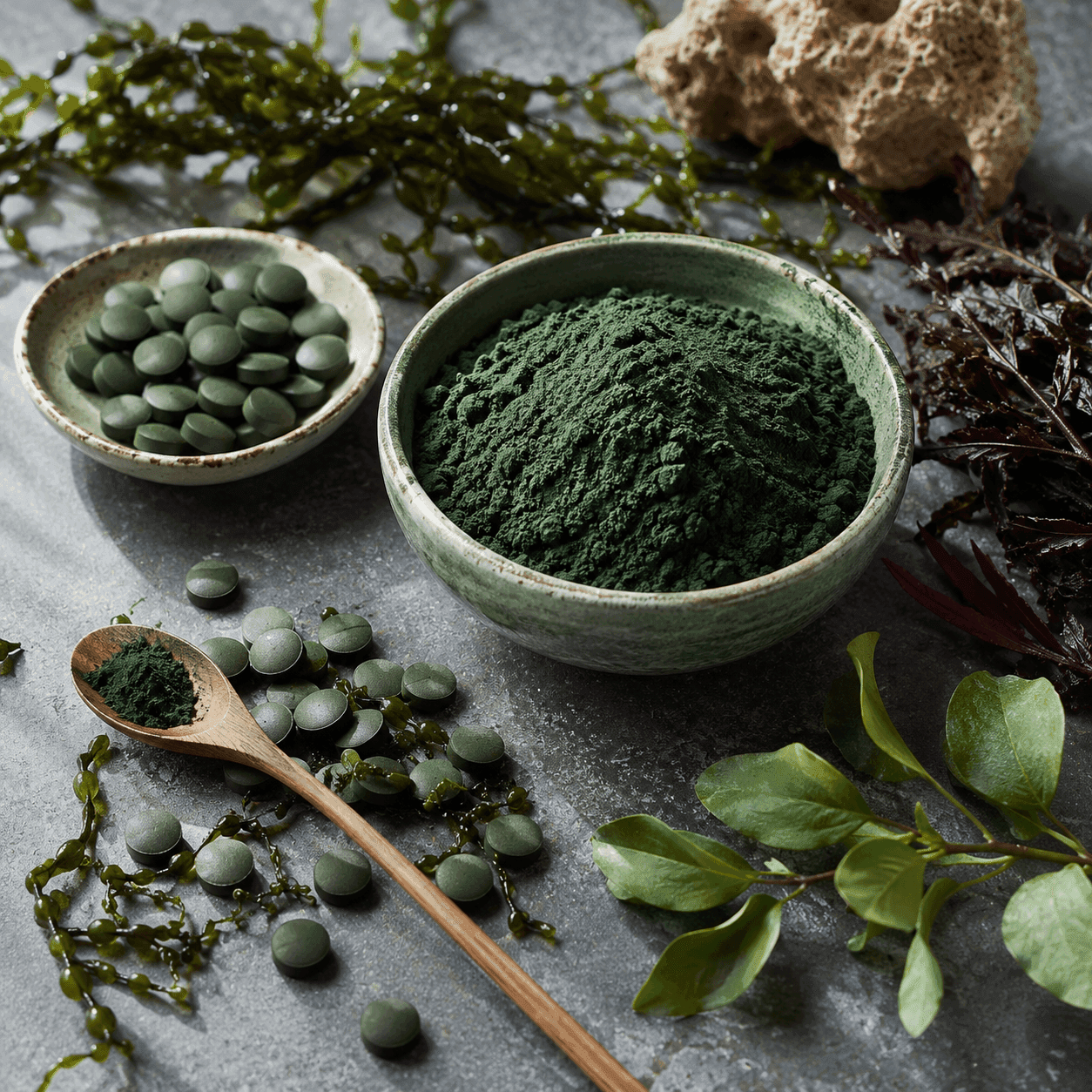
Spirulina is a blue-green algae — technically a cyanobacterium, not a plant — and an ancient one, growing in shallow alkaline lakes. It’s one of the oldest life forms on earth, and one of the most nutritionally dense foods ever characterized.
The Aztecs harvested it from Lake Texcoco, dried it into cakes called tecuitlatl, and ate it as a staple protein source. NASA studied it in the 1970s as a candidate food for long-duration space missions because no other food packs more complete nutrition per gram. The African Lake Chad communities have harvested wild spirulina (dihé) for centuries. And the modern alt-health literature has built three separate protocols around its phycocyanin content, its heavy-metal binding properties, and its protein density.
All of which is true. And all of which depends entirely on getting clean spirulina from a clean source. The quality question isn’t optional with this one.
The protein density
Dried spirulina is roughly 60–70% protein by weight — higher than any other natural food. A single tablespoon (roughly 7 grams) delivers about 4 grams of complete protein, with all nine essential amino acids present in usable ratios. By weight, spirulina has more protein than beef, chicken, soybeans, or anything else in the human diet.
For vegetarians and vegans, this matters. Plant-protein density is normally constrained by either lower absolute protein content (most vegetables) or incomplete amino acid profiles (most legumes, by themselves). Spirulina has neither problem. A 5-gram daily dose adds a small but complete protein contribution to the diet without the fiber or carb load that plant-protein sources usually bring.
The Aztec name tecuitlatl meant “stone’s excrement” — a reference to the dried green cakes they pulled out of Lake Texcoco and pressed into bricks. Not poetic, but accurate to what they were doing: harvesting a wild high-protein food and storing it for the dry season. It was traded as a staple commodity in the Aztec empire.
Phycocyanin — the blue pigment
The compound that gives spirulina its characteristic deep blue-green color is phycocyanin, a water-soluble protein-pigment unique to the cyanobacteria and a few related organisms. Pound for pound, phycocyanin is one of the most powerful natural antioxidants ever characterized.
What phycocyanin actually does:
- Selective COX-2 inhibition. Phycocyanin inhibits COX-2 (the inflammatory enzyme NSAIDs target) without affecting COX-1, the same selective pattern as ginger and turmeric. The clinical implication is genuine anti-inflammatory activity without the GI damage NSAIDs cause.
- Free radical scavenging. Phycocyanin scavenges peroxyl, hydroxyl, and alkoxyl radicals at concentrations meaningfully higher than standard reference antioxidants like ascorbic acid.
- Liver protection. Multiple animal and small human studies have documented phycocyanin’s protective effect on the liver against hepatotoxins, drug damage, and radiation.
- Hematopoietic support. Phycocyanin’s molecular structure is similar to bilirubin and biliverdin and stimulates red-blood-cell production. Reported clinical use in some anemia presentations.
- Anti-cancer activity — in vitro and animal studies have shown apoptosis induction in several cancer cell lines. The human evidence is preliminary but consistent enough that several research groups are pursuing it.
All of which is to say: the blue pigment isn’t cosmetic. It’s a significant fraction of what spirulina does.
Heavy-metal binding — Klinghardt’s protocol
One of the most-cited uses of spirulina in alt-health practice is heavy-metal chelation — particularly mercury, lead, cadmium, and arsenic. The mechanism involves both phycocyanin and chlorophyll binding metal ions in the gut, preventing their reabsorption from bile, and promoting their excretion through feces.
Dr. Dietrich Klinghardt — one of the leading alt-health authorities on heavy-metal toxicity — includes spirulina alongside chlorella as core components of his metal-detox protocol. The principle is the enterohepatic circulation of metals: the liver excretes mercury into the bile, the bile dumps it into the small intestine, and without a binder present in the gut at that moment, much of it gets reabsorbed. Spirulina (and chlorella) provide that binder.
The clinical literature here is meaningful but uneven — population studies after the Chernobyl disaster, where Belarusian children given 5 g of spirulina daily for 45 days showed substantial reductions in markers of radiation damage and improved immune function. The protocols have continued to be used in alt-health practice since.
The practical implication: spirulina is one of the cheapest, most accessible binders available, and it doubles as a nutrient source while it works. It isn’t a one-size chelation protocol on its own, but it’s a useful daily input alongside any broader detox effort.
Iron, vitamins, minerals
Spirulina is unusually iron-dense — about 28 mg per 100 grams of dried product, more than 150% of the adult RDA. The form is highly bioavailable, substantially better-absorbed than most plant irons. For people who can’t or won’t eat red meat or organ meats, spirulina is one of the cleanest non-animal iron sources available.
Other nutrients present in meaningful quantities:
- Beta-carotene (vitamin A precursor) — very high concentration
- Vitamin K
- B vitamins B1, B2, B3, B5, B6, B9 (folate)— though not B12, per the disclaimer above
- Magnesium, potassium, manganese, copper, zinc
- Gamma-linolenic acid (GLA) — an anti-inflammatory omega-6 fatty acid normally associated with evening primrose oil and borage. Rare in the food supply otherwise.
- Chlorophyll — in concentrations rivalling wheatgrass
The B12 trap
This deserves a section of its own because the misinformation here is unusually common.
Spirulina contains B12 — on the supplement-facts panel and in many marketing claims. But it’s mostly pseudovitamin B12 (corrinoid analogues) that humans can’t use functionally. Worse, those analogues may compete with real B12 at receptor sites and worsen functional deficiency in vegans relying on spirulina as their B12 source.
The standard alt-health correction: take spirulina for everything else it does, but get your B12 from methylcobalamin supplements or animal foods (see the B12 article). Don’t conflate the pseudovitamin spirulina contains with the real vitamin you actually need.
Quality and sourcing — the non-negotiable part
Spirulina is grown in open ponds (or, in better operations, controlled raceways). The quality of the water it grows in is the quality of the final product. Contaminated water produces contaminated spirulina — heavy metals from polluted soil and runoff, microcystins from associated cyanobacteria species, agricultural pesticides.
Two regions consistently produce reliable, third-party- tested spirulina:
- Hawaii (Kona). Cyanotech and Nutrex Hawaii grow spirulina in controlled raceways with deep-ocean water and filtered freshwater. Third-party tested. The gold standard.
- California. Earthrise has produced spirulina in the Sonoran Desert for decades. Quality control well-documented.
Bulk spirulina from unidentified Chinese sources has been repeatedly found to contain heavy metals at levels that exceed safe daily intake even at modest spirulina doses. The price difference between bulk Chinese product and Hawaii-sourced product is meaningful, but the safety margin is not.
Look for products that publish their heavy-metal and microcystin test results. Reputable brands do this; the ones that don’t are signalling something by their silence.
Spirulina versus chlorella
Spirulina and chlorella often appear together in detoxification protocols, and people new to algae foods often want to know which to choose. The short version:
- Spirulina — higher protein, easier to digest (no cell wall), higher phycocyanin, anti-inflammatory and hematopoietic emphasis.
- Chlorella — stronger heavy-metal binder (the cell wall is the binding agent and must be cracked or broken mechanically in processing for the product to work), higher chlorophyll, gut-detox emphasis.
For general daily use, spirulina is the more versatile choice. For aggressive heavy-metal protocols, the two together are stronger than either alone. The standard Klinghardt approach is to take both, with spirulina in slightly higher amounts.
Forms and dosing
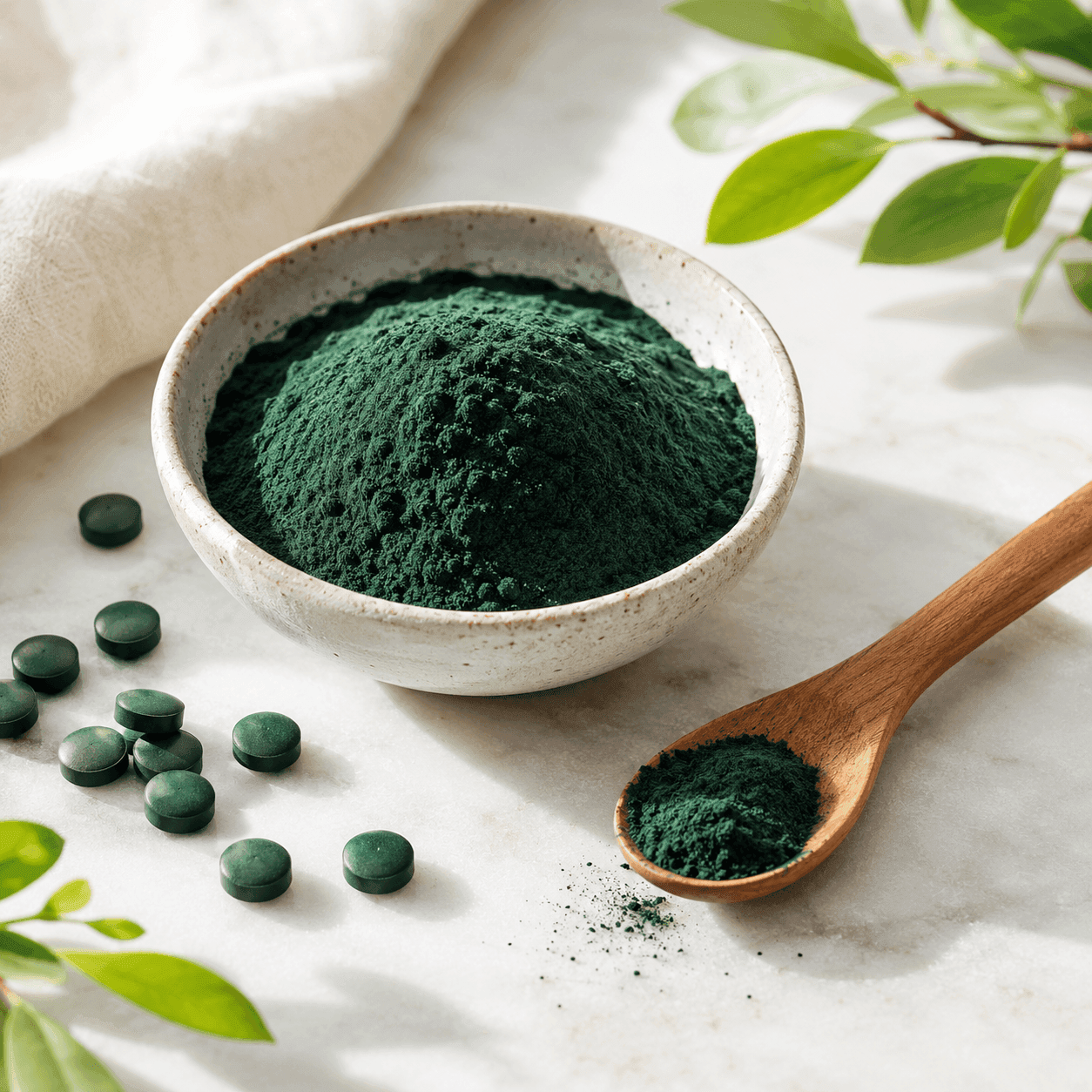
- Powder. The most versatile and economical form. Mix into smoothies, juices, or water. Deep blue-green color makes anything you mix it with also deep blue-green.
- Tablets. The most convenient form, dose-precise, easy to travel with. Slightly more processed than powder but the active compounds survive the tableting.
- Capsules. Same as tablets but encapsulated; useful for people who can’t tolerate the taste at all.
Dosing:
- Maintenance: 2–3 grams daily.
- Athletic / recovery / inflammatory load: 4–5 grams daily.
- Detoxification protocols: 5–10 grams daily, usually paired with chlorella and a binder like activated charcoal.
Start at the low end. Spirulina can produce a mild initial detox response (headache, fatigue) in people who’ve been carrying a higher toxic load. Ramp up gradually.
How to consume it — the taste problem
Spirulina tastes like the pond it was grown in. There isn’t much polite framing for it. Some people adapt quickly. Most people use it as a smoothie addition where stronger flavors mask the pond.
What works:
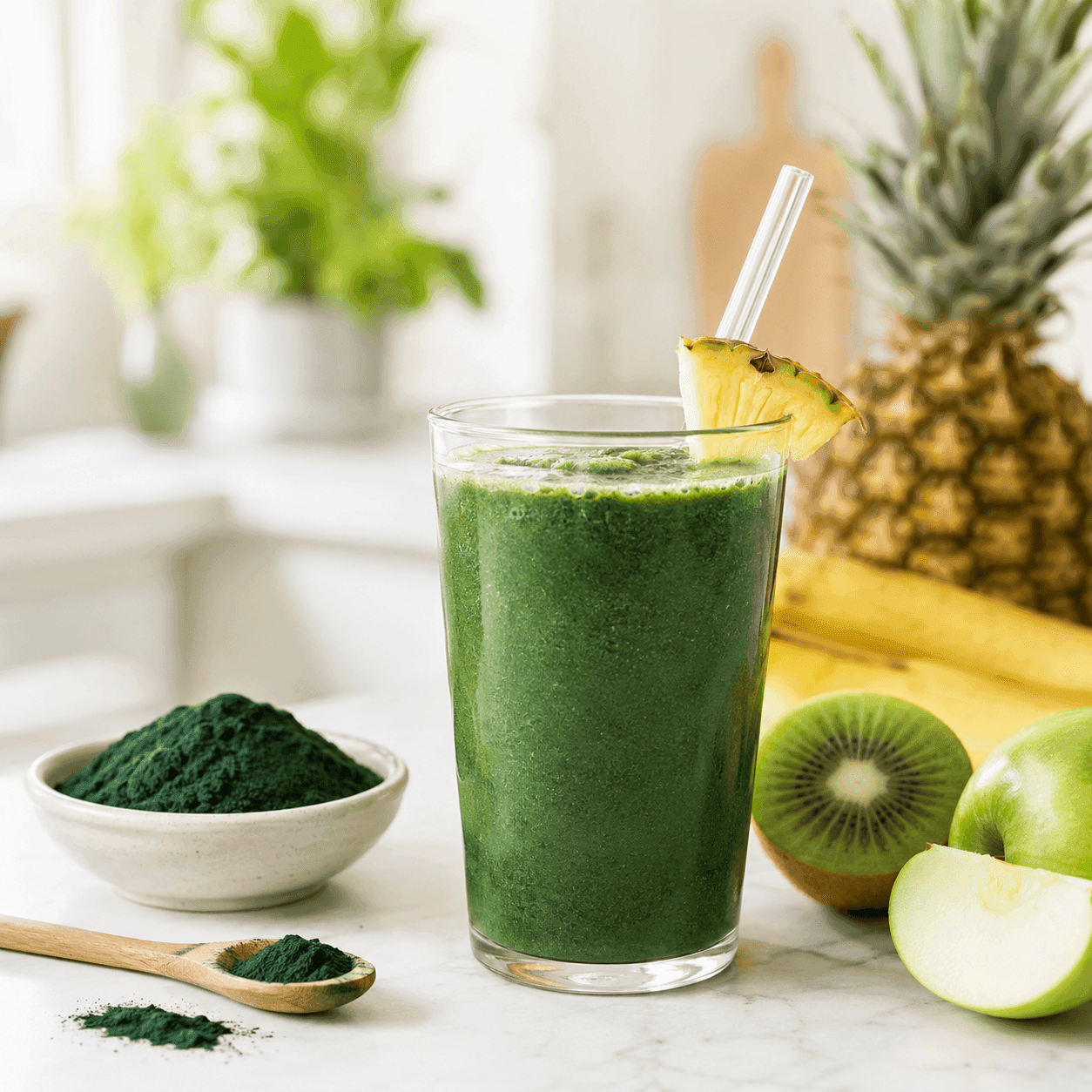
- Frozen banana + frozen berries + spirulina + raw honey + nut milk in a blender. The berries dominate the palate and the banana sweetens.
- Spirulina + pineapple juice (the pineapple acidity cuts through).
- Spirulina + lemon + honey + cold water for a less-pleasant but functional shot.
- Tablets with water, ignored entirely — the most practical daily delivery system for people who never acquire the taste.
Where I buy spirulina
- Nutrex Hawaii Pacifica Spirulina Powder — the gold standard. Kona-grown, third-party tested, the most-recommended product across the alt-health literature.
- Nutrex Hawaii Pacifica Spirulina Tablets — same source, tablet form. The form I default to for travel and for days when blending isn’t practical.
- Pure Hawaiian Spirulina Powder — alternative Hawaii brand. Slightly different processing, also clean and well-tested.
- Earthrise Spirulina Natural — the California option. One of the oldest continuous U.S. spirulina producers. Reliable, well- tested, sometimes more available than the Hawaii brands.
Where to start
A common starting point is about 3 grams (roughly six tablets) of Hawaii-grown spirulina with breakfast most days. On smoothie days, half a teaspoon of the powder can go in instead.
Higher doses (4–5 grams) suit training days, stretches of high environmental exposure (travel through polluted cities, dental work involving amalgam removal), or more deliberate seasonal detox phases.
Closing
Spirulina is one of those foods where the alt-health framing, the traditional use, and the modern science all converge. Protein-dense, mineral-rich, phycocyanin-loaded, and quietly working as a heavy-metal binder in the background. An ancient food, and one of the cleanest dense foods on earth, available at most health-food stores for the price of a coffee.
Get the Hawaii-grown version. Skip the cheap stuff. Take it daily. Don’t mistake the pseudovitamin B12 for real B12. The body knows what to do with the rest of it.
Sources & further reading
Authorities cited
- Dr. Dietrich Klinghardt, MD, PhD — Foremost alt-health authority on heavy-metal toxicity; spirulina and chlorella are core components of his clinical detox protocols.
- Cyanotech Corporation (Nutrex Hawaii) — The Kona-based spirulina producer with the most-cited safety and purity record in the industry.
Studies cited
- Loseva, L.P. & Dardynskaya, I.V. (1993). Spirulina — natural sorbent of radionuclids. Research Institute of Radiation Medicine, Minsk, Belarus. — The Belarusian Chernobyl-aftermath research on spirulina and radiation-damage markers in children.
- Romay, C. et al. (2003). C-phycocyanin: a biliprotein with antioxidant, anti-inflammatory and neuroprotective effects. Current Protein and Peptide Science. — Comprehensive review of phycocyanin pharmacology — the standard reference on the blue pigment’s clinical effects.
- Watanabe, F. et al. (1999). Pseudovitamin B12 is the predominant cobamide of an algal health food, spirulina tablets. Journal of Agricultural and Food Chemistry. — The foundational paper documenting that spirulina B12 is mostly pseudovitamin, not the bioavailable form.
Further reading
- Spirulina in Human Nutrition and Health — Gershwin & Belay (eds.) — The comprehensive academic reference on spirulina’s clinical applications and biochemistry.