

Health · Protocol · ~12 min read
Weight lifting — muscle is the largest endocrine organ.
Why muscle is the most under-rated longevity organ, the sarcopenia problem nobody warns you about, the compound lifts that produce most of the benefit, and a starting protocol that works for almost anyone.
By George Hinestrosa · Personal experience & independent research

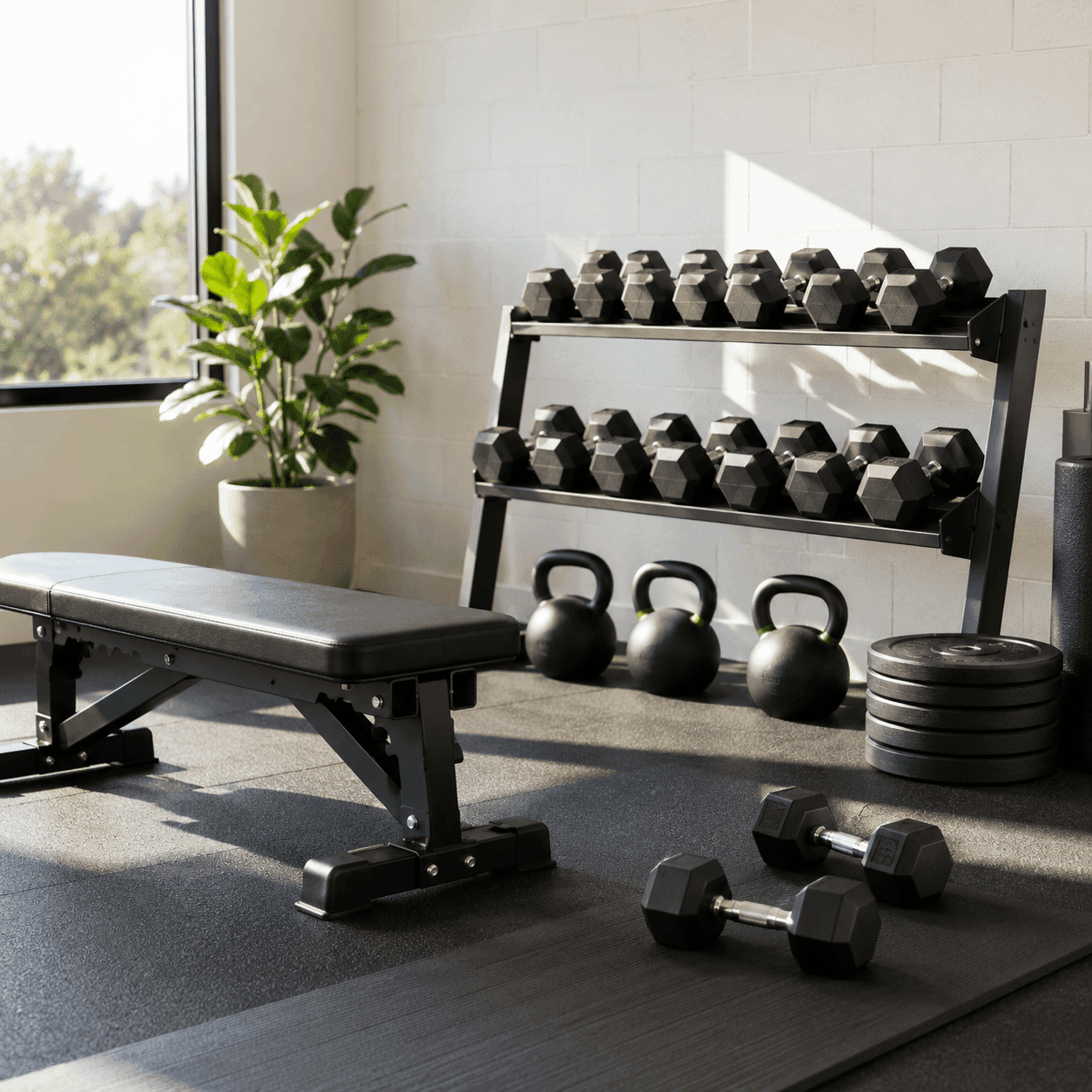
For most of the late twentieth century, the cultural consensus on exercise was that cardio was for health and weight lifting was for bodybuilders. That framing has aged badly. The science of the last two decades, much of it driven by researchers like Stuart Phillips, Peter Attia, and Gabrielle Lyon, has converged on something different: muscle is the largest endocrine and metabolic organ in the body, the most important predictor of healthy aging is the muscle mass and strength you carry into your sixties and seventies, and the single intervention that builds and preserves it is resistance training.
Cardio is necessary. The fasting, walking, and Zone 2 cases in this section all hold up. But cardio alone, without resistance training, leaves you cardiovascularly fit and metabolically vulnerable. The combination is what produces the long functional lifespan that most people say they want.
This article makes the case for resistance training as a fundamental health practice (not a vanity pursuit), walks through what muscle actually does metabolically and endocrinologically, explains why sarcopenia is the under-discussed catastrophe of modern aging, covers protein and recovery, and ends with a starting protocol that produces most of the benefit in three sessions a week.
Muscle is an endocrine organ
This was not the textbook framing twenty years ago. Muscle was a contractile tissue that moved bones. Then in the early 2000s, researchers (Bente Pedersen’s lab in Copenhagen was central) began identifying signaling molecules secreted by muscle during contraction. These molecules — now called myokines — act on other tissues throughout the body: liver, fat, bone, brain, immune system.
The myokine list is now extensive and growing. A few of the most studied:
IL-6 (when released by contracting muscle, not by chronic inflammation) acts as an anti-inflammatory signal and improves insulin sensitivity. Same molecule, opposite effect, depending on source — one of the more interesting findings in modern endocrinology.
Irisin converts white fat to brown fat (the metabolically active kind), improves cognition in animal models, and is implicated in the neuroprotective effects of exercise.
BDNF (brain-derived neurotrophic factor) supports neuron growth and survival; resistance training substantially elevates it.
Myostatin (a negative regulator of muscle growth) is suppressed by resistance training, opening the metabolic space for further muscle adaptation.
The practical implication: when you train muscle, you’re not just building a contractile tissue. You’re upregulating a signaling system that improves nearly every aspect of metabolic and cognitive health. This is the mechanism behind Gabrielle Lyon’s “muscle-centric medicine” framework — that the leverage point for most chronic disease isn’t the diseased tissue, it’s the muscle mass that supplies the signals keeping the other tissues healthy.
The glucose-disposal case
Skeletal muscle is the largest insulin-sensitive tissue in the body. After a meal, roughly 80% of ingested glucose ends up in muscle, either burned for fuel or stored as glycogen. The size of your muscle mass directly determines the body’s capacity to handle a carbohydrate load.
A small, low-muscle-mass individual has a small sink. A meal that’s mostly carbohydrate overflows the sink quickly, blood glucose spikes high, insulin rises, the pancreas has to work hard. Over years, that pancreatic overwork is the substrate of insulin resistance and type 2 diabetes — the framing covered in the fasting article.
A muscular individual has a large sink. The same meal disperses into glycogen without producing a large glucose spike. Insulin rises moderately. The pancreas isn’t taxed. The same diet, in other words, has different metabolic consequences depending on the size of the muscle sink it’s being deposited into.
This is the most under-appreciated long-term benefit of resistance training. You’re not just building strength. You’re expanding metabolic capacity in a way that protects you against the dietary chaos most modern people are exposed to.
Sarcopenia — the catastrophe nobody warns you about
Sarcopenia is the age-related loss of muscle mass and strength. It begins around age 30 and accelerates after 60. The average person loses roughly 3-8% of their muscle mass per decade after 30, and twice that after 60 if they don’t actively resist it. By 75-80, the typical non-training adult has lost half the muscle they had at 25.
The consequences are not cosmetic. They’re functional. Loss of muscle is loss of independence: ability to stand from a chair without help, climb stairs, lift groceries, catch yourself from a fall. Falls themselves — the leading cause of injury death in adults over 65 — are substantially a sarcopenia problem. The hip fractures from those falls become death sentences because the body has no muscle reserve to recover.
Peter Attia’s framing in Outlive is the most compelling I’ve read on this. He calls the last decade of life “the Marginal Decade” — the period when small functional capacities determine whether you can live independently or not. He argues that the interventions that determine the quality of the Marginal Decade have to start at least thirty years earlier, because muscle takes that long to build and maintain at the levels you’ll need to draw down from in your 80s.
Translation: the resistance training you do in your 40s is the foundation of whether you can lift your own grandchild in your 70s. Started in your 60s, it’s rehabilitation. Started in your 40s, it’s prevention.
Bone density
Bone responds to mechanical loading. Wolff’s Law — the principle that bone remodels in response to the loads placed on it — has been understood for over a century. Loaded bone gets denser; unloaded bone resorbs.
Resistance training is the most efficient way to load bone. Compound lifts (squat, deadlift, overhead press, row) place axial load through the skeleton in ways that walking and cardio don’t. For women specifically — who face accelerated bone loss at menopause and account for roughly 80% of osteoporotic fractures — resistance training is the single most effective non-pharmacological intervention available. The LIFTMOR trial (Watson 2018) showed that heavy-load resistance training in postmenopausal women produced bone density improvements pharmaceutical bisphosphonates don’t reliably match.
Light weights with high reps are largely useless for bone density. Bone needs meaningful load to adapt — the rule of thumb is the load that challenges you in the 5-8 rep range, with proper form.
The hormonal response
Heavy compound resistance training acutely raises testosterone and growth hormone, particularly in men, and the effect compounds over years with consistent training. The natural-testosterone article in this section covers the broader case; resistance training is the largest single non-pharmacological lever on testosterone in men, and the most important behavioral intervention for maintaining levels through aging.
For women, the testosterone effect is smaller in absolute terms but still meaningful, and the broader hormonal benefits — insulin sensitivity, growth hormone, the myokine system generally — apply equally. Women who train seriously do not become bulky in the cartoonish way the culture warns about; testosterone levels preclude it. They become strong, lean, and functionally capable in ways that change how the rest of their lives feel.
The protein requirement
Building muscle requires amino acids; preserving muscle through aging requires more of them, not less. The standard RDA for protein (0.8 g per kg of bodyweight, or roughly 0.36 g per pound) is the minimum to prevent overt deficiency — it’s not the amount that supports muscle preservation or growth.
The functional recommendation from researchers like Stuart Phillips and the consensus in the strength community is meaningfully higher: 1.6-2.2 grams of protein per kilogram of bodyweight per day, which is roughly 0.7-1.0 grams per pound. For a 180-pound person, that’s 125-180 grams of protein per day — substantially more than most Americans eat without conscious attention.
For older adults specifically, the requirement goes up rather than down. The phenomenon called anabolic resistance means aging muscle requires more amino acids to produce the same anabolic response. Older adults eating “normal” amounts of protein are functionally under-fed for muscle preservation. 1.0-1.2 g/kg/day at minimum, ideally higher, is the current functional-medicine consensus for the over-65 population.
Sources: animal protein (meat, eggs, dairy, fish) provides complete amino acid profiles with high leucine content (leucine being the key trigger for muscle protein synthesis). Plant proteins work but require more careful combining and larger total volumes to match. The protein source matters less than reaching the daily target.
The compound lifts
Almost all of the benefit of resistance training for most people comes from a handful of compound movements that recruit large amounts of muscle at once. Mark Rippetoe’s Starting Strength is the standard reference. The four foundational lifts:
Squat. The fundamental lower-body lift. Trains quads, glutes, hamstrings, core, and the entire posterior chain. Builds bone density through axial loading. Variations include back squat (barbell on the upper back), front squat (barbell on the front shoulders), and goblet squat (a dumbbell held to the chest, the right starting variation for beginners).
Deadlift. Lifting a loaded barbell from the floor. Recruits essentially every muscle in the body, with particular emphasis on the posterior chain (glutes, hamstrings, low back, traps). The most efficient single lift for whole-body strength. Form is critical; learn it under coaching before loading heavy.
Overhead press. Pressing a barbell or dumbbells overhead from the shoulders. Trains shoulders, triceps, upper back, and core stabilization. The lift that keeps shoulder mobility and overhead capacity functional through aging.
Bench press or push-up progression. Horizontal pressing for chest, shoulders, and triceps. Bench press is the standard barbell version; for home training, push-up variations (regular, decline, weighted) cover most of the same ground.
Pull-up or row. The horizontal counterpart to pressing. Trains back, biceps, rear shoulders, and grip. Pull-ups for vertical pulling, rows for horizontal. Most people can’t do an unassisted pull-up at first; assisted or band-supported versions are the entry point.
That’s essentially the entire program for the first year. Squat, deadlift, press, bench, row, pull. Progressively add load over time. Isolation work (curls, lateral raises, etc.) isn’t harmful but isn’t necessary either — the compound lifts produce the vast majority of the systemic benefit.
Frequency and recovery
For a beginner, three full-body sessions per week on non-consecutive days is the standard recommendation and the one that produces the most progress per unit of time. Monday/Wednesday/Friday with light walking or rest on other days is the classic schedule. Each session hits all the major movement patterns; the rest days are when adaptation actually happens.
More advanced lifters split into upper/lower or push/pull/legs to train more frequently per body part, but the three-day full-body template gets you through the first year or more without limiting progress.
Sleep is the recovery multiplier nobody can substitute for. Lifting without adequate sleep stalls progress within weeks; the sleep article in this section is part of the lifting program by default. Magnesium, electrolytes, and adequate calorie/protein intake do the rest.
The starting protocol
For someone who hasn’t lifted before, this is the simplest version of a working program:
Week 1-4 (form acquisition). Three sessions per week. Each session: 3 sets x 5 reps each of squat, press (alternate overhead and bench across sessions), and row. Add a deadlift (3 x 5) once weekly. Loads light enough that the last rep of every set is technically clean; the point of this phase is form, not load.
Week 5-12 (linear progression). Same template, but add a small amount of weight every session (5 pounds on lower-body lifts, 2.5 on upper). This is the “Starting Strength” program in its essence. Most beginners can add weight every session for two to four months before progress slows.
Beyond 12 weeks. When linear progression stalls, the program needs adjustment — either a Texas Method (Rippetoe’s next-level template), a 5/3/1 program (Jim Wendler), or a coach. The good news: by this point you’ve built a real strength base and the practice is firmly established.
For people who can’t access a gym, a pair of adjustable dumbbells, a doorway pull-up bar, and a sturdy floor for push-ups and goblet squats cover most of the same movement patterns. Not optimal for heavy loading long-term, but absolutely enough to get through the first year.
Where to start
A simple, sustainable pattern is three sessions per week, roughly an hour each, which a home setup handles fine. Squat or deadlift as the centerpiece of each session, paired with a pressing movement (alternating overhead and bench), a pulling movement (row or pull-up), and one or two accessory lifts to fill in. Loads heavy enough that the last set is genuinely hard, with one or two reps left in reserve on most sets rather than grinding to failure every time. (The training-to-failure article in this section covers the case for RIR-1 over true failure as the default.)
A protein target around 180 grams a day, mostly from real food — eggs at breakfast, meat or fish at lunch and dinner, the occasional protein shake to close the gap — covers the building blocks. Hit that, lift three times a week with progressive overload, sleep seven to eight hours, and the system largely handles itself.
The mindset that makes it stick is treating lifting as non-negotiable, the way most people treat brushing their teeth. The day it becomes optional is the day it stops happening — and the day it stops happening is the day the Marginal Decade gets shorter.
Products and resources I’d recommend
For most people the highest-leverage purchase is a gym membership at a place with proper barbells and racks. Failing that, the home setup options below cover the spectrum.
Starting Strength by Mark Rippetoe is the single most important book in this article. The most thorough, most precise treatment of the foundational lifts ever written. If you read one thing on lifting, read this. The form descriptions are the gold standard and will save you years of ineffective training and avoid most of the common injuries.
Bowflex SelectTech 552 Adjustable Dumbbells are the home-gym foundation I’d recommend for someone starting out. Each dumbbell adjusts from 5 to 52.5 pounds in 2.5-pound increments — covers nearly everyone’s first year or two of training in less floor space than a single fixed-weight set. The dial mechanism is well built and lasts.
PowerBlock Elite EXP Adjustable Dumbbells are the alternative I’d recommend for people who want a more compact form factor or higher max loading. Modular — can be expanded with add-on kits up to 90 pounds each. Slightly less intuitive to adjust than the Bowflex but more space-efficient.
Rogue R-3 Power Rack is the home-gym piece that unlocks serious barbell training. Squat, bench press, overhead press, pull-ups, rack pulls — all from a single piece of equipment that lasts a lifetime. Rogue is the standard in commercial-grade home equipment. Substantial investment, justified if you’re committing to long-term home training.
ProsourceFit Multi-Grip Pull-Up Bar is the doorway-mounted bar that lets you build pulling strength without a full setup. Multiple grip positions, supports up to 300 pounds, installs in minutes. The cheapest piece of equipment that produces a meaningful training adaptation.
The bottom line
Muscle is the largest endocrine and metabolic organ in the body. It’s the substrate of insulin sensitivity, the sink that absorbs dietary carbohydrate, the source of myokines that regulate inflammation and brain health, the mechanical loader that maintains bone density, and the functional capacity that determines whether you live the last decade of your life independently or not.
Cardio-only training neglects all of that. The combination of resistance training (3 sessions per week, focused on compound lifts) and the cardiovascular practices in the rest of this section is what the body is actually designed for. Add adequate protein, adequate sleep, and consistent progressive loading, and the adaptation does itself.
The best time to start was twenty years ago. The second-best time is now. Sarcopenia compounds silently for decades and is much easier to prevent than reverse.
Sources & further reading
Muscle as endocrine organ
- Pedersen BK, Febbraio MA. Muscles, exercise and obesity: skeletal muscle as a secretory organ. Nature Reviews Endocrinology. 2012;8(8):457-65.
- Boöström P, Wu J, Jedrychowski MP, et al. A PGC1-α-dependent myokine that drives brown-fat-like development of white fat and thermogenesis. Nature. 2012;481(7382):463-8. (Irisin discovery)
- Severinsen MCK, Pedersen BK. Muscle-organ crosstalk: the emerging roles of myokines. Endocrine Reviews. 2020;41(4):594-609.
Sarcopenia and aging
- Attia P. Outlive: The Science and Art of Longevity. Harmony, 2023 — the Marginal Decade framing and the case for early resistance training.
- Cruz-Jentoft AJ, Bahat G, Bauer J, et al. Sarcopenia: revised European consensus on definition and diagnosis (EWGSOP2). Age and Ageing. 2019;48(1):16-31.
- Janssen I, Heymsfield SB, Ross R. Low relative skeletal muscle mass (sarcopenia) in older persons is associated with functional impairment and physical disability. Journal of the American Geriatrics Society. 2002;50(5):889-96.
Protein requirements
- Phillips SM, Chevalier S, Leidy HJ. Protein 'requirements' beyond the RDA: implications for optimizing health. Applied Physiology, Nutrition, and Metabolism. 2016;41(5):565-72.
- Morton RW, Murphy KT, McKellar SR, et al. A systematic review, meta-analysis and meta-regression of the effect of protein supplementation on resistance training-induced gains in muscle mass and strength in healthy adults. British Journal of Sports Medicine. 2018;52(6):376-384.
- Lyon G. Forever Strong: A New, Science-Based Strategy for Aging Well. Atria Books, 2023 — muscle-centric medicine framework.
Bone density and resistance training
- Watson SL, Weeks BK, Weis LJ, et al. High-Intensity Resistance and Impact Training Improves Bone Mineral Density and Physical Function in Postmenopausal Women With Osteopenia and Osteoporosis: The LIFTMOR Randomized Controlled Trial. Journal of Bone and Mineral Research. 2018;33(2):211-220.
Training methodology and authority figures
- Rippetoe M. Starting Strength: Basic Barbell Training. The Aasgaard Company, 3rd edition 2011 — the foundational text on barbell training mechanics.
- Galpin A. Public commentary on muscle physiology, fiber types, and training adaptation — academic work and podcast appearances.
- Berg E. Public commentary on resistance training as a metabolic and hormonal intervention — YouTube channel.