
Health · Fermented food · ~13 min read
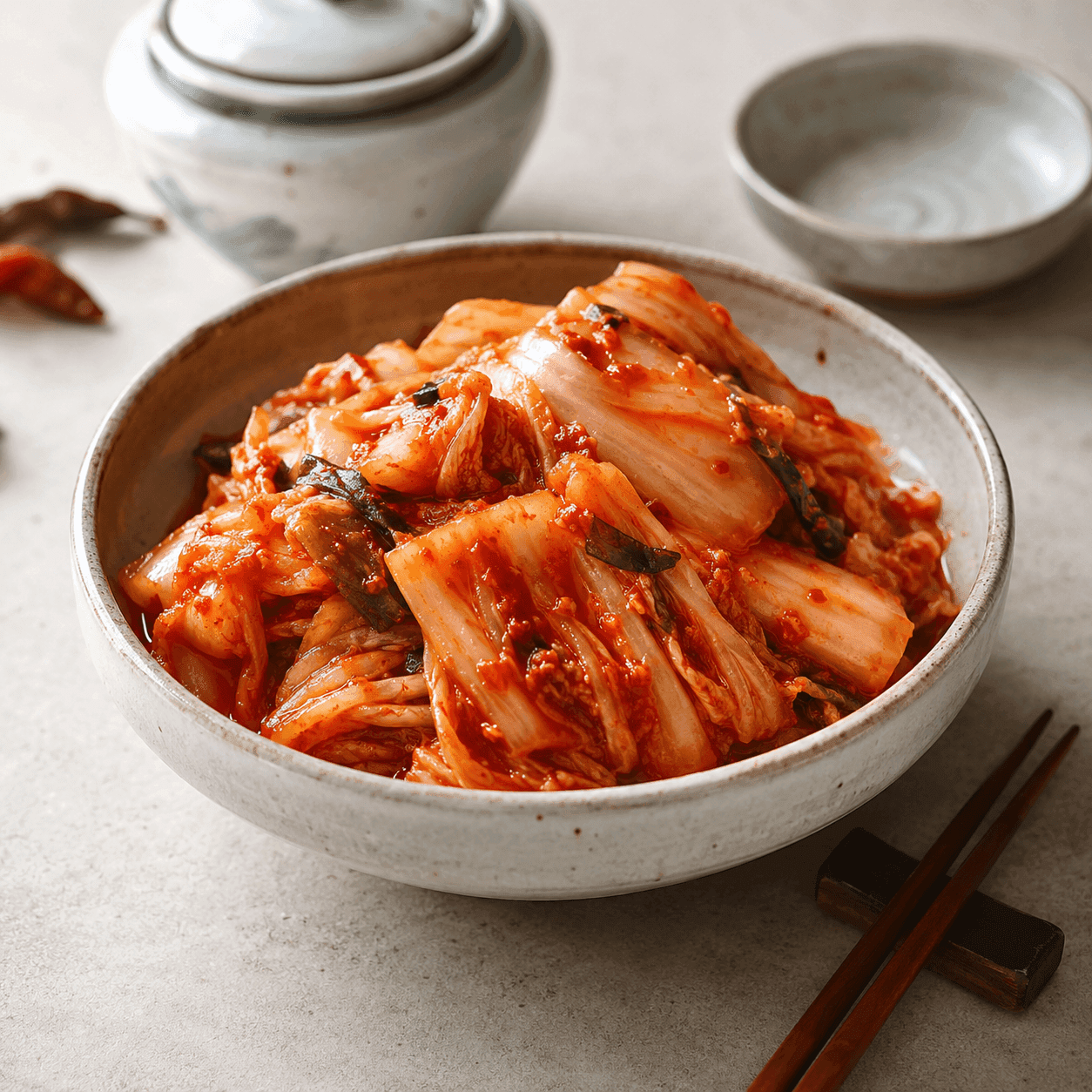
Kimchi & fermented foods.
Long before refrigeration, people kept their vegetables alive through the winter by letting the right bacteria have them. It turns out the living, sour, fizzing result is one of the best things you can put in a human gut — and a forkful a day is most of the program.
By George Hinestrosa · Personal experience & independent research
Fermentation is one of the oldest food technologies there is. For thousands of years, in nearly every culture that ever stored food through a winter, people packed shredded vegetables with salt and let them sit — and what came out was tangier, more digestible, longer-lasting, and, as it happens, teeming with life. Korea made kimchi. Germany and Eastern Europe made sauerkraut. Japan made miso and natto. The details differed; the principle was identical, and it was discovered everywhere independently because it works.
We mostly forgot why. Refrigeration and canning made preservation a solved problem, and the live, sour foods slid to the edge of the plate as condiments. But the thing that made fermentation a preservation method — a takeover by beneficial bacteria — is exactly the thing that makes it a gut food. The preservation was the side effect. The probiotics were the prize, and we threw them out.
What fermentation actually is
The kind that matters here is lacto-fermentation, and the name is a little misleading — it has nothing to do with dairy. Pack vegetables under salt water and seal out the air, and the beneficial bacteria already living on the plants — chiefly Lactobacillus species — go to work. They eat the natural sugars in the vegetables and produce lactic acid. That acid drops the pH, which does two things at once: it pickles the food (making it too sour for the bacteria that cause rot and spoilage), and it leaves behind a jar full of live, friendly cultures.
This is the distinction that trips most people up, so it’s worth being clear: lacto-fermented is not the same as pickled in vinegar. A supermarket pickle sitting in vinegar brine was never alive — the vinegar is the preservative, and there are no cultures in the jar. A true lacto-fermented food made its own acid, the living way, and the organisms are still in there. One is a flavor; the other is a food with a pulse. When you’re shopping, that difference is everything.
Fermentation also does free work on the nutrition. The bacteria pre-digest the vegetables — breaking down fibers and compounds that would otherwise be hard on the gut — and along the way they produce enzymes, synthesize B vitamins, and make the minerals already in the food more available. You are, in effect, letting a colony of microbes do the first stage of digestion for you, outside your body, and handing you the upgraded result.
The gut is the whole point
Everything good about fermented food runs through the gut. The human digestive tract is home to trillions of bacteria — the microbiome — and the health of that inner ecosystem turns out to touch nearly everything: digestion and bowel function, the immune system (the majority of which lives in the gut wall), inflammation, mood and the gut-brain axis, even how well you handle blood sugar. A diverse, well-fed microbiome is one of the quiet foundations of being well. A depleted one — the modern default, after decades of processed food, sugar, chlorinated water, and antibiotics — sits underneath a long list of complaints.
Fermented foods feed that ecosystem in two ways at once. They deliver live probiotic organisms directly, and they bring the fiber those organisms feed on. And the effect is not just theory. In 2021 a team at Stanford (Wastyk, Gardner, Sonnenburg, and colleagues) put healthy adults on either a high-fiber diet or a fermented-foods diet for ten weeks. The fermented-foods group saw their microbiome diversity climb — a marker of gut health that is notoriously hard to move — and, strikingly, their levels of inflammatory markers fell across the board. Fiber alone, in that study, didn’t do it. The live foods did. It was one of the cleaner demonstrations that what traditional cultures did by instinct, the body genuinely wants.
What kimchi brings to the table
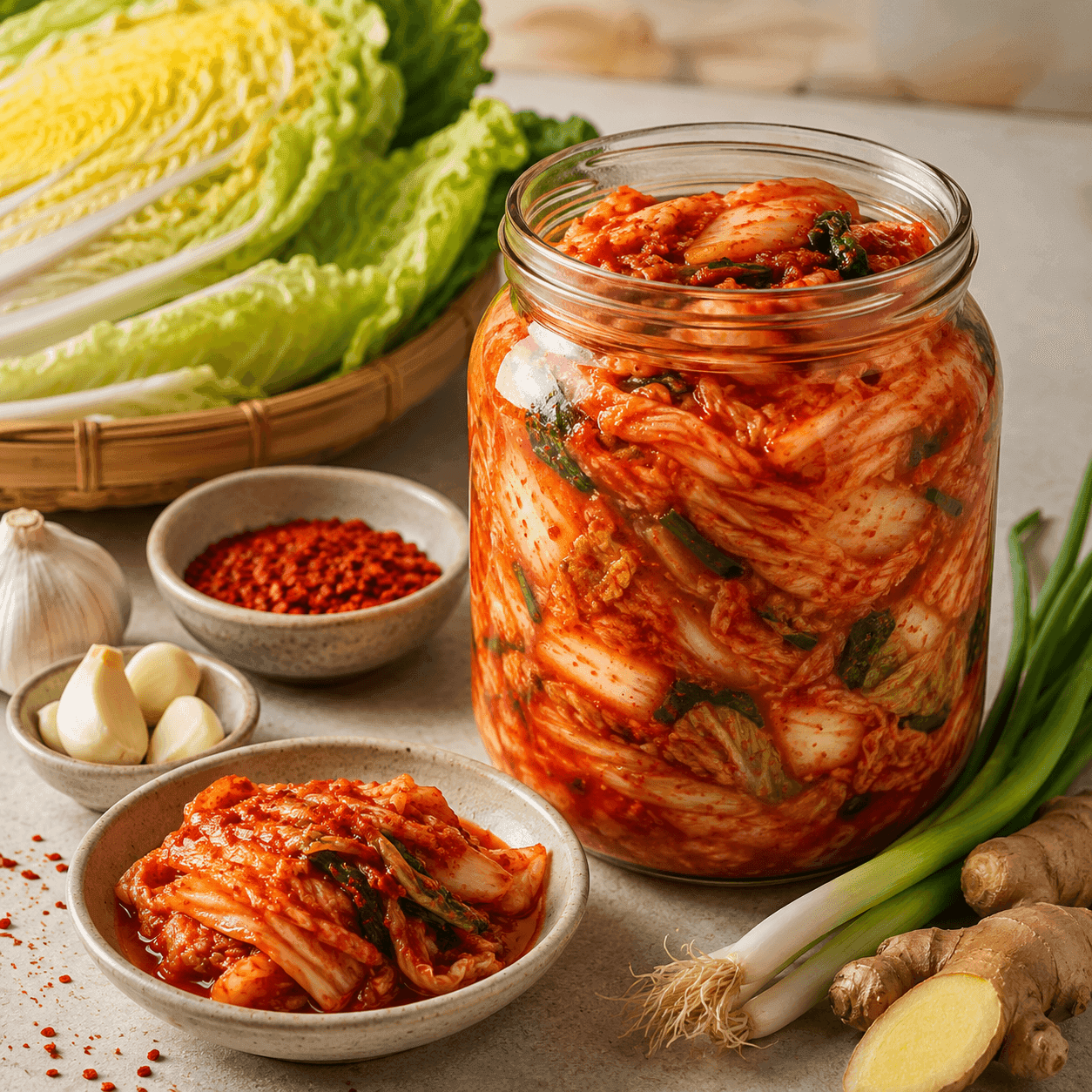
Kimchi is the flagship of the whole category, and deservedly so, because it starts from an unusually good base. Strip it down and it’s napa cabbage and radish, fermented with garlic, ginger, scallion, and red chili — which means before a single microbe gets involved you already have a small pharmacy of compounds: the sulfur compounds of garlic, the warming circulation of ginger, and the capsaicin of chili. Then fermentation layers the live cultures on top.
What you end up with, in a few tangy forkfuls, is genuinely dense:
- Live probiotic bacteria — a spread of Lactobacillus strains (including ones first identified in kimchi itself, like L. kimchii), feeding the microbiome directly.
- Vitamins and minerals — vitamins A, C, K, and a range of B vitamins (some of them produced by the fermentation), plus the minerals of the vegetables made more available.
- Fiber and antioxidants — the prebiotic fiber that feeds your existing gut flora, and the antioxidant compounds of the chili, garlic, and ginger.
- Very few calories — it is, nutritionally, one of the highest-value-per-calorie things you can eat.
The downstream benefits are what you’d expect from a food that feeds the gut and lowers inflammation: better digestion and regularity, immune support, an anti-inflammatory pull, and signals (still being studied) toward better blood-sugar handling and cardiovascular and metabolic health. It is worth noticing that kimchi is eaten at nearly every meal in a country that consistently posts some of the longest lifespans on earth. That’s not proof of anything by itself — but it’s the kind of traditional pattern that tends to be pointing at something real.
The wider family
Kimchi is the headline, but the principle is the family. The goal isn’t one magic jar; it’s a regular, varied stream of living foods, because different ferments carry different organisms. Worth rotating through:
- Sauerkraut — fermented cabbage, the European cousin of kimchi (and the subject of the bonus below).
- Real lacto-fermented pickles — cucumbers fermented in salt brine, not vinegar. Look for them in the refrigerated section, never the shelf.
- Kefir and live yogurt — fermented dairy, if you tolerate it; kefir carries a far broader range of organisms than yogurt.
- Miso, natto, and tempeh — fermented soy, traditional staples (miso unheated, to keep the cultures).
- Kombucha — fermented tea; useful, though watch the sugar in sweetened commercial versions.
- Genuine sourdough — long-fermented bread, far gentler on digestion than fast commercial loaves (the cultures are baked off, but the pre-digestion of the grain remains).
You don’t need all of them. You need some of them, most days.
Bonus: sauerkraut and the vitamin that won wars
Sauerkraut earns its own section, because behind the humble jar of sour cabbage sits one of the great stories in nutritional history — and it’s a story about vitamin C.
Cabbage is already a respectable source of vitamin C. What fermentation adds is stability: the acidic, oxygen-poor environment of a fermenting crock protects the vitamin C from the oxidation that normally destroys it, so a well-made sauerkraut holds its vitamin C for months — right through a winter, or a long voyage, when no fresh produce existed at all. In an age before refrigeration, that made fermented cabbage something close to miraculous: a vegetable that stayed nutritionally alive when everything fresh was gone.
Which is exactly why it went to sea. Scurvy — the disease of vitamin C deficiency, with its rotting gums, reopening wounds, and collapse — killed more sailors on long voyages than storms and battle combined. The cure was anything that held its vitamin C, and sauerkraut held its better than almost anything that would survive the trip. Captain James Cook famously carried barrels of it on his voyages of exploration and lost virtually no men to scurvy across years at sea — a record so unheard-of that it helped earn him recognition from the Royal Society. The crews of Northern Europe ran on it. A barrel of fermented cabbage quietly did what no medicine of the age could.
There’s a practical lesson folded into that history: heat destroys vitamin C, and heat kills the probiotics. Sauerkraut and kimchi cooked into a hot dish — simmered in a stew, baked on a sausage — still taste good, but you’ve killed the living cultures and driven off much of the vitamin C. To get what the sailors got, and what your gut wants, eat it cold and raw, straight from the jar, as a side or a topping. The forkful you don’t cook is the one that does the work.
Buying it without wasting your money
This is where most people accidentally buy a dead product. The single rule that sorts the living from the worthless:
- Buy it refrigerated, not off the shelf. Shelf-stable canned or jarred kraut and kimchi have almost always been pasteurized — heated to make them stable at room temperature, which kills every culture inside. The probiotics are the whole point, and pasteurization removes them. Real, live ferments live in the cold case.
- Look for “raw,” “unpasteurized,” or “live cultures” on the label, and a short, real ingredient list — vegetables, salt, spices. That’s it.
- Skip the added junk. A lot of commercial kimchi hides added sugar, MSG, or preservatives. Read the label; you want fermentation, not seasoning dressed up as fermentation.
One note for readers who keep a clean-food table: traditional kimchi is often made with salted shrimp or shrimp paste for depth of flavor. If shellfish isn’t something you eat, it’s an easy thing to avoid — plenty of kimchi is made with fish sauce (anchovy) instead, and fully vegetable-only versions are common and just as alive. The fermentation is the part that matters; the shrimp is optional.
Or just make it yourself
Fermenting vegetables at home is genuinely one of the easiest things in the kitchen, because the process protects itself — the same acid that preserves the food keeps the bad organisms out. The simplest possible version, sauerkraut, is two ingredients:
- Shred a cabbage, weigh it, and add roughly 2% of its weight in real salt (about a tablespoon per medium cabbage).
- Massage and squeeze it for a few minutes until it releases its own liquid, then pack it tightly into a clean jar so the cabbage sits under its own brine, with no cabbage poking up into the air.
- Cover loosely (gases need to escape) and leave it on the counter, out of direct sun, for one to four weeks. Taste it as it goes; when it’s as sour as you like, move it to the fridge.
Kimchi is the same idea with more flavor: add radish, scallion, garlic, ginger, and Korean chili to the salted cabbage before it ferments. Homemade is cheaper, fresher, and fully alive — and once you’ve done it once you’ll never quite trust the pasteurized jar again.
Where to start
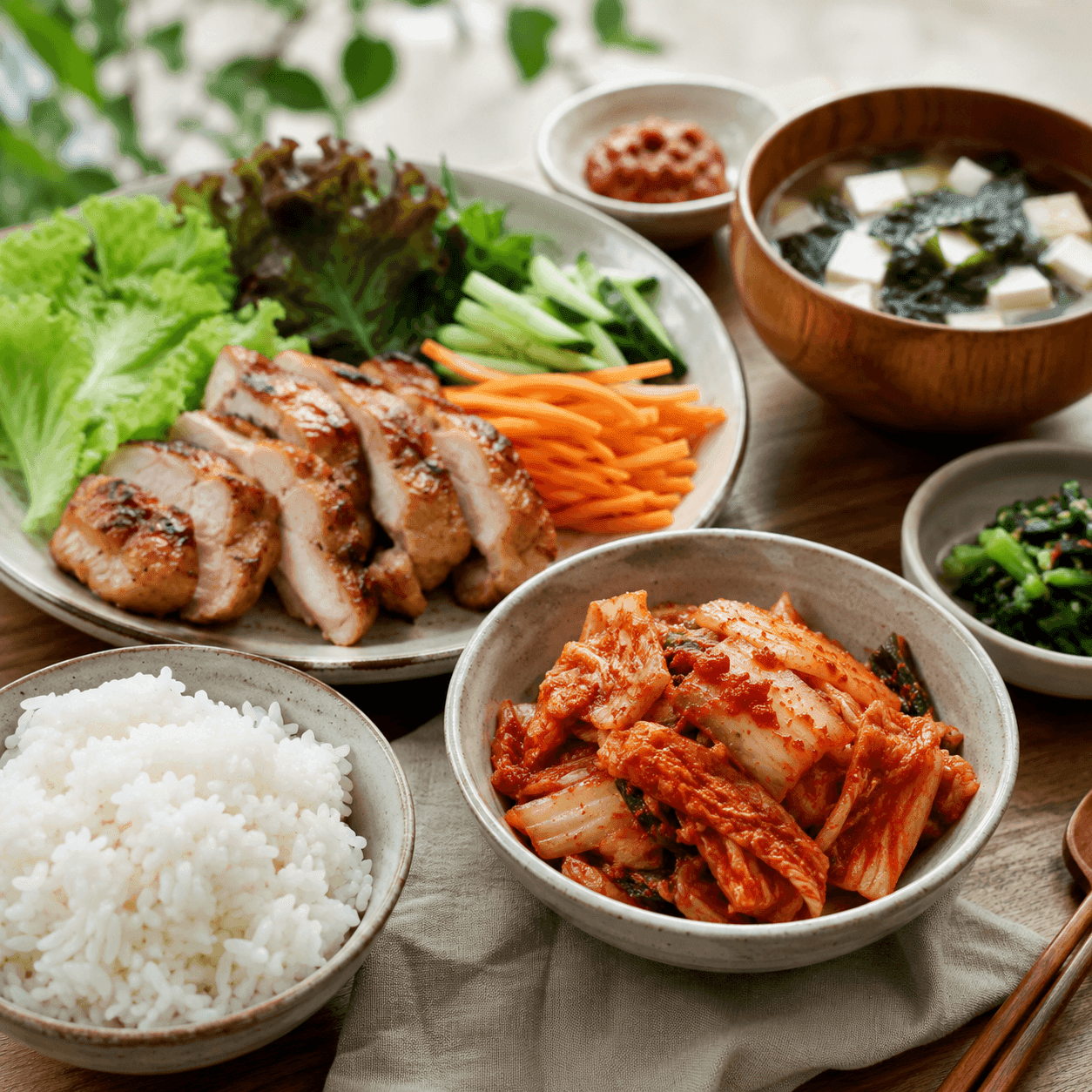
A sensible approach is small and daily. Add a forkful of a live ferment to one meal a day — kimchi alongside eggs or rice, sauerkraut on top of a bowl or beside the meat. Begin with a tablespoon, not a heap, so the gut has a week or two to adjust without the gas and bloating that a sudden flood of new organisms can cause. Keep it cold and uncooked. Rotate a couple of different ferments through the week so you’re feeding a range of organisms, not just one. That’s the whole habit, and it’s close to free.
Closing
There is a pattern worth noticing across this whole section: the foods that turn out to matter most are rarely new, and almost never patented. Fermentation is ancient, ordinary, peasant food — cabbage and salt and time — and it quietly does what an aisle of probiotic capsules is trying to imitate. The cultures that ran on it weren’t following a study. They were doing the obvious thing with the food they had, and the obvious thing was right.
Eat something alive every day. The gut has always known what to do with it.
Sources & further reading
Authorities & research
- Wastyk, Gardner, Sonnenburg, et al. (Stanford), Cell, 2021 — 'Gut-microbiota-targeted diets modulate human immune status' — the fermented-foods diet raised microbiome diversity and lowered inflammatory markers where a high-fiber diet alone did not.
- Sandor Katz — The modern authority on fermentation; author of The Art of Fermentation and Wild Fermentation.
- Dr. Eric Berg — On gut health, probiotics, and fermented vegetables on a whole-food frame.
- Weston A. Price Foundation — On traditional lacto-fermented foods and their place in ancestral diets.
Books & reading
- The Art of Fermentation — Sandor Katz — The comprehensive reference on how and why fermentation works. Start here if you want to make your own.
Related on this site
- Garlic — One of kimchi's active ingredients, in its own right.
- Ginger — The warming root that goes into the paste.
- Salt — Use real unrefined salt for fermenting — and everything else.
- Clean & Unclean Foods — On the shellfish sometimes used in traditional kimchi.